Charles Edward Stuart (1810-1887)
Kalamazoo Attorney, Michigan Senator, and Land Developer
“The strong, true men of a people are its most priceless possession, in their active usefulness while living, and in the inspiration and influence of their memory when they are gone”
—David Fisher & Frank Little, 1906
 Chas. E. Stuart, c.1859. Library of Congress
Hon. Charles E. Stuart was among the first, and some would say best, legal professionals to settle in the village of Kalamazoo. His colleagues described him as “the best jury lawyer we have ever had in Michigan. He was in the full and true sense of the term, a natural orator, gifted with a rich and sonorous voice, a graceful delivery and a most convincing and persuasive eloquence” (Kalamazoo Daily Telegraph). The street and surrounding neighborhood that bear his name are a testament to his lasting impact on the Kalamazoo community.
Charles Edward Stuart was born on 25 November 1810 at Canaan Corners in Columbia County, New York. He was the son of farmer and practicing physician Dr. Charles Stuart and his wife Catherine. After the close of the war of 1812, while Charles was an infant, his parents moved to Waterloo, New York. Charles spent his childhood years on the family farm there and attended rural school during the wintertime. At the age of 19, he began to study law in Waterloo at the office of Birdsall & Clark and was soon admitted to the bar in Seneca County, New York, where he remained until the age of 25.
In the early months of 1835, Stuart moved to Michigan, settling first in Detroit and then venturing westward to Kalamazoo, “when there were not more than fifty houses in the place” (Kalamazoo Daily Telegraph). He began practicing law and formed a partnership with Epaphroditus Ransom, who would later become the seventh governor of Michigan and serve as a justice of the Michigan Supreme Court.
After establishing his practice in Kalamazoo, Stuart returned to Waterloo, where he married Sophia Streeter Parsons (1812-1894). After their November wedding, the couple made their home in Kalamazoo, where Stuart resumed his law practice. The Stuarts had at least six children: Marissa Jannis Stuart Ferguson Hibbart (1837-1917), George Augustus Stuart (1839-1849), Martha Mayhew Stuart (1841-1849), Mary Jane Stuart (1843-1846), Charles Lee Stuart (1846-1938), and Katherine Emma Stuart Austin (1850-1928). Three of the children survived to adulthood, while three others died young.
In addition to his law practice, Stuart served as commissioner for the ill-fated Kalamazoo and Lake Michigan Railroad Company. In 1837, he was appointed by the governor as master in Chancery for Kalamazoo County and was elected as a county delegate to the Senate District Convention. In March 1838, Stuart was assigned as a colonel with the 29th regiment of the Michigan Militia during the Canadian rebellion that year.
Political Career
Stuart’s political career gained significant momentum when he was elected to the Michigan House of Representatives in the fall of 1841 and to the U.S. House of Representatives in 1847. In 1852, during his last term of service, Stuart’s support of a bill before congress helped secure the appropriation of land for the Sault Ste. Marie Canal.
Aside from his legal and political aspirations, Stuart was a rather noteworthy farmer. His livestock won numerous premiums at the annual Kalamazoo County Agricultural Society Fair during the 1840s and 1850s. Stuart also served on several committees that oversaw the various exhibitor categories.
During his first decade as a Kalamazooan, Stuart bought and sold bits and pieces of property countywide. His earliest land holdings in Kalamazoo were in sections 27 and 28 directly south of the village, which he purchased in 1836. He also secured property in the village proper, including lots at the “lower end” of Portage Street near the Lovell Street intersection.
 Stuart property in Portage Township (Section 4) c.1860. Geil & Harley (1861). Library of Congress
Stuart Manor
In March 1851, Stuart purchased a block of land on the north side of West Milham Road in Portage Township. Four years later he purchased additional blocks of the adjoining property. Combined, the parcel encompassed most of section 4 south of West Fork Portage Creek between the Genesee Prairie Road (Oakland Drive) and the Schoolcraft Road (Westnedge Avenue). Included with the property was a Greek Revival home that was built in 1846 by a previous property owner, William H. Welch. The home, rumored to have been a stop on the Underground Railroad, was used by the Stuarts as their summer home for several years. In 1994, the home, now the oldest surviving structure in Portage Township, was moved to the Celery Flats Historical Area and restored as Stuart Manor.
 Chas. E. Stuart, c.1880. Library of Congress
In 1853, the Michigan Legislature elected him to the U.S. Senate, where he served a term of six years before resuming his law practice in Kalamazoo. Senator Stuart was the Democratic nominee in the 1858 Michigan gubernatorial election but was defeated by Republican nominee Moses Wisner.
Stuart Neighborhood
By 1856, Stuart had acquired a tract of land along the north side of the Grand Prairie Road (West Main Street) west of the village, where he laid out Stuart Avenue and erected a stately home for his family. Stuart would later open Douglas Avenue (named for his friend, Illinois senator Stephen A. Douglas) and subdivide portions of the property as a residential area known as Stuart’s Addition, which would form the core of today’s Stuart neighborhood.
When the Civil War broke out, Stuart was charged with organizing the 13th Michigan Volunteer Infantry Regiment and was again commissioned as colonel. Ill health, which would plague Stuart for the rest of his life, forced him to resign from the military after a few brief months of service.
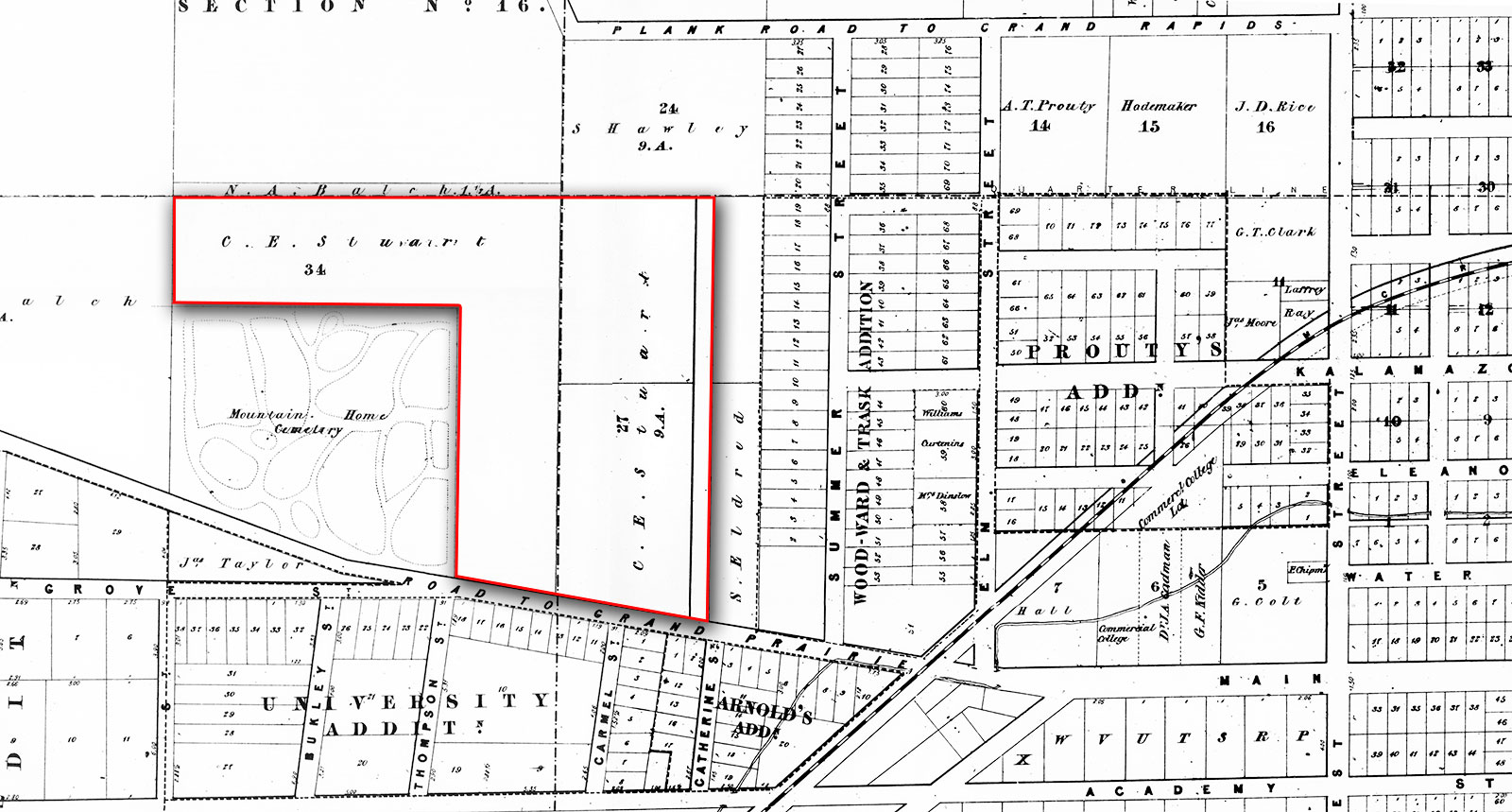 Stuart property (9 acres) west of the village c.1856. Map of Kalamazoo, C.F. Miller, 1859. Kalamazoo Public Library
Kalamazoo School Case
Although his philanthropic efforts were many, Stuart was among those who initiated a lawsuit against the Kalamazoo school board, which became known as the Kalamazoo School Case. Like many others at the time, Stuart believed that education beyond eighth grade should be paid for privately and not by public taxation. He brought suit against the school board but, to Stuart’s dismay, the suit failed. The court’s decision, however, cleared the way for ongoing public financial support of Michigan’s high schools.
Later Years
In 1883, the Stuarts sold their home and remaining portion of the estate to Samuel A. Browne, a horse breeder and lumberman from Pentwater, and moved to West Cedar Street. In 1972, their elegant 1858 Italian Villa, which still stands along the west side of Stuart Avenue, was listed on the National Register of Historic Places.
Charles Stuart passed away on 19 May 1887 at the age of 77. Following his death, the flag over the capitol building in Lansing was flown at half-staff in his honor. Sophia Stuart remained in Kalamazoo at her daughter’s home on Cedar Street until her death on 14 November 1894. Both were laid to rest in Kalamazoo’s Mountain Home Cemetery.
Written by Keith Howard, Kalamazoo Public Library staff, May 2025
Special thanks to Ryan Gage for additional insight.
Sources
Books
History of Kalamazoo County, Michigan: with illustrations and biographical sketches of its prominent men and pioneers
Samuel W. Durant
Originally published in 1880 by Everts & Abbott, Philadelphia.
Evansville, Indiana: Unigraphic, 1976, page 120
H 977.417 H67U (CEN)
Portrait and biographical record of Kalamazoo, Allegan and Van Buren counties, Michigan, 1892
Originally published in 1892 by Chapman Bros., Chicago.
H 977.41 P85, pages 204-05 (CEN)
Compendium of history and biography of Kalamazoo County, Mich., 1906
David Fisher and Frank Little
Originally published in 1906 by A.W. Bowen & Co., Chicago.
H 977.417 F53, page 208 (CEN)
Michigan Pioneer Collections, Vol. 3: Memorial biographical sketch
1880
H 977.4 M62, volume 3, pages 138-139 428
Michigan Pioneer Collections, Vol. 11: Memorial biographical sketch
1887
H 977.4 M62, volume 11, pages 292-297
Michigan Pioneer Collections, Vol. 26: Memorial biographical sketch
1896
H 977.4 M62, volume 26, page 428
Michigan biographies, Volume 2
1924
H 920 M62, volume 2, page 338
Articles
“Kalamazoo and Lake Michigan rail road”
Kalamazoo Gazette, 11 February 1837, page 3, column 3
“Sheep in Kalamazoo County”
Kalamazoo Gazette, 27 August 1847, page 3, column 1
“See how ‘Charley Stuart’ is spoken of… ”
Waterloo Observer via Kalamazoo Gazette, 22 October 1847, page 2, column 4
“Agricultural society ”
Kalamazoo Gazette, 22 October 1847, page 3, column 1
“Fourth annual fair”
Kalamazoo Gazette, 15 June 1849, page 2, column 5
“Fourth annual fair”
Kalamazoo Gazette, 5 October 1849, page 2, column 6
“List of premiums”
Kalamazoo Gazette, 26 October 1849, page 3, column 2
“County agricultural fair!”
Kalamazoo Gazette, 20 September 1850, page 3, column 5
“List of premiums”
Kalamazoo Gazette, 25 October 1850, page 2, column 6
“Office of the Kalamazoo County Agricultural Society”
Kalamazoo Gazette, 5 September 1851, page 1, column 5
“Chas. E. Stuart dead”
Kalamazoo Gazette, 20 May 1887, page 4, column 2
“In memory of Col. Stuart”
Kalamazoo Daily Telegraph, 20 May 1887, page 2, column 4
“Ex-senator Stuart dead”
Kalamazoo Daily Telegraph, 20 May 1887, page 7, column 3
“Death comes”
Kalamazoo Daily Telegraph, 15 November 1894, page 1, column 6
Local History Room Files
History Room Orange Dot File: Stuart, Charles E.
History Room Name File: Stuart, Charles E.
History Room Subject File: Houses – Kalamazoo – Stuart, 427
Websites
In Memoriam Charles Edward Stuart: June 21, 1887 (Michigan Supreme Court Historical Society)