Samuel Alexander Browne (1833-1895)
Nationally Recognized Horse Breeder
Breeding horses was a lifelong passion for Samuel Browne; it seems it was in his blood. His father was a breeder of fine horses in their native Ireland, and even in his youth, Samuel grew to love fast horses and wanted to someday have one of his own. After moving to the U.S. and spending more than two decades in the booming lumber trade, Browne found his way to Kalamazoo, where he soon became one of the nation’s leading horse breeders of his time, particularly for harness racers.
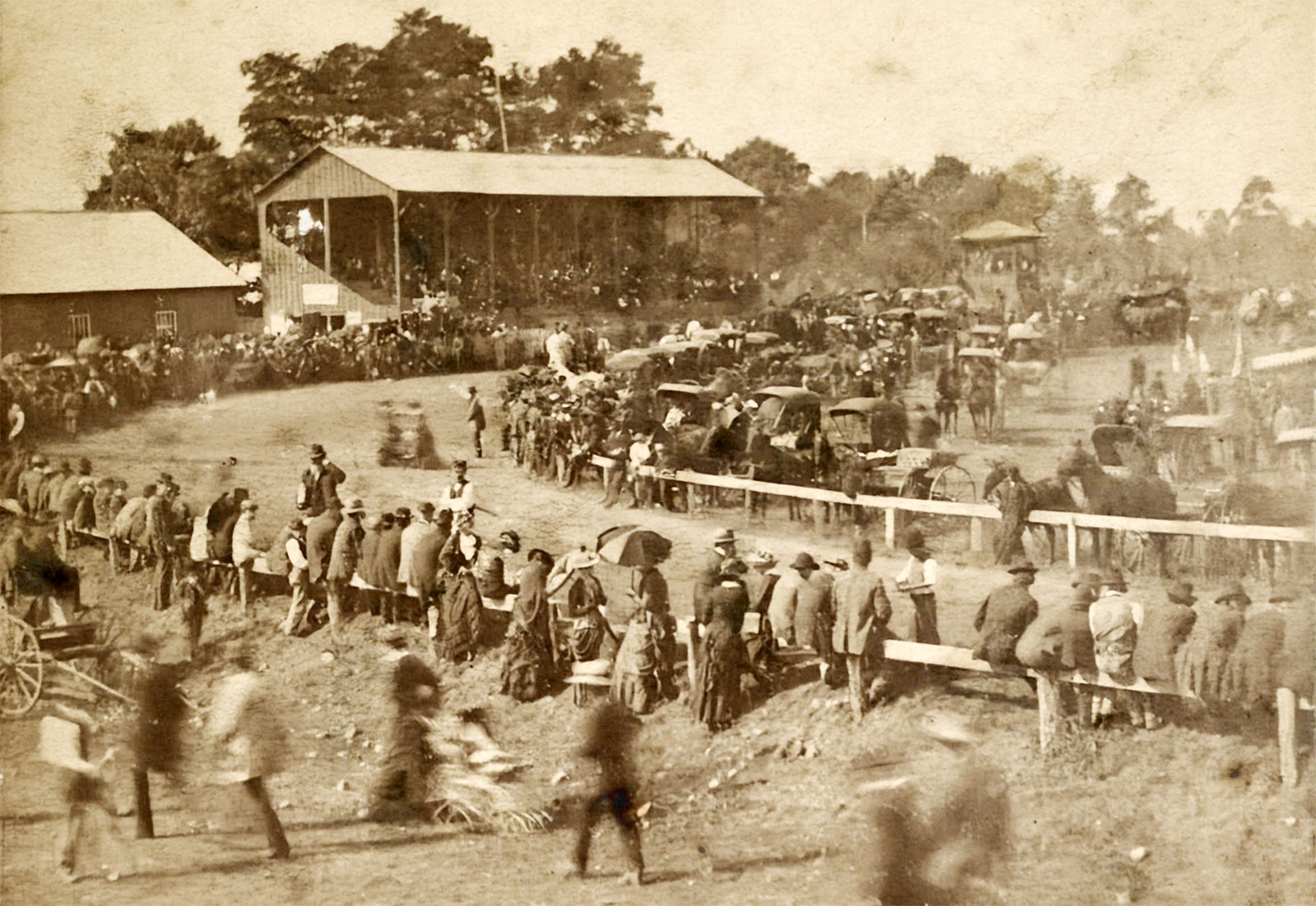 Horse races at Recreation Park in Kalamazoo, c.1875. Courtesy, Western Michigan University Archives and Regional History Collections
Harness racing was an extremely popular sport in North America during the 19th century. In 1837, soon after the village was founded, Kalamazooans developed the Burr Oak Track in what’s now the Vine neighborhood. That lasted until 1858 when Charles Stuart and his associates built a new horse track called the National Driving Park in today’s Edison neighborhood, which boasted the “best grounds and accommodations in the Northwest” (Gazette). Thousands of spectators would gather during the warm weather months to watch the nation’s leading trotters compete for generous cash prizes.
Samuel Alexander Browne
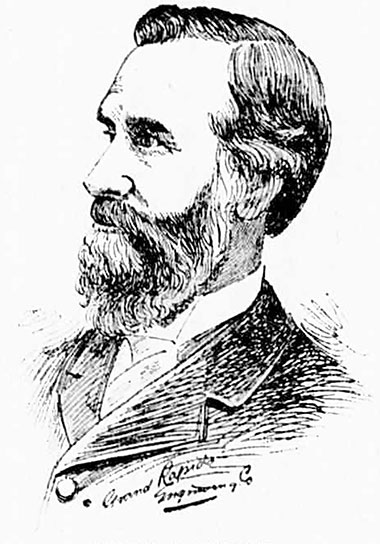 S.A. Browne, Kalamazoo Telegraph, 4 March 1895
Samuel Alexander Browne, the son of William and Anna Browne, was born in September 1833 in Dublin, Ireland. In March 1856, Samuel married Jane Hanna in Dublin and moved to the United States, settling at first in New York and later Chicago, where they raised their five children: William H. Browne (1857–deceased), James Browne (1859–1870), Margaret Jane Browne (1862–1901), Samuel Alexander Browne (1863–1905), and Charles Frederick Browne (1874–1945).
By the 1860s, Chicago was at the center of the lucrative lumber trade, a key distribution hub on the Great Lakes for lumber from the north woods. Browne worked for a lumber manufacturer in Chicago for two years, then joined a lumber company in Macomb, Illinois, following the opening of the Illinois & Michigan Canal. Two years later, Browne moved on to St. Louis where he engaged in the produce business for a time.
Following the Great Chicago Fire in 1871, Browne returned to the lumber trade in Michigan, where he formed Hart, Maxwell & Company with partners John C. Maxwell of Pentwater and J. Potter Hart, a Muskegon-area sawmill operator who was “turning out an immense quantity of lumber and employing from forty to sixty men” (Dasef). Browne also formed a partnership with William B. Phillips, a Chicago-based lumber dealer, which gave Phillips & Browne end-to-end delivery of lumber between Michigan and the expanding markets across the Midwest.
By the mid-1870s, Browne was in Grand Rapids pursuing his childhood dream as a horse breeder while serving as president of the Michigan Breeders and Trotters Association. He later served as director of the National Breeders Association and the Trotting Registers Association, and was vice president of the Northwestern Breeders and Trotting Association, all of which were early precursors to the National Association of Trotting Horse Breeders (now the United States Trotting Association).
“S.A. Browne, Esq., of Pentwater, an extensive lumberman, was in town yesterday. Mr. Browne will sometime during this season move his stable of thirty trotting horses to Kalamazoo, and thereafter make this his headquarters.”
—Kalamazoo Gazette, 10 April 1883
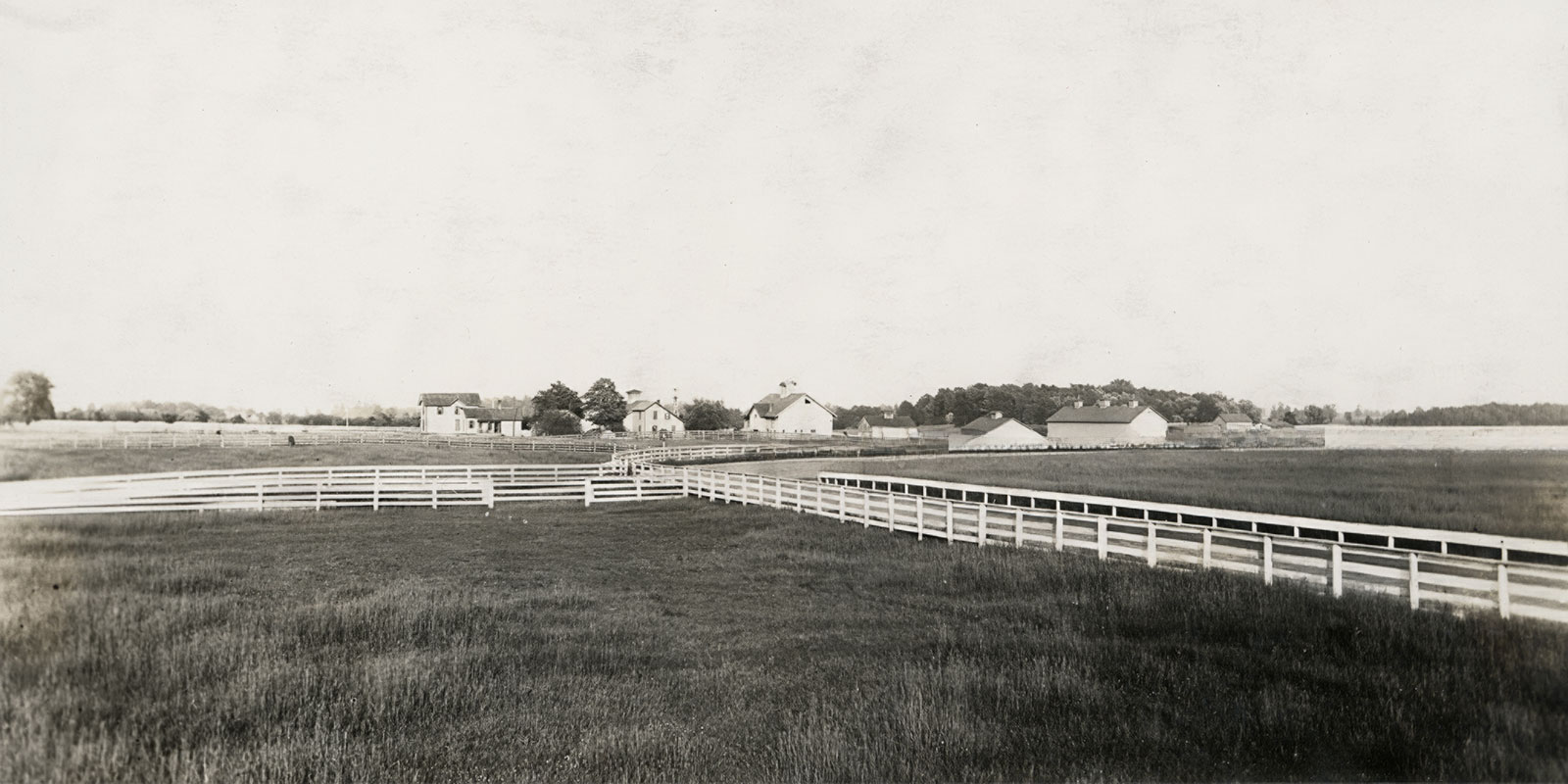 S.A. Browne & Company, c.1900. Kalamazoo Public Library photo file P-435
Kalamazoo Stock Farms
As Michigan’s lumber supply began to dwindle, Browne sold his lumbering businesses in 1883 and moved to Kalamazoo, where he purchased the Charles E. Stuart home and the 5½-acre surrounding property between Stuart and Douglas avenues. He then formed S.A. Browne & Company with fellow lumberman and horse breeder Frances B. Stockbridge. With $70,000 of combined stock, they purchased 316 acres along the south side of West Main Road in Kalamazoo Township west of the city limits and established a celebrated horse breeding business known as the Kalamazoo Stock Farms.
 “Kalamazoo Stock Farm. S.A. Browne & Co., Proprietors” from Kalamazoo Illustrated, 1892. Kalamazoo Public Library
Success came swiftly for the two veteran horsemen. At the 1883 Michigan State Fair in September, Browne & Company entered 27 horses, for which they received 21 premium awards. They exhibited 20 of their finest trotting horses at the 1884-1885 World’s Industrial and Cotton Centennial Exposition (World’s Fair) in New Orleans and brought home 27 premium awards, including a $500 prize for “the best stable of trotting bred roadsters” (Gazette).
 S.A. Browne & Company, c.1890. Kalamazoo Township map, Wm. C. Sauer, C.E., 1890. Kalamazoo Public Library
“It was the universal verdict that this firm had more promising young horses than any other breeding farm in the west. The crosses are made with the very best thoroughbred trotting stock in the land, and the establishment is not only backed with money, but with brains.”
—Kalamazoo Gazette, 4 October 1884
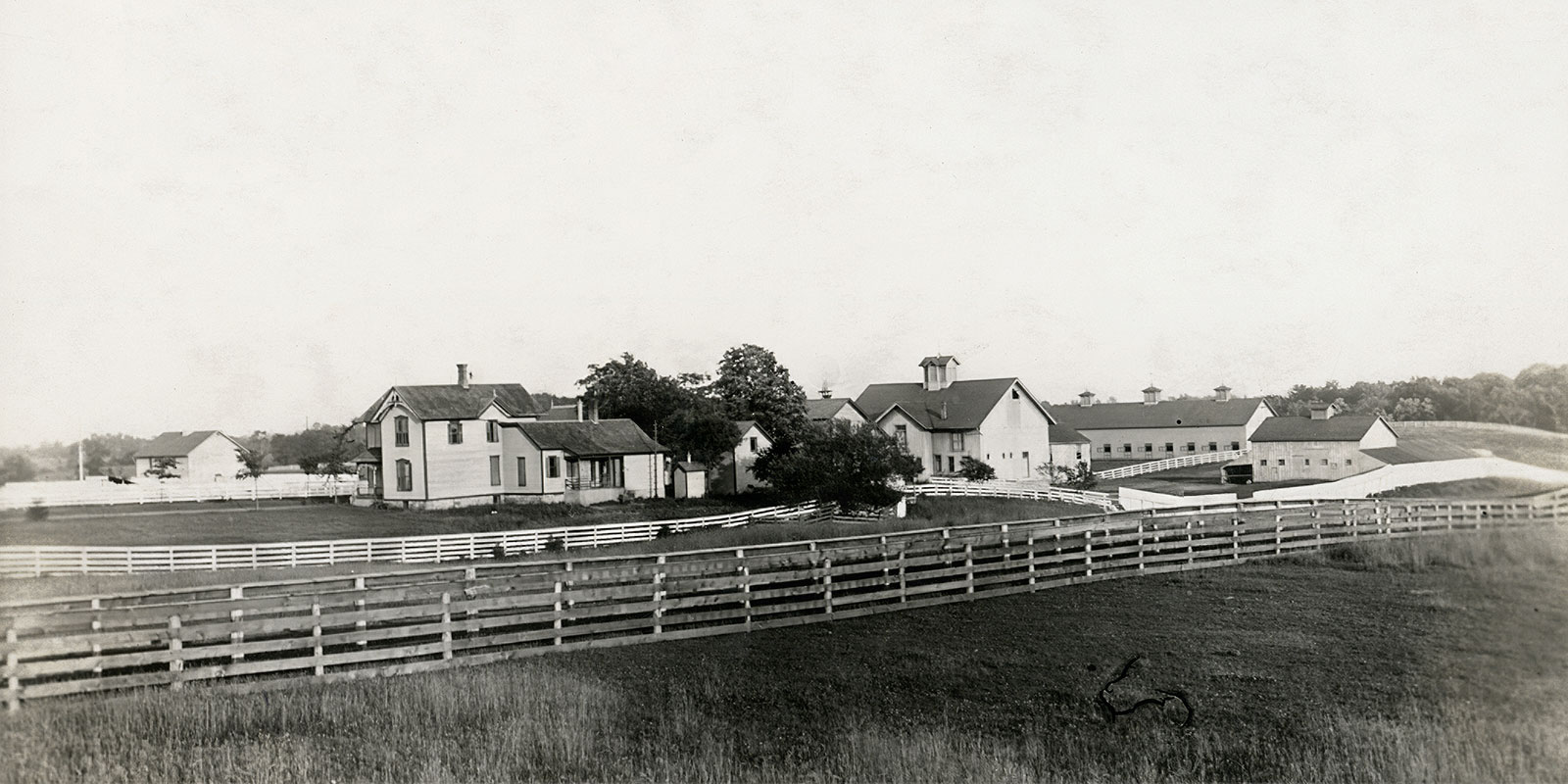 S.A. Browne & Company, c.1900. Kalamazoo Public Library photo file P-1020
Standardbred Horses
The Standardbred breed was developed in North America during the mid-19th century and played an important role in the success of harness racing in the United States. Standardbred horses were bred specifically for harness racing and became widely recognized as the fastest trotting horses in the world.
“The Michigan Trotting Horse Breeders’ association held their annual meeting here yesterday. The members were unanimous in the opinion that Michigan is a better state in which to raise trotters than Kentucky, despite its famous blue grass.”
—Kalamazoo Gazette, 15 November 1889
For a dozen years, Browne & Company bred some of the fastest and most expensive horses in the nation. Their stables housed nearly 200 prize-winning horses, and the farm was “universally recognized by horsemen as headquarters of trotting bred stock for the northwest” (Gazette). In 1888, one of their stallions, Bell Boy, was sold to a Kentucky horseman for a record $30,000 ($1 million today), at that time the highest price ever paid for a stallion. Another, Anteo, later sold for $60,000. The Browne & Company stallion, Ambassador, was awarded first prize at the 1893 Chicago World’s Fair. After mating Ambassador with his mare, Santos, Browne sold Santos to wealthy Kalamazoo horseman Daniel D. Streeter for $1,000. Santos later produced a colt named Peter the Great, Kalamazoo’s legendary trotter and considered one of the most important sires in Standardbred breeding.
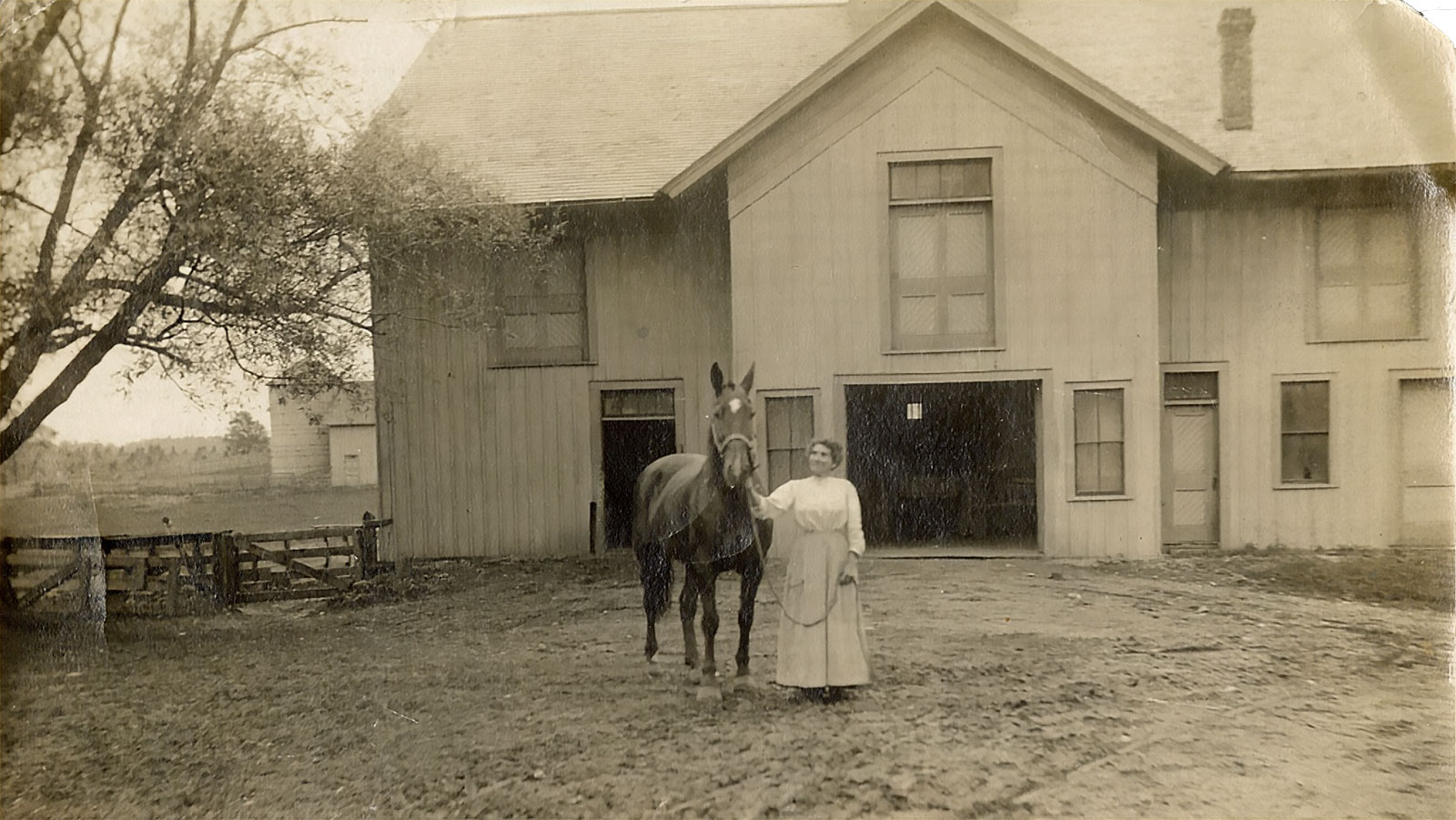 “Grandma Fyler at old stock farm” (S.A. Brown & Company) c.1900. Kalamazoo Valley Museum photo ID: 2011.33.3
After Samuel Browne’s death in 1895, his son William managed the farm until 1911, when it was sold to attorney Samuel H. Van Horn and farmer Ralph E. Waldo. Portions of the property were later sold and subdivided for residential and commercial use. After Waldo’s death in 1923, Paul H. Todd purchased the remaining 154 acres, which today forms the headquarters of Kalsec.
Written by Keith Howard, Kalamazoo Public Library staff, May 2025. Last updated 26 May 2026.
Sources
Books
Kalamazoo illustrated
Frank C. Dayton
Kalamazoo, Michigan: Ihling Bros. & Everard,1892
H 977.418 D276 (CEN), page 57
The trotting and the pacing horse in America
Hamilton Busbey
London: The Macmillan Company, 1904
Library of Congress call number: SF339.B97
Compendium of history and biography of Kalamazoo County, Mich.
David Fisher and Frank Little
Chicago, Illinois: A.W. Bowen & Co, 1906
H 977.417 F53 (CEN), pages 177-78
History of Montcalm County, Michigan its people, industries and institutions…
John W. Dasef
Indianapolis, Indiana: B.F. Bowen, 1916
University of Michigan Library Digital Collections, page 180
Articles
“Grand Rapids races”
Kalamazoo Daily Telegraph, 15 June 1874, page 4, column 2
“The state fair”
Kalamazoo Daily Telegraph, 9 September 1874, page 1, column 2
“Michigan horse breeders’ association”
Kalamazoo Gazette, 22 August 1876, page 1, column 7
“The state trotting circuit – Kalamazoo in the circuit”
Kalamazoo Daily Telegraph, 15 February 1877, page 4, column 3
“Fine horses for Kalamazoo”
Kalamazoo Daily Telegraph, 22 September 1882, page 2, column 4
“The Stockbridge horses”
Kalamazoo Daily Telegraph, 23 September 1882, page 3, column 3
“Personal”
Kalamazoo Gazette, 10 April 1883, page 3, column 2
“Extensive purchase – another valuable accession to our village”
Kalamazoo Daily Telegraph, 30 April 1883, page 3, column 4
“Real estate transfers”
Kalamazoo Gazette, 25 May 1883, page 8, column 2
“Mr. S.A. Browne of Pentwater…”
Kalamazoo Daily Telegraph, 28 May 1883, page 3, column 2
“A big stock farm”
Kalamazoo Gazette, 29 May 1883, page 3, column 2
“S.A. Brown & Co…”
Kalamazoo Gazette, 23 September 1883, page 3, column 2
“A company of gentlemen from Detroit and Kalamazoo…”
Kalamazoo Gazette, 4 October 1884, page 3, column 1
“Kalamazoo stock farm ahead of all competitors at the world’s fair”
Kalamazoo Gazette, 30 January 1885, page 1, column 3
“New Orleans. Department of trotting bred horses”
Kalamazoo Gazette, 6 March 1885, page 6, column 4
Display ad
Kalamazoo Gazette, 6 June 1886, page 7, column 3
“Bell Boy sold”
Kalamazoo Gazette, 2 March 1888, page 2, column 5
“Michigan horses”
Kalamazoo Gazette, 15 November 1889, page 1, column 3
“S.A. Browne a valued Kalamazoo citizen passes away”
Kalamazoo Daily Telegraph, 4 March 1895, page 1, column 3
“S.A. Browne dead”
Kalamazoo Gazette, 5 March 1895, page 4, column 2
“Burial in Chicago”
Kalamazoo Daily Telegraph, 5 March 1895, page 3, column 4
“Famous farm is sold”
Kalamazoo Gazette, 14 January 1909, page 7, column 6
“Famous Browne stock farm passes into the hands of local men”
Kalamazoo Gazette, 6 December 1910, page 3, column 2
“The Browne farm is sold”
Kalamazoo Gazette, 1 April 1911, page 10, column 4
“Death claims Ralph E. Waldo”
Kalamazoo Gazette, 8 January 1923, page 2, column 4
“Paul Todd buys S.A. Browne farm, West Main Road”
Kalamazoo Gazette, 2 February 1929, page 7, column 4