Moses Henry “M.H.” Lane (1849-1930)
Kalamazoo Industrialist and Developer
 M.H. Lane. Men of Progress, (Detroit), 1900
Moses Henry Lane (commonly known as “M.H.”) was among Kalamazoo’s foremost early manufacturers and land developers. Lane and his partners founded the Michigan Buggy Company, which became one of the nation’s largest carriage manufacturers. Lane helped develop the South Park Addition, a centerpiece of the city’s south side residential and industrial development. He built trucks and automobiles, ran railroads and a newspaper, and served on the boards of numerous companies. The Lanes were pillars of society in Victorian-era Kalamazoo.
Born 21 January 1849, M.H. Lane grew up in Genoa, Cayuga County, New York, where his father worked as a wagonmaker. With his dad’s guidance, Lane learned the wagonmaking business from the ground up—from painting and blacksmithing, to woodworking, wood selection, and purchasing. While in his early twenties, Lane left the wagonmaking business and moved to Michigan, where he worked as a farmhand for three years. He returned to New York in 1875 and took up work with a large carriage manufacturer in Trumansburg. Lane then accepted a position with the Courtland (New York) Wagon Company, and as a successful salesman and head of the purchasing department, he traveled extensively throughout the country.
While traveling as a sales manager for the Courtland Wagon Company, Lane met Ida E. Lay, daughter of George T. Lay, a prosperous Allegan County landowner, farmer, and agricultural implement dealer. They were married in 1878, and in January 1881, the couple moved to Kalamazoo, where Lane helped organize the Kalamazoo Wagon Company.
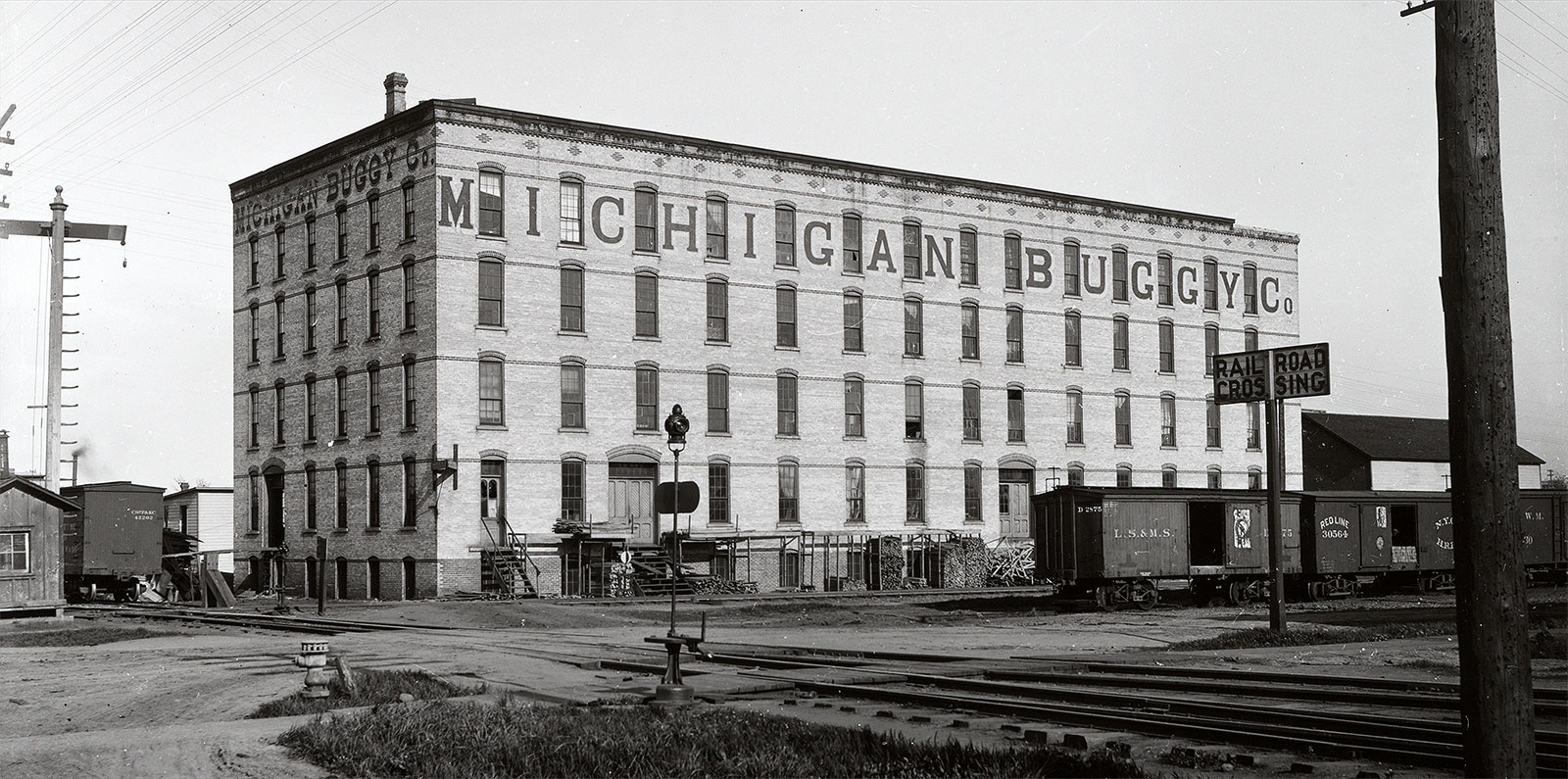 Michigan Buggy Company, c.1890. Local History Room Photograph File P-305
Michigan Buggy Company
Lane sold his interest in the Kalamazoo Wagon Company in April 1883 to Frederick Myers and formed the Michigan Buggy Company with his brother-in-law, Frank B. Lay, and his father-in-law, George Lay. Lane’s new firm began life as the Kalamazoo Buggy Company, but Myers sued and Lane was forced to change the company name to Michigan. Fortuitous, perhaps, for within a few short years, the Michigan Buggy Company became one of the largest manufacturers of its kind in the nation.
Learn more about the Michigan Buggy Company >
“Mr. M. H. Lane is president of the Michigan Buggy company and a thorough, wide awake, live man, who is at the head of one of the most successful carriage and sleigh manufacturing companies in the United States, and all built up inside of two years by his energy and business ability.”
—Kalamazoo Daily Telegraph, 30 October 1885
Lane did rather well in the buggy business. Over the years, he acquired an extensive amount of real estate in Kalamazoo. In September 1886, he purchased the lot and home on the southwest corner of Main and West streets (now Michigan and Westnedge avenues) for $12,500 (close to $450,000 in today’s dollars) from pioneer resident Charles L. Cobb.
Mansion Row
After three years in the old Cobb place, the Lanes moved to temporary quarters on nearby Academy Street while the existing house was removed and a substantial new home was erected on their property. Completed in 1893, their massive 17-room, $70,000 (roughly $2.2 million today) mansion joined the community’s showcase of fine Main Street homes known as Mansion Row.
 M.H. Lane House, c.1894. Art Work of City of Kalamazoo [1894], W. H. Parrish Publishing Co. Kalamazoo Public LibraryIn 1890, Lane was appointed by the governor as one of Michigan’s two state commissioners to help organize the World’s Columbian Exposition (the 1893 Chicago World’s Fair). While in Chicago, the National Carriage Builders’ Association put Lane in charge of arranging a massive exhibit of premium carriages at the exposition. Given his success at the Chicago World’s Fair, Lane was appointed as a Michigan vice president at the 1901 Pan-American Exposition in Buffalo, New York.
As the saying goes, Lane had a great many irons in the fire. He served as president and general manager of the Chicago & Kalamazoo (Belt Line) Railway Company (a single-track north-south freight line within the Kalamazoo city limits, later sold to Grand Trunk Western). He was president of the Kalamazoo Improvement Company, and a director in the Portland Cement Company, the Mutual Telephone Company, the American Cash Register Company, the First National Bank, and the Comstock Manufacturing Company, all based in Kalamazoo. He was a member of the National Carriage Builders’ Association and served as its vice president for two years. Lane was an early backer of Kalamazoo’s electric streetcar system, and for two years, he was part-owner of the Kalamazoo Evening Telegraph newspaper.
“Too often charity entertainments are more in the nature of a benefit to those who are in charge of them than for the object for which they are given, but a suggestion has been made by Mr. And Mrs. M. H. Lane whereby they propose to give a novel entertainment for the benefit of a band of little children who are cared for alone from charity’s offerings, those who live in the Children’s home and in accordance with the offer there cannot possibly be but one result, as substantial benefit which will be measured by the interest the people take in the project.”
—Kalamazoo Gazette, 8 December 1892
The Lanes maintained a certain philanthropic presence in the community, as well. They were avid supporters of the Kalamazoo Children’s Home and often opened their own home with its expansive third-floor ballroom for lavish charity events that raised hundreds of dollars for the less fortunate. Ida Lane served on the Children’s Home board of directors for several years.
Seemingly above all else, the Lanes loved to travel. Frequent business dealings took them to New York, Chicago, Detroit, and other major cities, while the summertime months often found them traveling northward to vacation in upper Michigan. In 1890, Lane built a cottage on Mackinac Island, which was shared with brother-in-law, Frank Lay, and his family. The Lanes also enjoyed spending the warm weather months at their cottage on Gull Lake at prestigious Island Park, where for a number of years, Lane served as president of the island’s exclusive Island Park Club.
South Park Addition
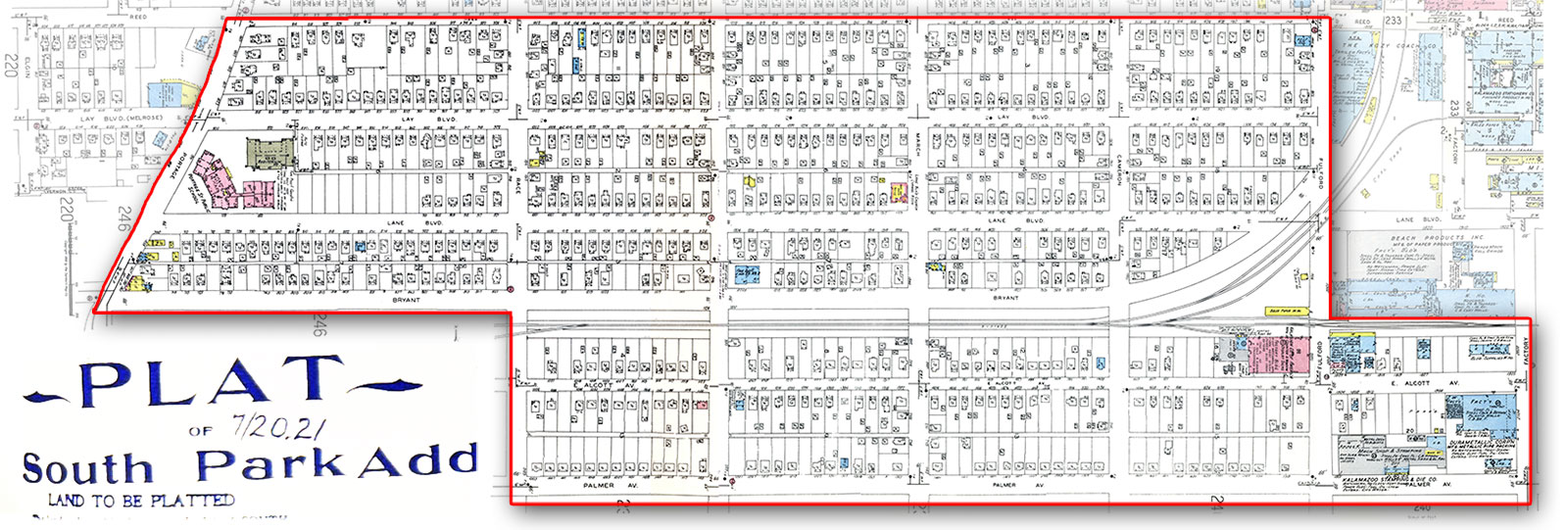 South Park Addition, platted January 1906. Sanborn Map Company, 1958. Kalamazoo Public Library / Library of Congress
In 1906, Lay and Lane began development of the South Park Addition, a residential section on Kalamazoo’s south side, bordered roughly by Portage, Reed, Fulford, Factory, and Palmer streets. The South Park area also became a hotbed for industrial development, thanks in part to its proximity to the railroad freight lines. A slew of early automobile companies, truck companies, and other manufacturing firms would locate their facilities in the area. Lane Boulevard and Lay Boulevard were named for the South Park Addition developers, M.H. Lane and Frank B. Lay.
Lane Motor Truck Company
Lane stepped aside as president of the Michigan Buggy Company in 1912. The shift from horse-drawn vehicles to the automobile, along with a pair of disastrous fires, eventually brought an end to the company, sending M.H. Lane and Frank Lay into bankruptcy. Undaunted, Lane saw great promise in Kalamazoo’s heavy truck manufacturing business and in 1916, he gathered enough capital to form the Lane Motor Truck Company, with Fred W. Gilsky of Kalamazoo, and his son-in-law, George Edward Bardeen, Jr., of Otsego. Lane remained president and general manager of the truck company until 1918, before retiring to pursue other interests.
Learn more about the Lane Motor Truck Company >
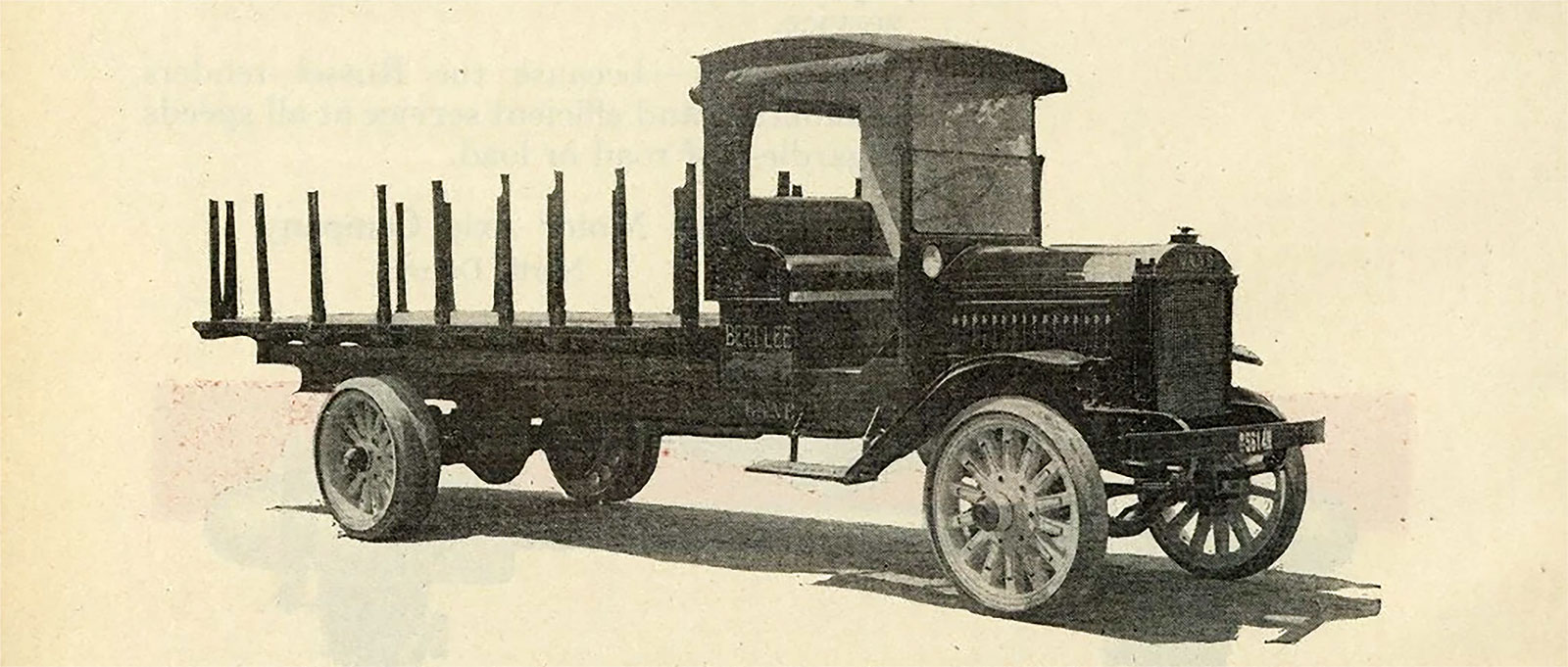 A 1918 Lane Model “B” two-and-a-half-ton stake bed truck. Automobile Trade Journal, 1 November 1917. University of Iowa
Retirement
By 1920, the Lanes were spending their winters in California and the summer months in Kalamazoo, entertaining friends and family in their West Main Street mansion. In 1921, the spacious lawns on the south and west sides of their “cut-stone castle” gave way to a pair of automobile dealership showrooms. Lane attempted to sell the property intact but couldn’t find a buyer, and with their only daughter married by then and living in Kansas City, they no longer needed the space. “The house doesn’t owe me a cent,” Lane told the Kalamazoo Gazette in 1921, “I have had more fun and more good times in it than any other ten men in Kalamazoo. I will stay in it as long as I live.”
The Lanes closed their Main Street mansion in 1927 and took up residence in local hotels and apartments. A filling station was erected on the northeast corner of the property that year, and a streetcar luncheonette all but obscured the front porch. The once stately home stood precariously amid the trappings of commercial progress.
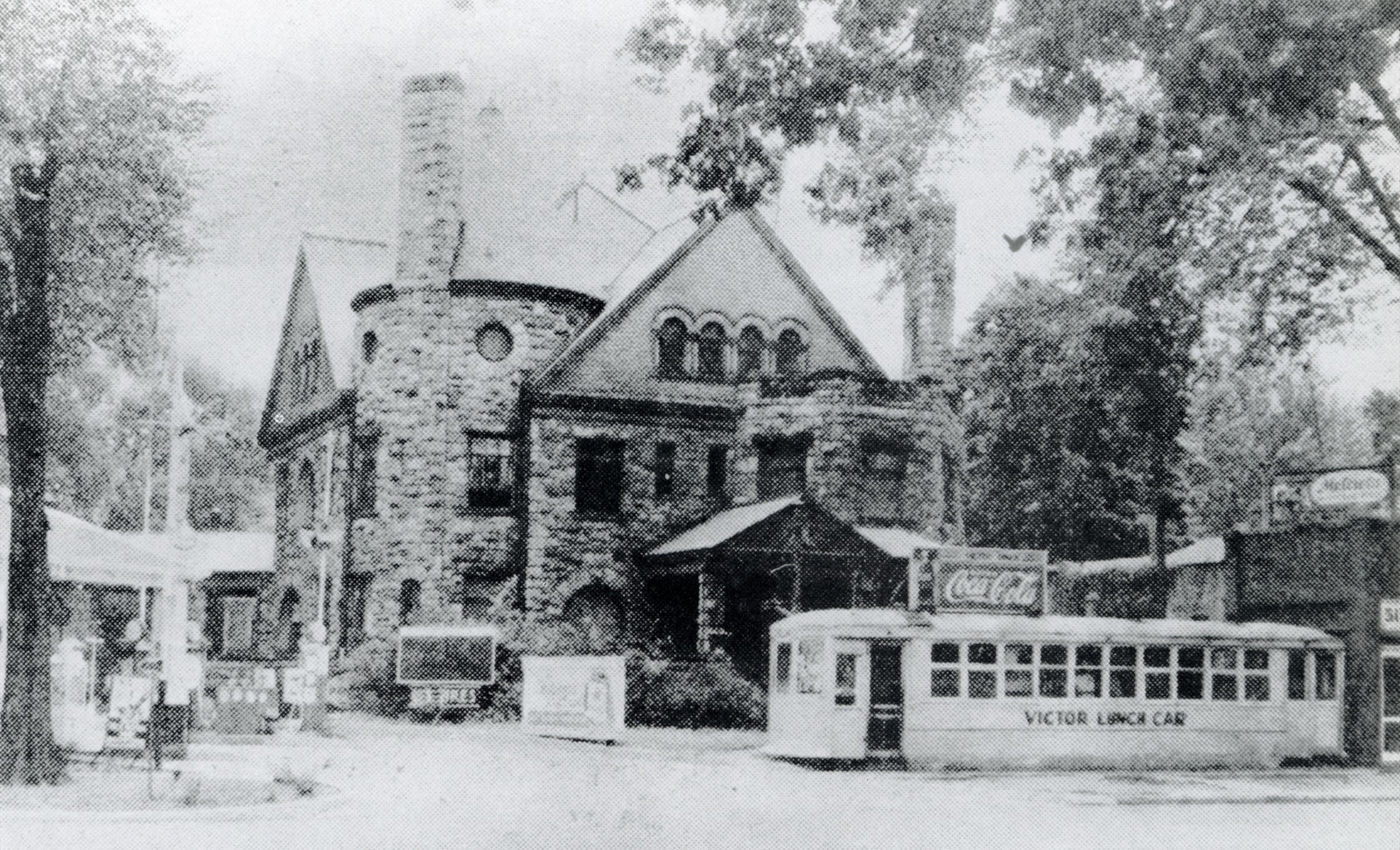 Lane home on West Main Street, c.1930s. Kalamazoo Public Library
M.H. Lane played a vital role as an early automobile manufacturer in Kalamazoo. “To him it brought both success and misfortune, then death” (Gazette). Lane died in April 1930 at the age of 80 as the result of injuries he sustained in an automobile accident while vacationing in California. His remains were returned to Kalamazoo and interred at Mountain Home Cemetery.
“If milady dropped her handkerchief today from a window in its third-floor ballroom—the scene for three decades of some of Kalamazoo’s most brilliant social events—it would fall in an automobile greasing pit.”
—Kalamazoo Gazette, 23 August 1936
Once a cultural showcase of the community, the finely manicured lawns that surrounded the Lanes’ stately Main Street mansion had by the 1930s become littered with “incongruous commercial impediments” (Gazette). It was razed in the fall of 1936 to make way for additional automobile dealership space. Ida Lane moved to an apartment in the Marlborough Building on South Street and typically spent the winter months with her daughter in Los Angeles. She died in April 1945 at the age of 77 and was buried at Mountain Home.
Written by Keith Howard, Kalamazoo Public Library staff, January 2026
Sources
Books
Men of progress : embracing biographical sketches of representative Michigan men with an outline history of the state
The Evening News Association, Detroit. Published 1900
University of Michigan
Articles
“The new wagon company”
Kalamazoo Daily Telegraph, 9 February 1881, page 2, column 5
“Kalamazoo wagon company”
Kalamazoo Daily Telegraph, 27 April 1881, page 4, column 4
“Local news”
Kalamazoo Gazette, 6 April 1883, page 5, column 1
“A new factory”
Kalamazoo Daily Telegraph, 7 April 1883, page 3, column 5
“Local news”
Kalamazoo Gazette, 7 April 1883, page 4, column 1
“Real estate transfers”
Kalamazoo Gazette, 13 April 1883, page 8, column 4
“Baked pike”
Kalamazoo Daily Telegraph, 30 October 1885, page 6, column 2
“Big real estate sales”
Kalamazoo Gazette, 26 September 1886, page 6, column 2
“Local gleanings”
Kalamazoo Gazette, 24 May 1889, page 4, column 1
“It is coming!”
Kalamazoo Gazette, 6 March 1891, page 2, column 1
“Lane go’s it”
Kalamazoo Gazette, 25 October 1891, page 1, column 5
“First national bank”
Kalamazoo Gazette, 31 December 1891, page 3, column 6
“Kalamazoo”
Kalamazoo Gazette, 23 1 December 1892, page 11, column 3
“A grand benefit”
Kalamazoo Gazette, 8 December 1892, page 1, column 3
“New buggy company”
Kalamazoo Gazette, 12 November 1897, page 3, column 6
“A merited honor”
Kalamazoo Gazette, 14 March 1900, page 8, column 4
“Portland cement company of Kalamazoo”
Kalamazoo Gazette, 14 March 1900, page 8, column 4
“Prosperous is this factory”
Kalamazoo Gazette, 24 September 1905, page 16, column 2
“South park addition”
Kalamazoo Gazette, 23 January 1906, page 2, column 4
“Island park club formed”
Kalamazoo Gazette, 28 February 1906, page 5, column 2
“New cottages for Gull Lake”
Kalamazoo Gazette, 9 March 1907, page 3, column 5
“M. H. Lane is main owner of Telegraph”
Kalamazoo Gazette, 13 November 1908, page 1, column 5
“Not to make automobiles”
Kalamazoo Gazette, 6 June 1909, page 9, column 4
“Big automobile factory here”
Kalamazoo Gazette, 24 September 1909, page 1, column 3
“M.H. Lane retires as head of Michigan Buggy Co.”
Kalamazoo Gazette, 4 May 1912, page 1, column 6
“Kalamazoo men are declared bankrupts”
Kalamazoo Gazette, 7 February 1915, page 3, column 5
“Lane motor co. gets location”
Kalamazoo Telegraph Press, 26 February 1916, page 9, column 6
“Break ground for new factory”
Kalamazoo Telegraph Press, 31 March 1916, page 14, column 4
“Lane in one- to five-ton capacities”
Automobile Trade Journal, 1 November 1917, page 246, column 1
“M.H. Lane succumbs at Los Angeles”
Kalamazoo Gazette, 21 April 1930, page 1, column 6
“Hold last rites for M. Henry Lane”
Kalamazoo Gazette, 25 April 1930, page 1, column 2
“M.H. Lane’s mansion will be razed by demolishers”
Kalamazoo Gazette, 23 August 1936, page 4, column 2
Local History Room Files
Name File: Lane, M. Henry