The Lane Motor Truck Company
Truck and Commercial Vehicle Manufacturers
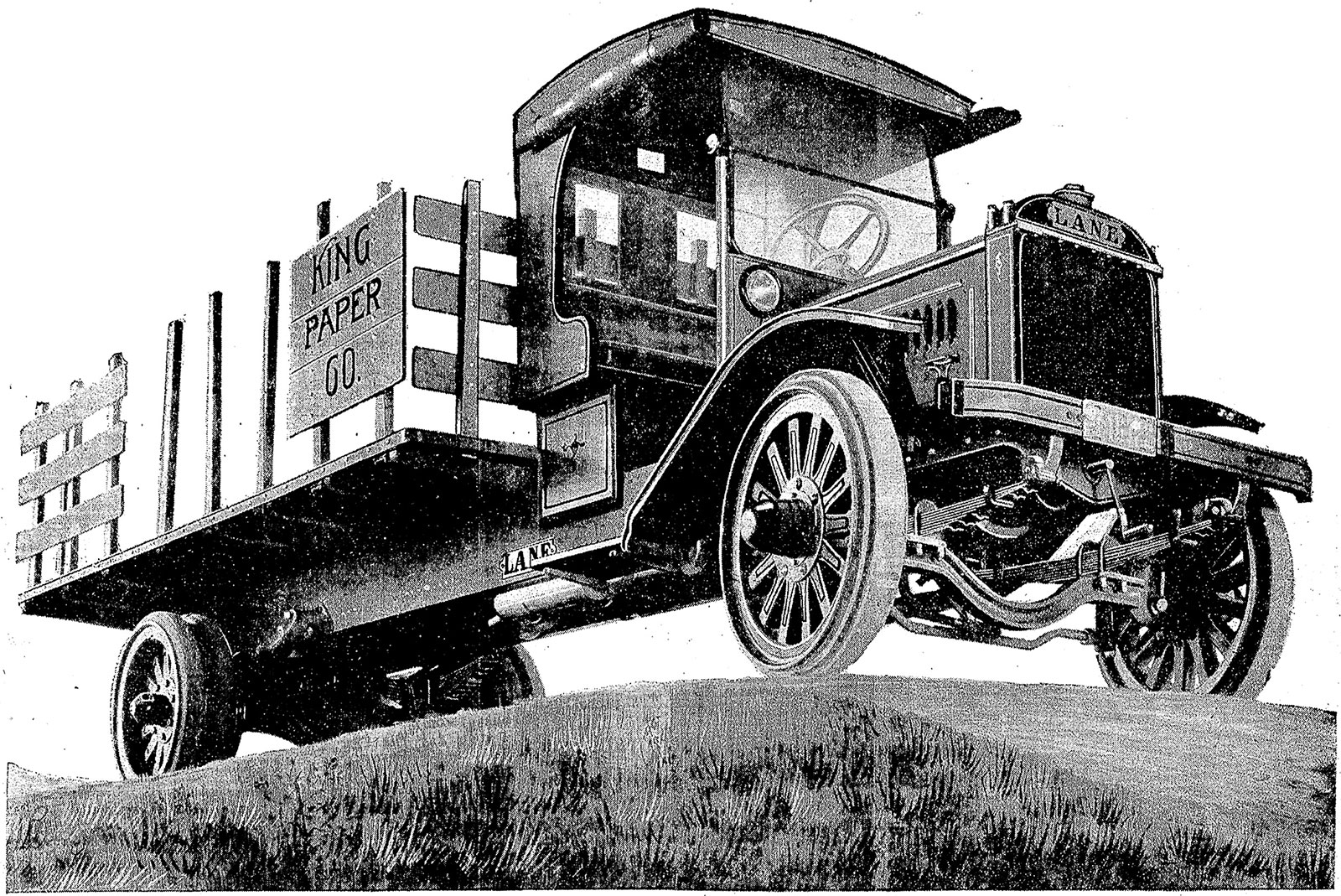 King Paper Company’s “Lane” stake bed cargo truck, c.1918. Kalamazoo Gazette, 13 February 1918. Kalamazoo Public Library
Kalamazoo entrepreneur M.H. Lane would have been well aware of Frank G. Clark and his popular line of “Kalamazoo” trucks. Lane had already dabbled in the automobile business, and in Clark’s own words, “I see great prospects for a successful future for the motor truck business. The surface has hardly been scratched as yet, and the style of truck we make appeals to millions of possible customers” (Gazette). But when Clark changed the name of his Kalamazoo Motor Vehicle Company in 1915 and moved his firm to Pontiac, he left a door of opportunity wide open in Kalamazoo. Lane wasted no time.
Lane Motor Truck Company
The demise of the Michigan Buggy Company sent owners M.H. Lane and Frank Lay into bankruptcy. Undaunted, Lane formed a new company in February 1916 called the Lane Motor Truck Company. Lane’s partners in the new venture would be his former Michigan Buggy Company engineer, Fred W. Gilsky, and Lane’s son-in-law, George Edward Bardeen, Jr. of Otsego.
Like its predecessor, Lane was an “assembled car” manufacturer, who purchased parts from outside suppliers rather than producing them in-house. Lane’s firm would at first focus on light-duty flatbed trucks in four available body styles: an express body with flared side boards, a stake bed cargo truck, a commercial delivery model with a fixed top over the cargo area, and a delivery model with solid side panels.
The line would soon be expanded to meet the rising demand for more robust vehicles. Lane’s 2-ton models employed a six-inch channel steel frame, with a standard 150-inch wheelbase, or available 180-inch option. Lane’s trucks were powered by six-cylinder Continental brand motors, with Gray & Davis ignition systems and Timken axles. Unlike his predecessors’ chain driven models, Lane’s trucks employed a more reliable driveshaft and “worm gear” for transferring power to the rear axle. Lane’s firm expected to produce at least 200 light duty ¾-ton and 1-ton trucks during the coming year, along with 100 of its heavy-duty 2-ton and 2½-ton models. The first demonstration model was completed and ready for testing by late April.
 Burtt Manufacturing on Fulford Street, c.1908. Sanborn Fire Insurance map, 1908. Kalamazoo Public Library / Library of Congress
Lane secured property for his factory on the southeast corner of Reed and Fulford streets, adjacent to his South Park Addition. Meanwhile, he arranged for temporary use of Frank Burtt’s nearby engine factory on Fulford Street while his new building was under construction. William A. Cook, formerly with the Indiana Truck Corporation, and said to be “one of the best-known truck engineers in America” (Gazette), was brought in as chief engineer and head of construction.
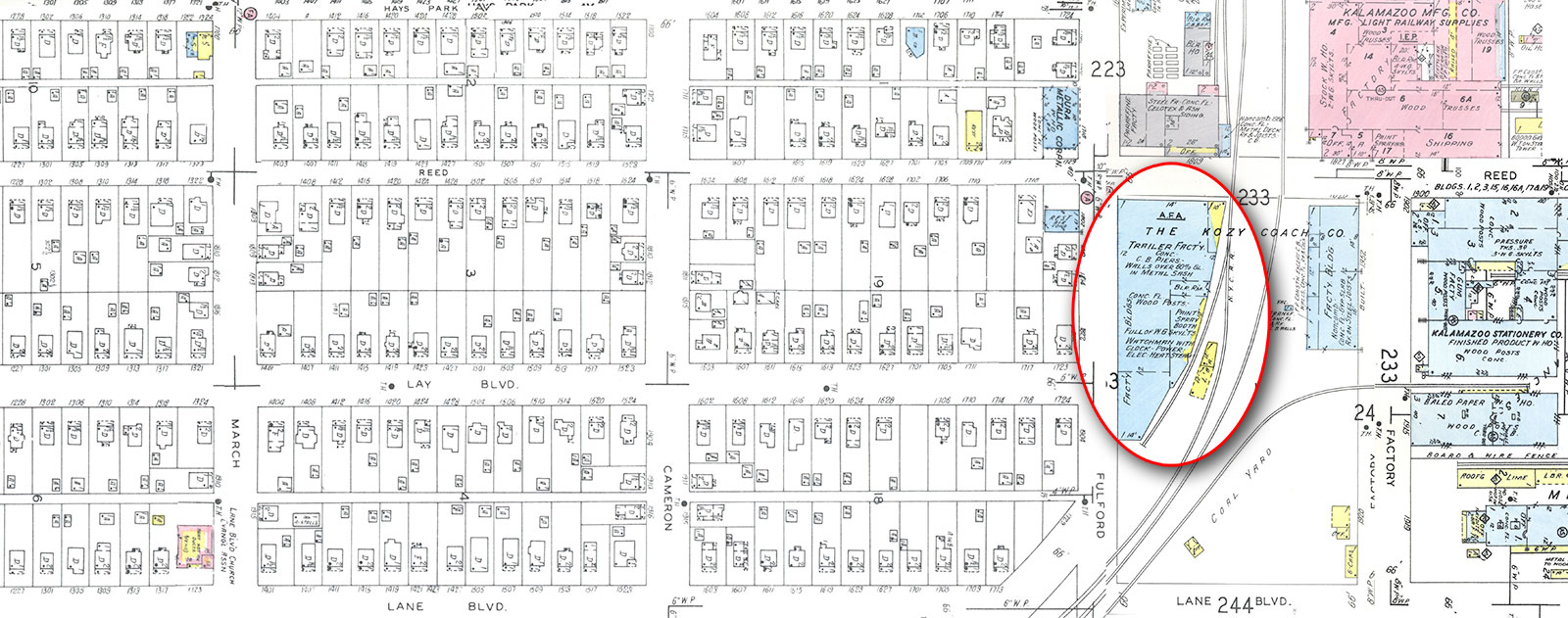 Location of Lane’s factory on Fulford St. Sanborn Map Company, 1958. Kalamazoo Public Library / Library of Congress
By the end of 1916, construction work on Lane’s new $8,000 building (roughly $238,000 today) at 1800 Reed Street was completed and production was underway. The building was a single-story “L” shaped structure, with 175 feet of frontage facing Reed Street and 325 feet along Fulford. The lower portion of the factory’s sidewalls were made of concrete, with sixteen-foot steel-framed multi-pane windows above, separated by four-foot brick piers. This new design in factory architecture known as “daylight factory” allowed for ample lighting and more adequate ventilation. The first truck sold by the Lane Motor Truck Company was a 2½-ton Model “B” purchased by the Western Papermakers Chemical Company of Kalamazoo. It appeared on city streets in February 1917. Lane planned to build 100 more like it by year’s end.
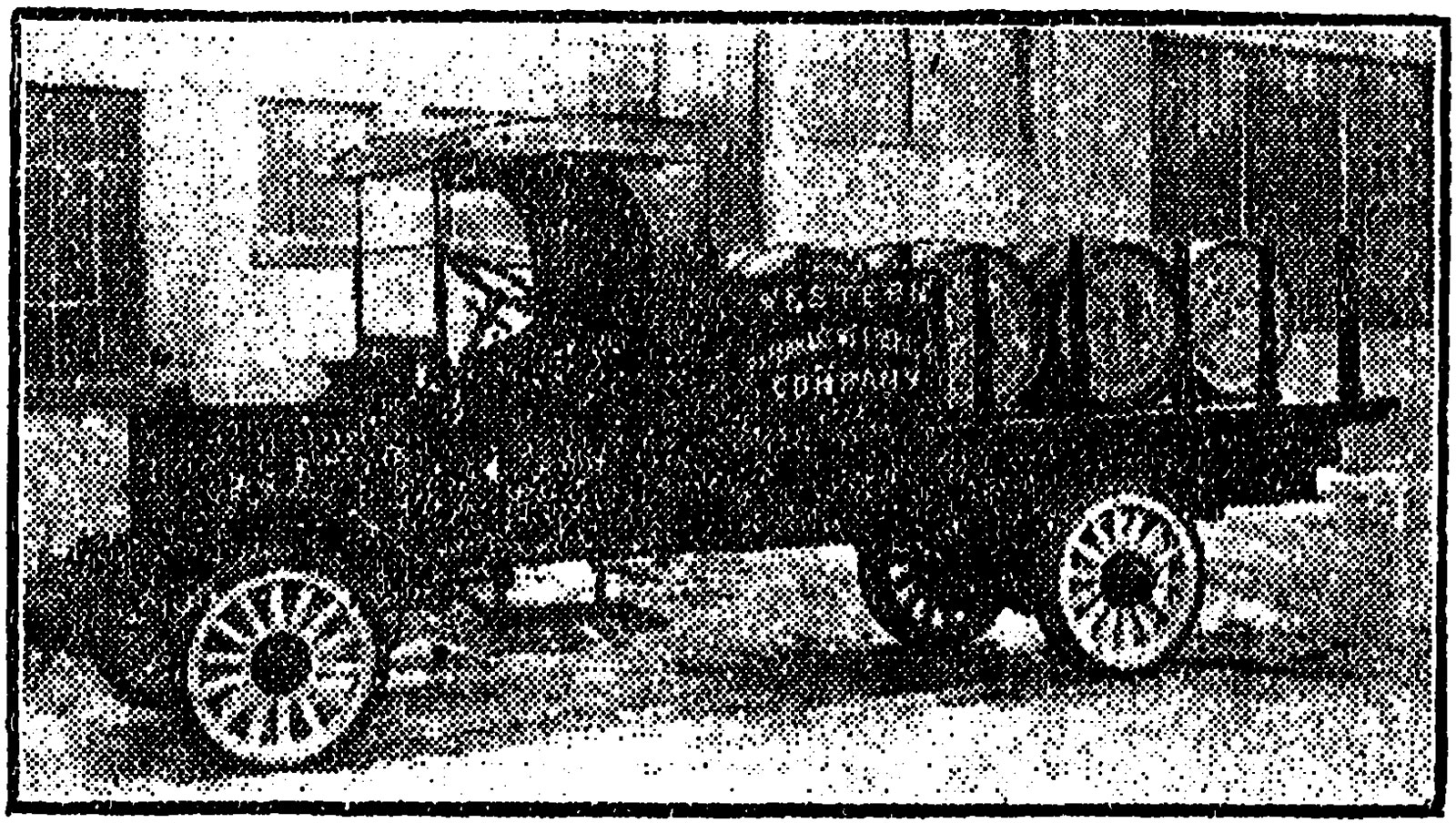 Lane “Model B” truck, Western Papermakers Chemical Co., c.1917. Kalamazoo Gazette, 18 March 1917. Kalamazoo Public Library
As the war in Europe escalated, the prospect for government contract work looked promising. And there was considerable demand for trucks in the private sector, as well. “We are receiving inquiries from all sections of the country,” Lane told a reporter, “and there is little doubt but that we will be able to sell every truck we can make” (Gazette).
Lane received permission from the Securities and Exchange Commission to increase the company’s capital stock to $250,000 (nearly $5.4 million today), ten times the firm’s initial share capital. The stockroom was increased in size, and a 100-foot addition was added. By January 1918, the company was preparing to turn out some 500 trucks – at least 10 per week – during the coming year.
M.H. Lane Retires
M.H. Lane retired from the firm in March 1918, leaving William A. Cook as company president, Dr. Walter W. Lang as vice president, and L. W. Hamilton of Grand Rapids as secretary-treasurer and general manager. Edward W. Bitzer was added to the board of directors later in the year. Robert M. Gregory, active in the automobile manufacturing business for more than a decade, joined the firm as head of the purchasing department in May. Despite impending governmental restrictions during wartime, the firm was able to secure adequate materials, and production was allowed to continue.
“Our list of distributors is being added to regularly. Some of the best truck salesmen in America are now handling the Lane truck and find it a ready seller.”
—Kalamazoo Gazette, 19 March 1918
With the Lane Motor Truck Company set to make a prominent showing of its products at the Chicago Automotive & Accessories Exposition in May, significant changes began to happen within the company’s corporate structure. In the wake of M.H. Lane’s departure, L.W. Hamilton took over as company president and general manager in July 1918. Yet another, perhaps more significant, change occurred in August when assistant engineer Harvey M. Stewart resigned from the firm and Lembert W. Coppock was hired. Coppock had been an automotive design engineer for more than a decade by then. He received patents for several of his inventions, from starters and cooling devices to engine components and motor vehicle design. He formed the Coppock Motor Car Company in Decatur, Indiana, and later moved his operation to Grand Rapids, where he reincorporated it as the United Truck Company. Coppock then moved to Kalamazoo, where he joined the Lane firm.
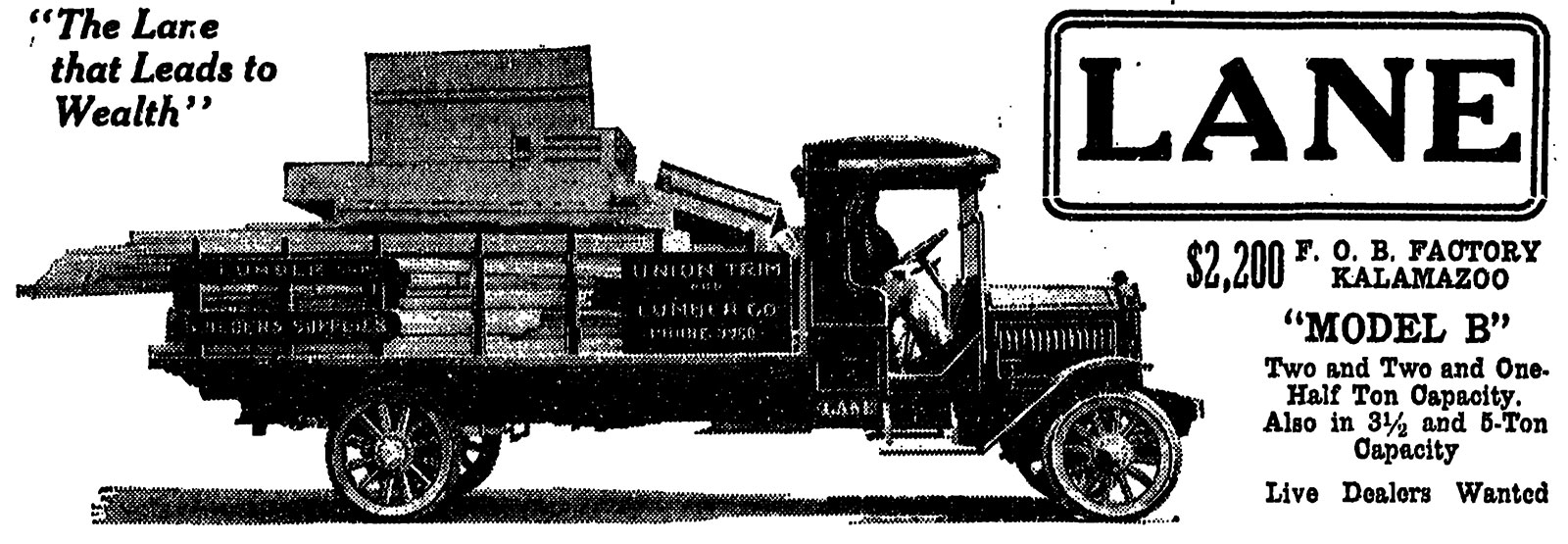 Lane “Model B” truck, Union Trim & Lumber Co., c.1917. Kalamazoo Gazette, 16 May 1917. Kalamazoo Public Library
“There is every indication that the Kalamazoo Motors Corporation will be a leading factor in the industrial growth of this city. The stockholders are men interested in Kalamazoo’s biggest enterprises and well able to make a success of the new concern.”
—Kalamazoo Gazette, 30 March 1919
Kalamazoo Motors Corporation
By March 1919, The Great War was over, and big changes were on the way for the Lane Motor Truck Company. A new firm called the Kalamazoo Motors Corporation was organized to take over the entirety of the Lane truck manufacturing operation. With a completely new board of directors, the new organization would continue to use Lane’s Fulford Street facilities, while focusing on models “designed and perfected” (Gazette) by the firm’s now chief engineer and production manager, Lembert Coppock. The company would be rebuilt “from the ground up,” with a completely new line of trucks to be known as the “Kalamazoo.”
Learn more about the Kalamazoo Motors Corporation >
Written by Keith Howard, Kalamazoo Public Library staff, January 2026
Sources
Articles
“Company will make trucks”
Kalamazoo Gazette, 1 February 1916, page 1 (column 5), page 4 (column 4)
“Lane Motor Truck firm organized”
Kalamazoo Gazette, 11 February 1916, page 5, column 1
“Jottings”
Kalamazoo Gazette, 23 February 1916, page 12, column 3
“Lane motor co. gets location”
Kalamazoo Telegraph-Press, 26 February 1916, page 9, column 6
“New Lane truck ready March 15”
Kalamazoo Gazette, 26 February 1916, page 9, column 1
“Break ground for new factory”
Kalamazoo Telegraph-Press, 31 March 1916, page 14, column 4
“Lane factory to be ready June 1”
Kalamazoo Gazette, 19 April 1916, page 9, column 1
“Break ground for new factory”
Kalamazoo Telegraph-Press, 31 March 1916, page 14, column 4
“Masons at work on Lane plant”
Kalamazoo Gazette, 24 May 1916, page 1, column 5
“Lane truck concern getting under way”
Kalamazoo Gazette, 7 August 1916, page 10, column 6
“Lane company starts making trucks in week”
Kalamazoo Gazette, 18 August 1916, page 7, column 4
“Lane truck co. has many orders”
Kalamazoo Gazette, 29 October 1916, page 1, column 1
“Lane company to build larger car”
Kalamazoo Gazette, 4 December 1916, page 7, column 4
“Will make 300 trucks yearly”
Kalamazoo Gazette, 25 January 1917, page 3, column 3
Display ad
Kalamazoo Gazette, 4 February 1917, page 15, column 1
“First Lane truck appears on streets”
Kalamazoo Gazette, 24 February 1917, page 3, column 6
Display ad
Kalamazoo Gazette, 18 March 1917, page 18, column 5
“Lane truck co. builds 12 passenger automobile”
Kalamazoo Gazette, 8 April 1917, page 19, column 2
“Union Trim buys Lane Motor Truck”
Kalamazoo Gazette, 29 April 1917, page 24, column 5
Display ad
Kalamazoo Gazette, 16 May 1917, page 3, column 5
“Lane to bid on government trucks”
Kalamazoo Gazette, 8 November 1917, page 11, column 3
“Lane company gets big order”
Kalamazoo Gazette, 20 November 1917, page 4, column 6
“Lane to boost stock $225,000”
Kalamazoo Gazette, 6 January 1918, page 3, column 8
Display ad
Kalamazoo Gazette, 3 February 1918, page 23, column 1
“Lane company able to obtain supplies”
Kalamazoo Gazette, 22 February 1918, page 3, column 5
“M. H. Lane quits truck company”
Kalamazoo Gazette, 19 March 1918, page 1, column 6
“Lane truck to be shown at Chicago”
Kalamazoo Gazette, 11 May 1918, page 2, column 5
“R. M. Gregory joins Lane truck forces”
Kalamazoo Gazette, 29 May 1918, page 9, column 1
“Lane motor truck officers elected”
Kalamazoo Gazette, 17 July 1918, page 5, column 3
“New engineer joins Lane truck forces”
Kalamazoo Gazette, 13 August 1918, page 2, column 3
“$250,000 auto company to start in Kalamazoo”
Kalamazoo Gazette, 9 March 1919, page 1, column 1
Local History Room Files
Name File: Lane, M. Henry
Patents
L.W. Coppock. Starter for combustion engines. No. 888,226. Patented 19 May 1908.
(Application filed 4 April 1907)
United States Patent and Trademark Office
L.W. Coppock. Process of forming steel connecting rods. No. 986,547. Patented 14 March 1911.
(Application filed 23 February 1910)
United States Patent and Trademark Office
L.W. Coppock. Steel connecting rod. No. 1,006,632. Patented 24 October 1911.
(Application filed 23 February 1910)
United States Patent and Trademark Office
L.W. Coppock. Automobile. No. 1,075,816. Patented 14 October 1913.
(Application filed 8 June 1911)
United States Patent and Trademark Office
L.W. Coppock. Automobile construction. No. 1,111,525. Patented 22 September 1914.
(Application filed 20 August 1913)
United States Patent and Trademark Office
L.W. Coppock. Cooling device for internal combustion engines. No. 1,111,525. Patented 22 September 1914.
(Application filed 20 August 1913)
United States Patent and Trademark Office
L.W. Coppock. Motor vehicle. No. 1,709,777. Patented 16 April 1929.
(Application filed 4 February 1925)
United States Patent and Trademark Office
L.W. Coppock. Motor vehicle. No. 1,731,765. Patented 15 October 1929.
(Application filed 26 March 1925)
United States Patent and Trademark Office