The Kalamazoo Motors Corporation
Makers of “Kalamazoo” Hand-Made Trucks
After the close of the First World War, assembly lines, standardization, and new technologies spurred growth in several sectors, including the truck manufacturing industry. Innovations like pneumatic tires, larger and more powerful engines, better transmissions, and four-wheel-drive, allowed truck builders to create specialized models for a variety of uses. Dump beds, fire trucks, buses, farm vehicles, tank trucks, and heavy-duty tractor trailer models were among the many new options.
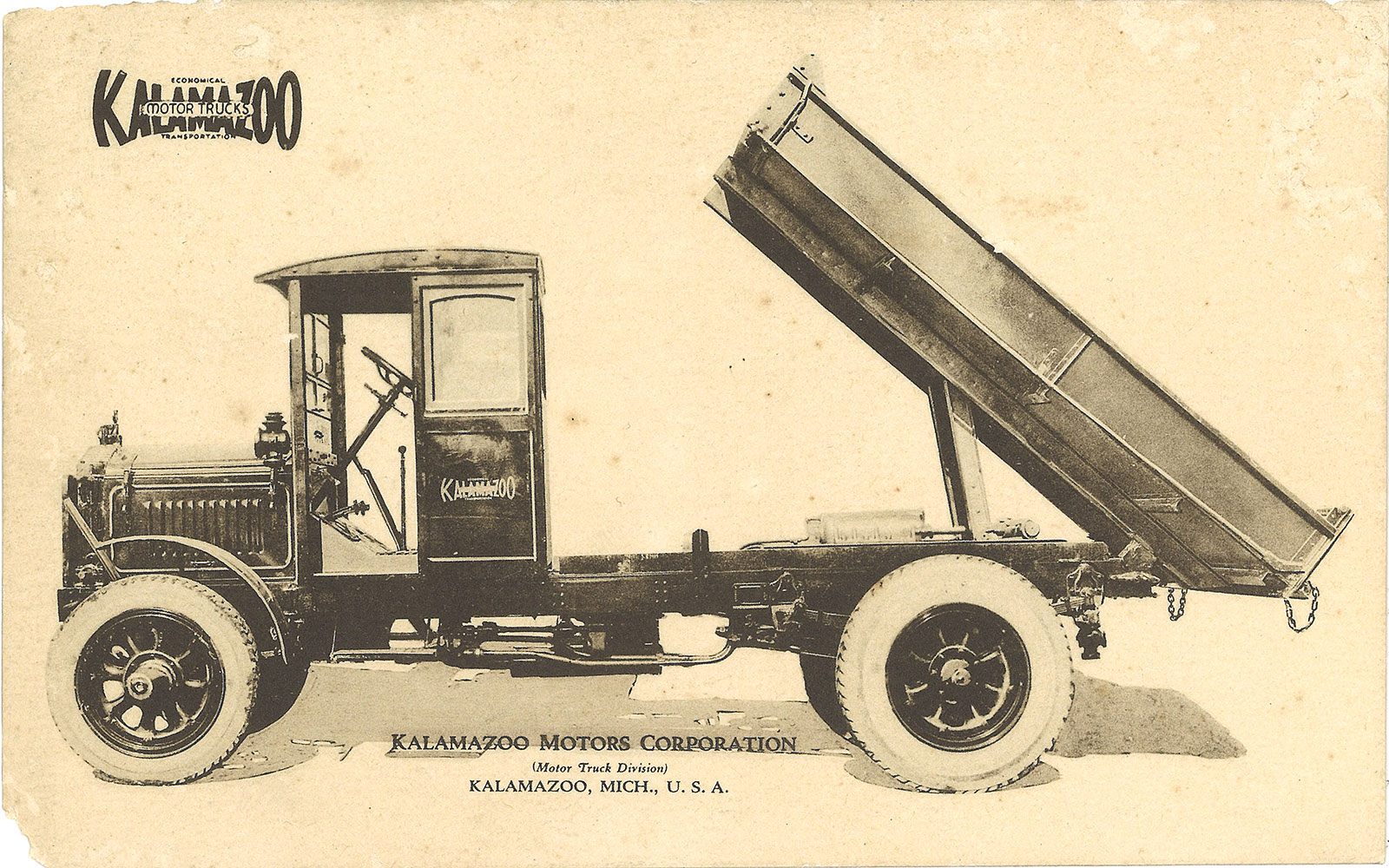 A “Kalamazoo” truck equipped with a dump bed, c.1920. Courtesy, Western Michigan University Archives and Regional History Collections
Lane Motor Truck Company
In March 1919, the Lane Motor Truck Company was absorbed by an ambitious new firm called the Kalamazoo Motors Corporation (KMC). With $250,000 in capital (nearly $5.4 million today) and a new board of directors, the KMC would be restructured “from the ground up” (Gazette) with its primary focus on a new line of trucks to be known as the “Kalamazoo.”
“There is every indication that the Kalamazoo Motors Corporation will be a leading factor in the industrial growth of this city. The stockholders are men interested in Kalamazoo’s biggest enterprises and well able to make a success of the new concern.”
—Kalamazoo Gazette, 30 March 1919
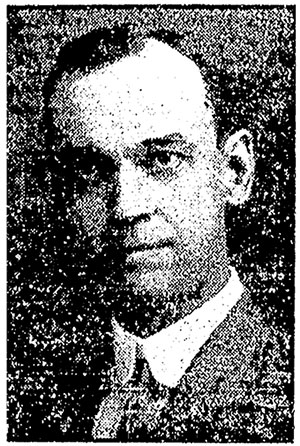 H. Alexander Crawford, c.1916
A list of KMC officers and investors reads like a Who’s Who of Kalamazoo business professionals at the time. Local developer Charles B. Hays would function as the firm’s financial manager. Arthur L. Pratt (president of the King Paper Company), along with Frank H. Milham, Noah Bryant, Joseph E. Brown, and Hale P. Kauffer (all associated with the Bryant Paper Company), and Hugh Alexander Crawford (former Flint mayor and president of the Lull Carriage Company) topped the list of initial investors, although others would soon follow.
H. Alexander Crawford
Hugh Crawford was to become the new company president, with South Dakota financier C.J. Johnson, vice president; Robert M. Gregory (from the Lane Motor Truck Co.), secretary; and William B. Milham (president of the Illinois Envelope Co.), treasurer. Lembert W. Coppock (also from the Lane Motor Truck Co.) would continue his work as chief engineer and production manager, with Vernon T. Barker (president of the Home Savings Banks), Hale Kauffer, Joseph Brown, Arthur Pratt, Frank Milham, and John McKinnon rounding out the board of directors.
“…and with the organization of the new Kalamazoo Motors corporation, this city is put on the map with the towns that produce both passenger cars and trucks.”
—Kalamazoo Gazette, 13 April 1919
The new firm would continue to use the Lane Motor Truck Co. facilities on Fulford Street, while focusing on models “designed and perfected” (Gazette) by the firm’s now chief engineer and production manager, Lembert Coppock. Early emphasis was placed on trucks in the 1½-ton, 2½-ton, and 3½-ton categories. The company’s goal was to produce 1,000 trucks during its first year.
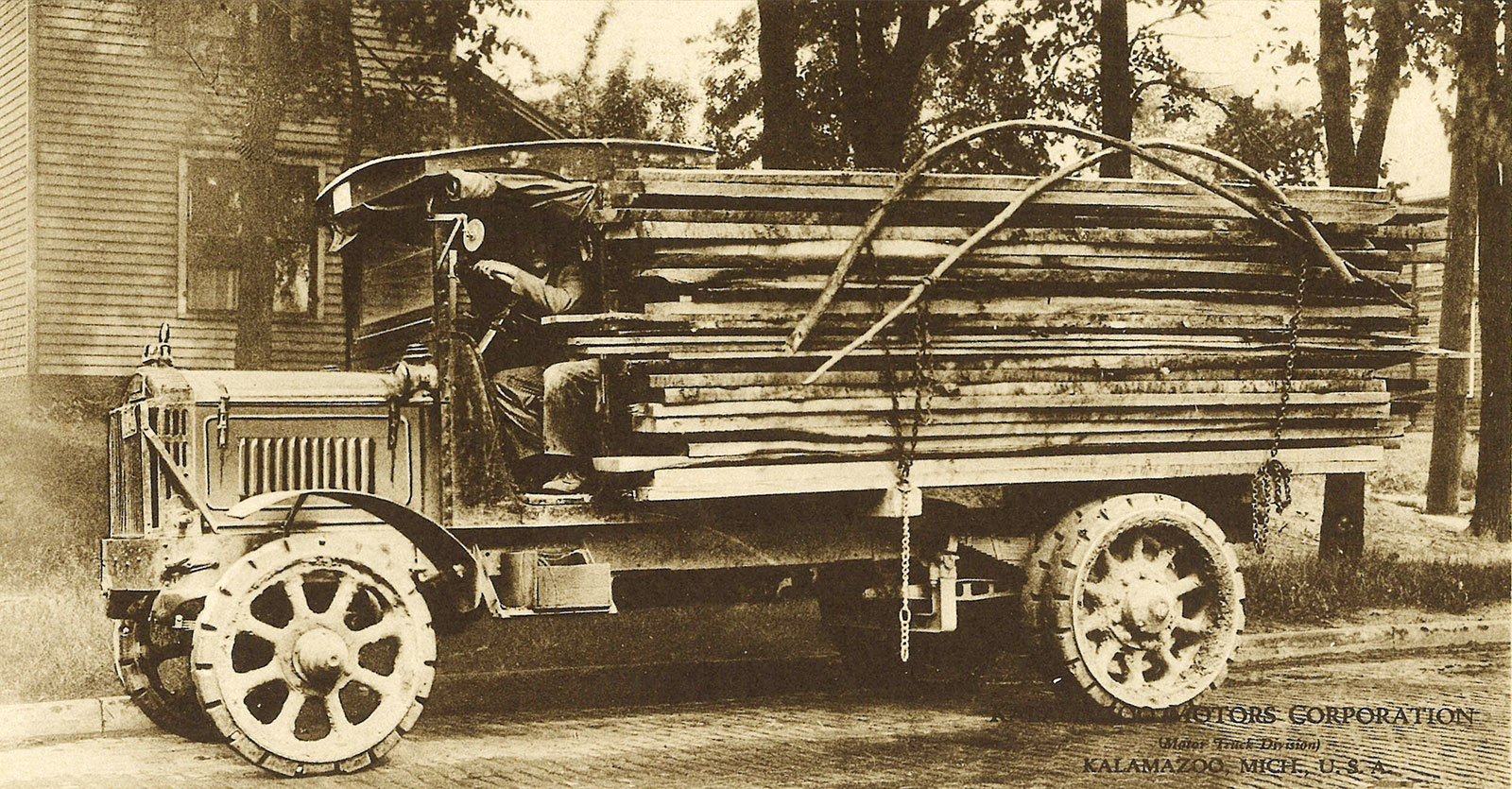 A heavy-duty “Kalamazoo” flatbed truck, c.1920. Courtesy, Western Michigan University Archives and Regional History Collections
The former Lane factory building was to be rearranged, expanded, and retooled, as orders began to roll in from as far away as Minnesota, Nebraska, South Dakota, North Dakota, Iowa, and California. A 1,500-square-foot addition would make more room for the paint shop, while the machine shop would receive a 2,000-square-foot addition.
Support Home Industry
Postwar buyers were encouraged to “help turn the wheels of home industry” (Gazette) by patronizing hometown merchants and buying locally made products. The Kalamazoo Hack & Bus Company, Michigan Coca-Cola Bottling Company, Kalamazoo Storage, the Kalamazoo City Fire Department, Corlett-Stone Lumber, and Wolverine Construction were among the first in town to own “Kalamazoo” trucks. In June, James F. Johnson purchased a 1½-ton “Kalamazoo” bus for use on his popular Long Lake and West Lake passenger routes. In July, KMC secured its first foreign customer when a 2½-ton “Kalamazoo” truck was shipped overseas to the city of Arnhem in The Netherlands. Production reached 125 to 150 trucks per month with most units going to out-of-state buyers.
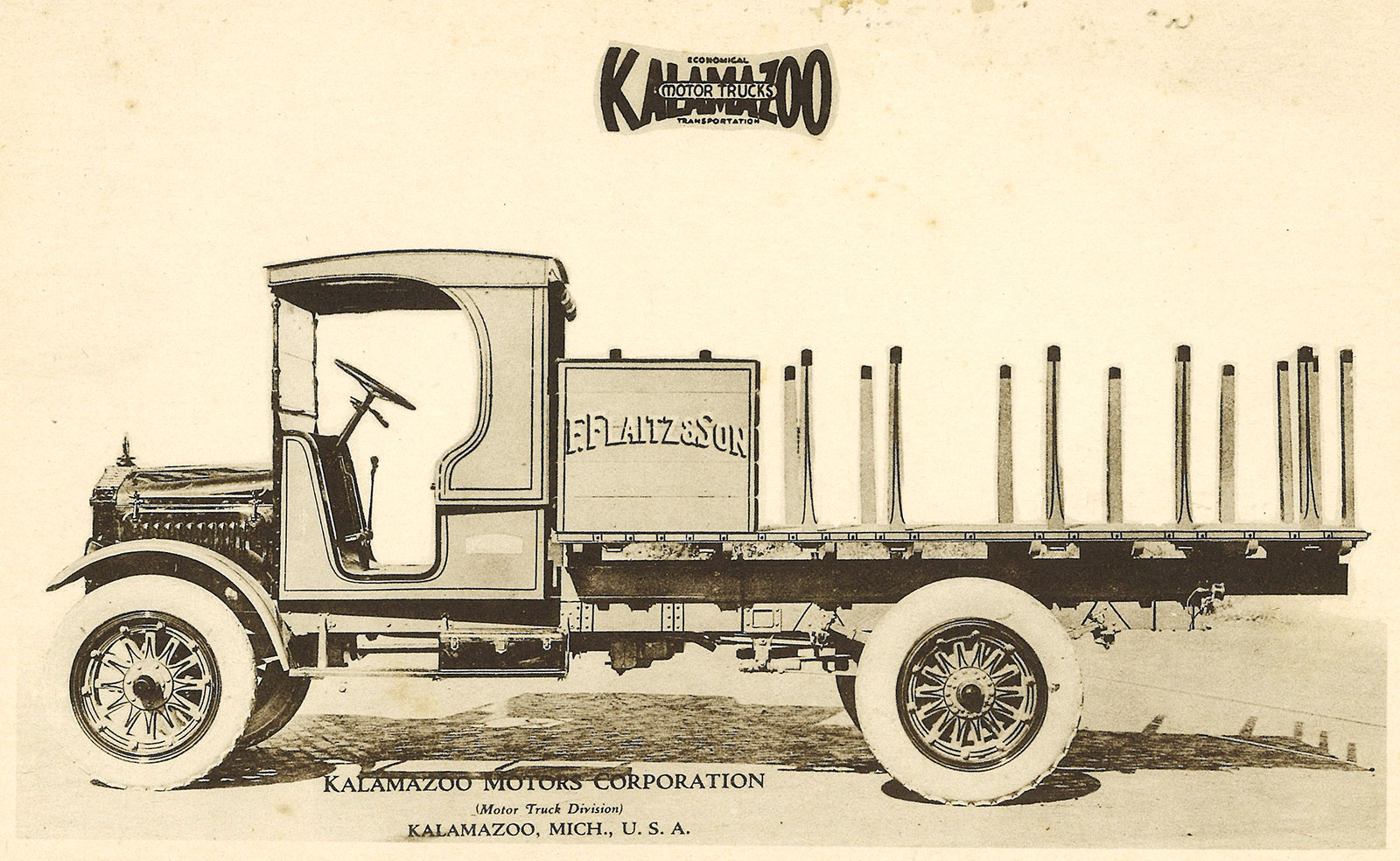 Frank Flaitz & Son’s “Kalamazoo” stake-bed truck, c.1920. Courtesy, Western Michigan University Archives and Regional History Collections
In February 1920, the firm’s capital stock was increased to $1 million (more than $16.1 million today). One hundred workers were on the payroll by then, and plans were in the works for a 114-foot by 80-foot addition designed by Kalamazoo architect Rockwell A. LeRoy. This latest addition would be used as a woodshop and assembly space.
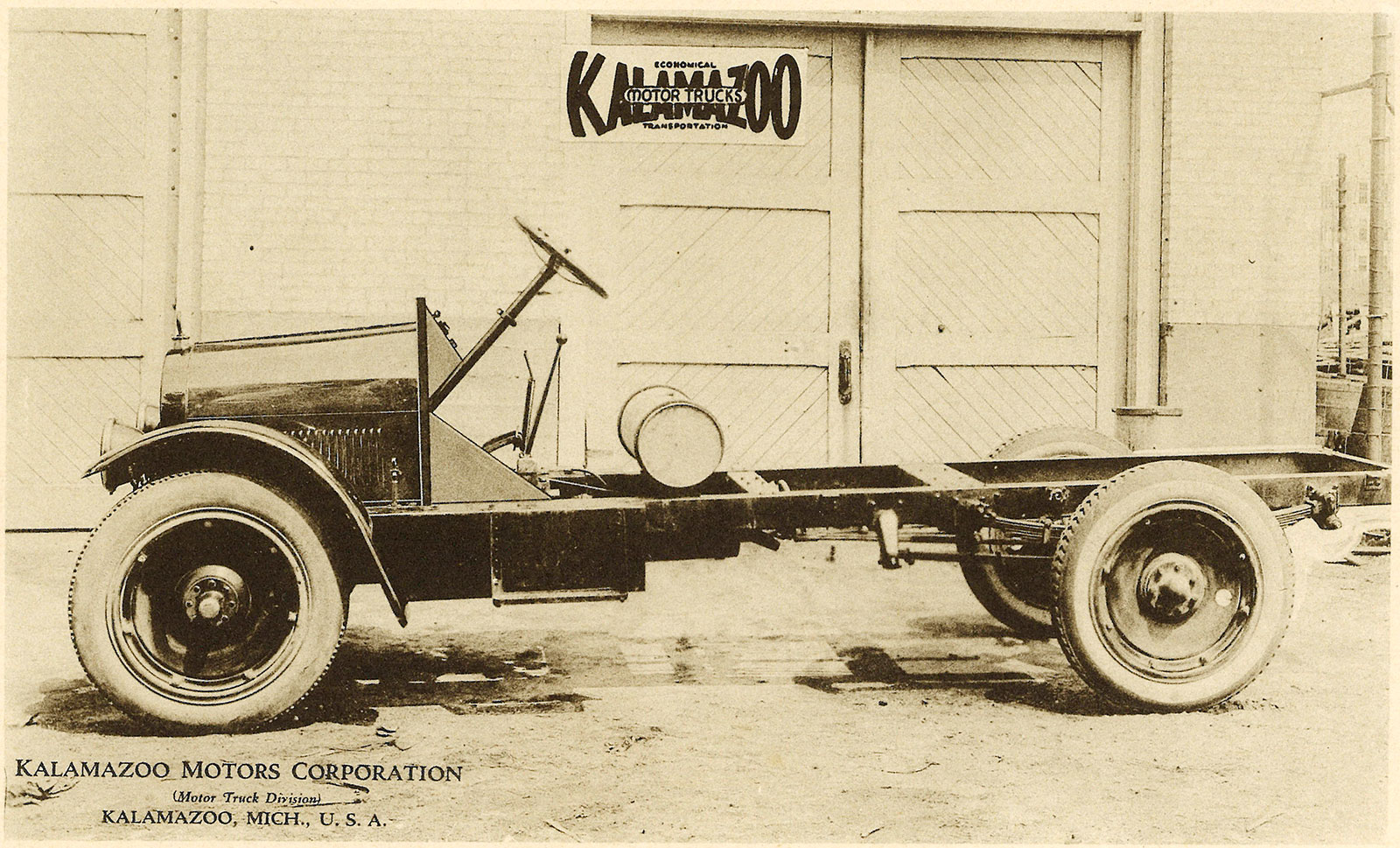 “Kalamazoo” truck chassis, c.1920. Courtesy, Western Michigan University Archives and Regional History Collections
New Models for 1920
For its 1920 models, KMC chose to use four-cylinder engines as opposed to the six-cylinder variety used during the previous year, citing greater adaptability and better economy (and most likely less expensive). The firm’s “Model G” 1½-ton trucks used a four-cylinder engine from Continental Motors Corp. (Detroit), while its “Model H” 2½-ton and “Model K” 3½-ton trucks used Wisconsin Motor’s “Type A” four-cylinder engines (Wisconsin Motor Manufacturing Co., Milwaukee). Larger and heavier wheels were also used on the 1920 models. Models “H” and “K” saw metal wheels used with pneumatic tires, still a relatively new development at the time, while the model “G” retained traditional wooden wheels, although heavier than those previous.
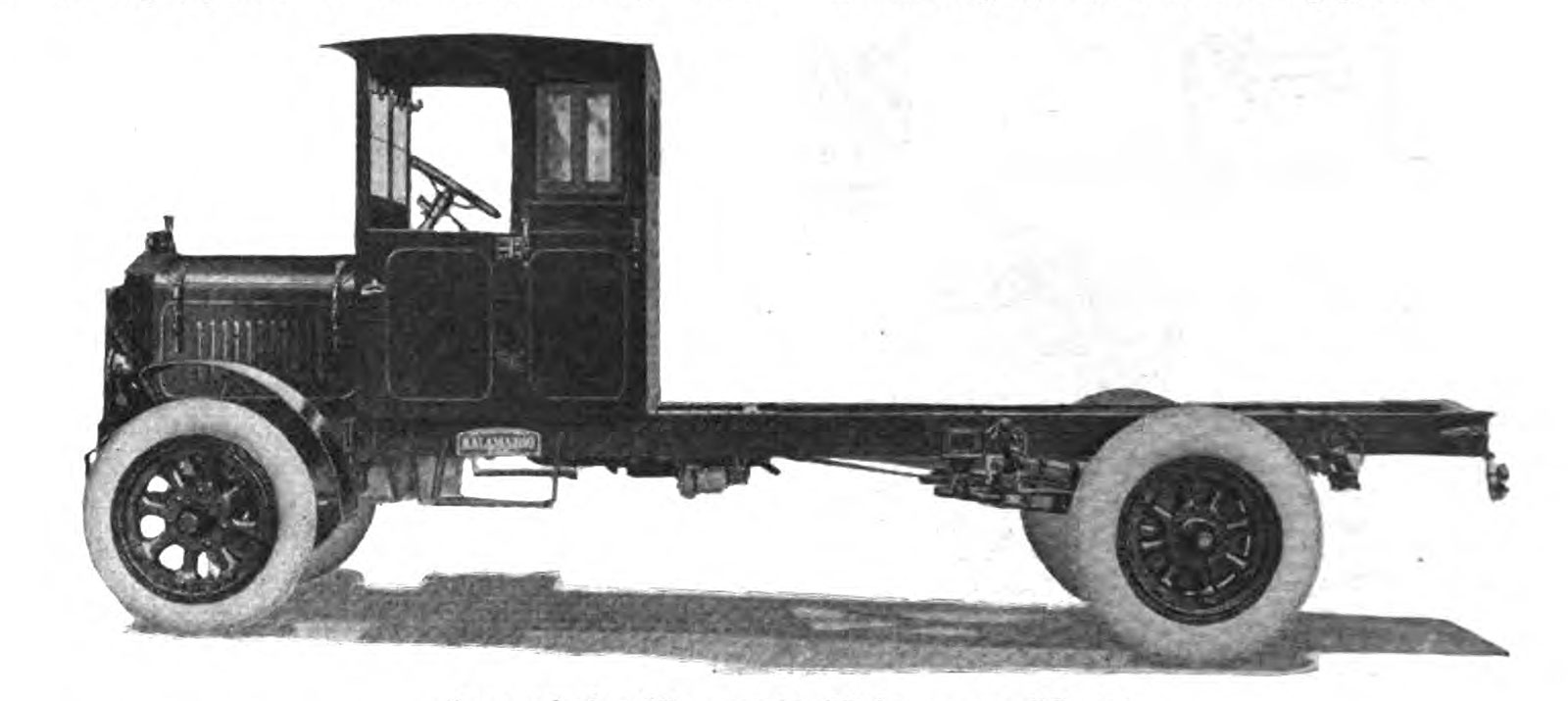 A 1920 “Kalamazoo” Model “H” two-and-a-half-ton truck. Automobile Trade Journal, 1 June 1920. New York Public Library
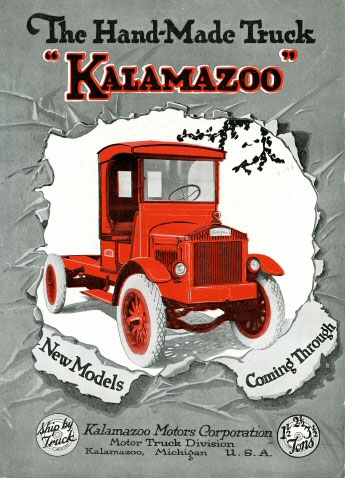 Courtesy, Kalamazoo Valley Museum
For its 1922 lineup, the company featured ten standard models: a one-ton “speed truck” designed for light duty highway use, four commercial models from 1½-ton to 5-ton capacity, four tractor trailer units ranging from 6-ton to 15-ton capacity, and an 18-passenger motor coach. The lighter capacity trucks used pneumatic tires, while the heavy-duty models featured air brakes and solid rubber tires. By July 1921, there were 56 registered “Kalamazoo” truck owners in the city with close to 70 trucks on the streets.
The Struggle to Stay Alive
After 1921, problems developed quickly for the Kalamazoo-based manufacturer. While facing formidable competition from larger firms, a five percent price increase was announced for the 1923 model year as KMC attempted to pay off $165,000 in mortgage bonds. The firm’s chief engineer, Lembert Coppock, who was regarded as “one of the highest type of engineers in this industry” (Gazette), resigned from KMC in February 1923 and took a position with the American Motorway Equipment Corporation, a large New York-based manufacturer. John L. Carey replaced Hugh Crawford as company president, while Crawford attempted to recover $6,500 in his own unpaid wages and “was forced to take a rest after a long struggle to keep the firm alive” (Gazette).
By May 1923, the company had been deemed insolvent and was placed in receivership, citing foreclosure of a mortgage on the company’s real estate and outstanding bonds of $104,000.00 (nearly $2 million today). By August 1923, the once promising Kalamazoo Motors Corporation was no more.
The factory complex on Fulford Street was sold in 1926 to the Voigtmann Metal Window Corporation of Chicago. By 1927, engineer Lembert Coppock was designing buses for the Metropolitan Coach and Cab Corporation in Cleveland. Coppock died in Kalamazoo in December 1929 at the age of 55. Hugh Alexander Crawford remained in Kalamazoo, where he formed the Milburn Refrigerator Company in 1927. He later served as a director for the Bank of Kalamazoo and Title Bond and Mortgage Company. Crawford died in Flint in February 1951 at the age of 77. John Carey, KMC’s final president and receiver, returned to the Detroit area and was later elected mayor of Dearborn. He died in Ypsilanti in 1983 at the age of 96.
Written by Keith Howard, Kalamazoo Public Library staff, January 2026
Sources
Articles
“The velvet hammer”
Kalamazoo Gazette, 18 January 1916, page 4, column 4
“$250,000 auto co. to start in Kalamazoo”
Kalamazoo Gazette, 9 March 1919, page 1 (column 1), page 6 (column 7)
“Kazoo auto co. is being organized”
Kalamazoo Gazette, 30 March 1919, page 1, column 7
“Notice”
Kalamazoo Gazette, 4 April 1919, page 19, column 1
“Start to make new truck”
Kalamazoo Gazette, 11 May 1919, page 15, column 1
“Making first shipment of new trucks this week”
Kalamazoo Gazette, 18 May 1919, page 12, column 2
“Remodeling motor plant”
Kalamazoo Gazette, 1 June 1919, page 14, column 4
“To erect addition to Kazoo Motors building”
Kalamazoo Gazette, 10 June 1919, page 7, column 1
“Award contract for new machine shop”
Kalamazoo Gazette, 16 June 1919, page 3, column 5
“New fire wagon being completed”
Kalamazoo Gazette, 29 June 1919, page 21, column 8
“First export shipment”
Kalamazoo Gazette, 1 July 1919, page 17, column 4
“Kalamazoo trucks win high praise”
Kalamazoo Gazette, 8 September 1919, page 3, column 4
“For fire department”
Kalamazoo Gazette, 25 September 1919, page 11, column 1
“Three models comprise new Kalamazoo line”
Automobile Trade Journal, 1 June 1920, page 408, column 1
“Motor Corporation awards contract for new plant”
Kalamazoo Gazette, 6 April 1920, page 2, column 2
“Home dollars turn the wheels of home industry”
Kalamazoo Gazette, 10 October 1920, page 4, column 6
“Reduces price of Kazoo truck”
Kalamazoo Gazette, 27 June 1921, page 10, column 3
“Seventy ‘Kazoo’ trucks in city”
Kalamazoo Gazette, 17 July 1921, page 18, column 1
“Kazoo Motors prices slashed”
Kalamazoo Gazette, 20 July 1921, page 1, column 1
“100-hour run to test truck”
Kalamazoo Gazette, 13 August 1922, page 8, column 4
“Speed record set by truck made in city”
Kalamazoo Gazette, 13 August 1922, page 8, column 5
“Local trucks start 100-mile run today”
Kalamazoo Gazette, 15 August 1922, page 13, column 5
“De lux motor bus is built in Kalamazoo”
Kalamazoo Gazette, 10 November 1922, page 24, column 1
“Increase price of Kalamazoo truck models”
Kalamazoo Gazette, 8 December 1922, page 38, column 7
Display ad
Kalamazoo Gazette, 10 December 1922, page 32, column 6
Display ad
Kalamazoo Gazette, 24 December 1922, page 28, column 6
“Local trucks subjected to severe tests”
Kalamazoo Gazette, 24 December 1922, page 27, column 3
Display ad
Kalamazoo Gazette, 31 December 1922, page 30, column 1
“Price of local truck up Jan. 1”
Kalamazoo Gazette, 31 December 1922, page 26, column 6
“Crawford again head of Motors”
Kalamazoo Gazette, 23 January 1923, page 12, column 3
“Coppock leaves Motor concern”
Kalamazoo Gazette, 4 February 1923, page 26, column 8
“Two companies get receivers”
Kalamazoo Gazette, 7 May 1923, page 11, column 6
“Firm head work held not labor”
Kalamazoo Gazette, 26 June 1923, page 2, column 7
“Legal notice”
Kalamazoo Gazette, 26 August 1923, page 2, column 1
“Two factories to resume full time operation”
Kalamazoo Gazette, 25 August 1925, page 1, column 3
“Metal windows company buys factory here”
Kalamazoo Gazette, 20 October 1926, page 1, column 6
“Voigtmann factory to operate soon”
Kalamazoo Gazette, 5 January 1927, page 10, column 5
“A.J. Bestervelt still in hospital”
Kalamazoo Gazette, 15 July 1932, page 11, column 5
“Earl Weber meets Dearborn’s mayor – former local man”
Kalamazoo Gazette, 23 May 1938, page 8, column 3
“H. Crawford dies in Flint”
Kalamazoo Gazette, 2 February 1951, page 20, column 5