Pioneer Attorneys
Development of the legal profession
The Early Years
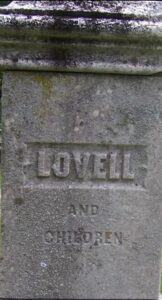 Cyrus Lovell grave, Oak Hill Cemetery, Ionia, Michigan. Photo Sharon Wood
Despite there being “no great need for lawyers in frontier Bronson,” two New Englanders educated and trained as attorneys came to Kalamazoo County. New Yorker Lyman I. Daniels settled in Schoolcraft in 1831, whereas Cyrus Lovell (1804-1895) chose Bronson a year later, conveying upon him title of Kalamazoo’s first lawyer. Soon after arriving in the fall of 1832, Lovell allegedly built the first framed house in the village near Church and South streets. Lovell had been born in 1804 in Grafton, Vermont to Mary and Enos Lovell. Before coming to Michigan, Lovell practiced law in his home state and Massachusetts in the late 1820s. Then in 1829 the twenty-five year old relocated to Detroit, then to Ann Arbor, and finally to Galesburg, Michigan, arriving in 1831. He married Louisa Fargo, and then relocated to Bronson a year later.
County and Circuit Courts
While Lovell only remained in Bronson until 1836, he’s best known for serving as the young village’s first prosecuting attorney who participated in the first cases litigated in the county. He also served as supervisor and justice of the peace. Lovell was one of the attorneys who participated in the first county court case (United States vs. Hannah Carpenter) heard in Bronson in the fall of 1832, the session being held in Titus Bronson’s log cabin. Carpenter was accused of acting counter to prevailing community standards and fined $25 after failing to appear before the court. After four years in Bronson, he moved to Ionia, Michigan, where he lived out the rest of his life, dying there in 1895. While in Ionia, Lovell was elected to the Michigan House of Representatives twice, and served as House speaker.
In November 1833, the circuit court was established, hearing a wide array of cases ranging from Benjamin Harrison’s commercial ferry license and service fees, to a case in November of 1834, which saw Joseph Knight, formerly a native of Queens County, Ireland, file the first declaration for American Citizenship. Judge William A. Fletcher presided over this new court. During Kalamazoo’s first decade, most legal disputes were civil, but occasionally the courts heard a criminal complaint. In 1837, a violent dispute between two men named Hannibal and Martin took place as the two were digging a ditch.
“A dispute over how the ditch should be dug developed with both men coming to blows. Martin raised a pick intending to strike Hannibal. Hannibal anticipated the blow and countered with a pitch fork handle to the head, killing Martin instantly. Hannibal was subsequently tried and acquitted on the basis of a self defense plea.”
Early Growth and Development of the Kalamazoo Legal Profession, p.15-16
Some of the early Bronson/Kalamazoo lawyers other than Lovell and Daniels included John Hascall (father of Volney Haskall), Jeremiah Humphrey, Joseph Miller, Zephaniah Platt, Epaphroditus Ransom, Hezekiah G. Wells, Nathaniel A. Balch, and Charles E. Stuart (Stuart and Ransom were law partners). Ransom would be appointed to sit on the inaugural Michigan Supreme Court as an associate justice. He would later ascend to chief justice of the court in 1842, and elected governor five years later. Stuart went on to be elected a U.S. Senator, serving the state of Michigan from 1853 to 1859.
Probate Court
More and more settlers poured into Bronson after the Government Land Office in White Pigeon relocated northward to Bronson in 1834. The fervent interest of New Englanders in southwest Michigan land between the years 1834 and 1836 brought with it legal concerns that were mostly addressed by the probate court. The influx of land speculation provided lawyers with opportunities for work and self-promotion. In 1837, the probate court was given power to sell land to secure financial judgments and debt. The first probate court judge in Kalamazoo County was Isaac Barnes, who served from 1831 to 1838. The moving of the land office to Bronson provided lawyers with exciting new prospects, and they too streamed into the area along with speculators to take advantage of the village’s population boom. By 1836, 1,634,511 acres had been purchased for $2,043,866. A lawyer eager to offer his services was Zephaniah Platt, who concentrated his entire business model around real estate transactions in the bustling village. Many of the early attorneys in the county saw the writing on the wall, and like Platt, turned their attention to representing the interests of speculators from the east. Many of these attorneys were also quick not only to represent land buyers, but also to become land buyers themselves, selling for big profits before the market turned. By 1837, the amount of government land shrunk dramatically, and with it land speculation spun to a halt. From 1837 onward, speculators employed attorneys to negotiate the sale of their “choice lots.” 1837 was also the year that with the financial support of Justus Burdick, Kalamazoo built its first court house on the southwest corner of W. Main and Rose streets.
 Interior of the first Kalamazoo County Courthouse, c. 1870-1880
Despite the economic recession of 1837, local attorneys continued to fair well. There were an increase in bankruptcy filings and mortgage transactions to settle during the late 1830s. By 1841, there were seven law firms established in Kalamazoo with roughly eleven practicing lawyers. In 1859, the University of Michigan Law School was created, which allowed for further growth of the profession from within the state, as several notable graduates came from Kalamazoo (Noah P. Bulloch, Walter O. Balch, e.g.). By the turn of the century, several lawyers had also made their mark on local politics and civic affairs by running for public office, including John W. Breese (village president), William H. Deyoe (postmaster), William G. Austin (county clerk), Hezekiah G. Wells (village president), Nathaniel A. Balch (village president), and Gen. Dwight May (village president, state attorney general, lieutenant governor of Michigan).
Article written by Ryan Gage, Kalamazoo Public Library staff, January 2025