Kalamazoo Wheel Works
Carriage and Wagon Wheel Manufacturers
The Kalamazoo “Wheel Works,” a local manufacturer of wagon and carriage wheels, went by several different names between 1887 and 1901… the Woolsey Wheel Company, the Kalamazoo Wheel Company, the American Wheel Company, and the Standard Wheel Company. Yet during its relatively brief tenure, the firm provided employment for hundreds of workers and helped establish Kalamazoo’s Northside Neighborhood as a local manufacturing center.
Woolsey Wheel Company
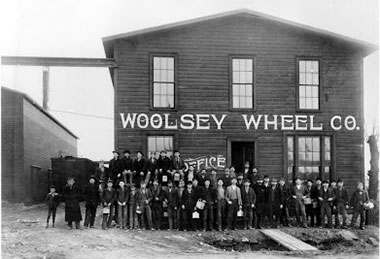 Woolsey Wheel Co., c.1880. Sandusky Library
The Kalamazoo Wheel Company came about in 1887 when the Woolsey Wheel Company, a 30-year-old manufacturer of wagon and carriage wheels in Sandusky, Ohio, moved its operation to Kalamazoo. Sixty percent of Woolsey’s sales that year had been to carriage manufacturers in Kalamazoo, and company owners hoped to protect their share of the market by relocating their business close to the source and expanding from there.
Kalamazooans embraced the move, as well. The company was planning to employ upwards of 300 workers, which would mean a significant boost for the local economy. To that end, Kalamazoo business leaders banded together and launched an effort to secure Woolsey’s move by raising a $5,000 bonus incentive and ensuring an appropriate space for a new factory building.
 Illustrated Atlas of Kalamazoo County, 1890. Wm. C. Sauer, publisher. Local History Room
A five-acre site on the north side of town, somewhat beyond the city limits, was purchased from Jerome B. Trowbridge for $900. The new factory would stand on the east side of North Pitcher Street, north of Paterson, between the Grand Rapids & Indiana and the Lake Shore & Michigan Southern railroad lines. The area seemed readymade for industry, since new facilities for the Fuller Brothers washboard company and the St. John plow works were already being built nearby. Bush & Paterson, Trowbridge, and others platted and developed the surrounding area to provide housing for the anticipated influx of workers.
“A number of cottages have been erected on the new addition (north of Bush street and outside the city limits) and many more are to be built this season for the men who will be employed in the Woolsey wheel works, the Fuller washboard factory and the St. John plow works.”
—Kalamazoo Daily Telegraph, 27 July 1888
Kalamazoo contractor John Wesley Damerell was awarded a contract to build the 15,000 square foot factory building, which was designed by architect George William Doerzbach from Sandusky, Ohio. Construction began in May as requisite shipments of stone and brick began to arrive on the site. Brickwork had reached the second story by August and by September the roof was on, while the machinery was being installed.
Kalamazoo Wheel Company
By October 1888, the construction work was finished and the franchise of the Woolsey Wheel Company was transferred to the newly formed Kalamazoo Wheel Company, with officers Edward Flickinger, president and treasurer; George E. Stockbridge, vice president; and Eugene McCall, secretary, with H.G. Olds and O.L. Hayes as directors. Flickinger, McCall, Olds, and Hayes were all prominent businessmen from Sandusky. Flickinger was a career manufacturer of buggy wheels who accompanied the firm to Kalamazoo, then later returned to Ohio, where he continued making wheels and breeding horses. O.L. Hayes was an Ohio banker, while H.G. (Harry Grant) Olds later went on to become a highly regarded photographer in Argentina. George Stockbridge, nephew of Senator Francis Stockbridge, then vice-president of the Kalamazoo Spring and Axle Company, was the sole Kalamazoo officer. Production in the new factory began on October 31st with an initial workforce of 150 members, many of whom had followed the company from Ohio.
“The Kalamazoo wheel factory turned out 50 sets of wheels, the result of the first day’s work.”
—Kalamazoo Daily Telegraph, 1 November 1888
By the spring of 1889, the wheel company was producing 200 sets (800 wheels) per day, yet it was still struggling to keep up with incoming orders. Kalamazoo’s buggy and wagon manufacturers were by then turning out 75,000 vehicles annually and the market was growing. A new 40-foot by 100-foot building and machine shop were in the works and by the end of the year the company hoped to employ 300 workers with a capacity to produce up to 1,200 wheels per day.
 Kalamazoo Wheel Co. (north side), c.1889, likely photographed by S.C. Baldwin. Picturesque Kalamazoo, 1890. Kalamazoo Public Library
American Wheel Company
The 1890s began a period of industrial upheaval in the United States when many companies were consolidated into large corporations that held dominant shares of the markets in which they operated. In September 1890, the Kalamazoo Wheel Company was sold to the American Wheel Company of Chicago, a conglomerate that essentially controlled the wheel production industry with 30 of the nation’s largest wheel manufacturers under its umbrella. Capacity at the Kalamazoo plant would soon be pushed to 1,600 wheels per day.
But the sale to the American Wheel Company came at a cost when in December 1890, the firm suddenly upped the price of its wheels from $4 per set to $10, an unprecedented jump in price that would have potentially devastating effect on the carriage manufacturing industry. In response, the Kalamazoo-based Michigan Buggy Company was among several vehicle manufacturers that decided to begin making their own wheels. Michigan Buggy owner Moses Henry Lane stated, “it will be for the interest of all large carriage manufacturers to put in machinery for making wheels and protect themselves against such monopolies as the American Wheel company” (Gazette).
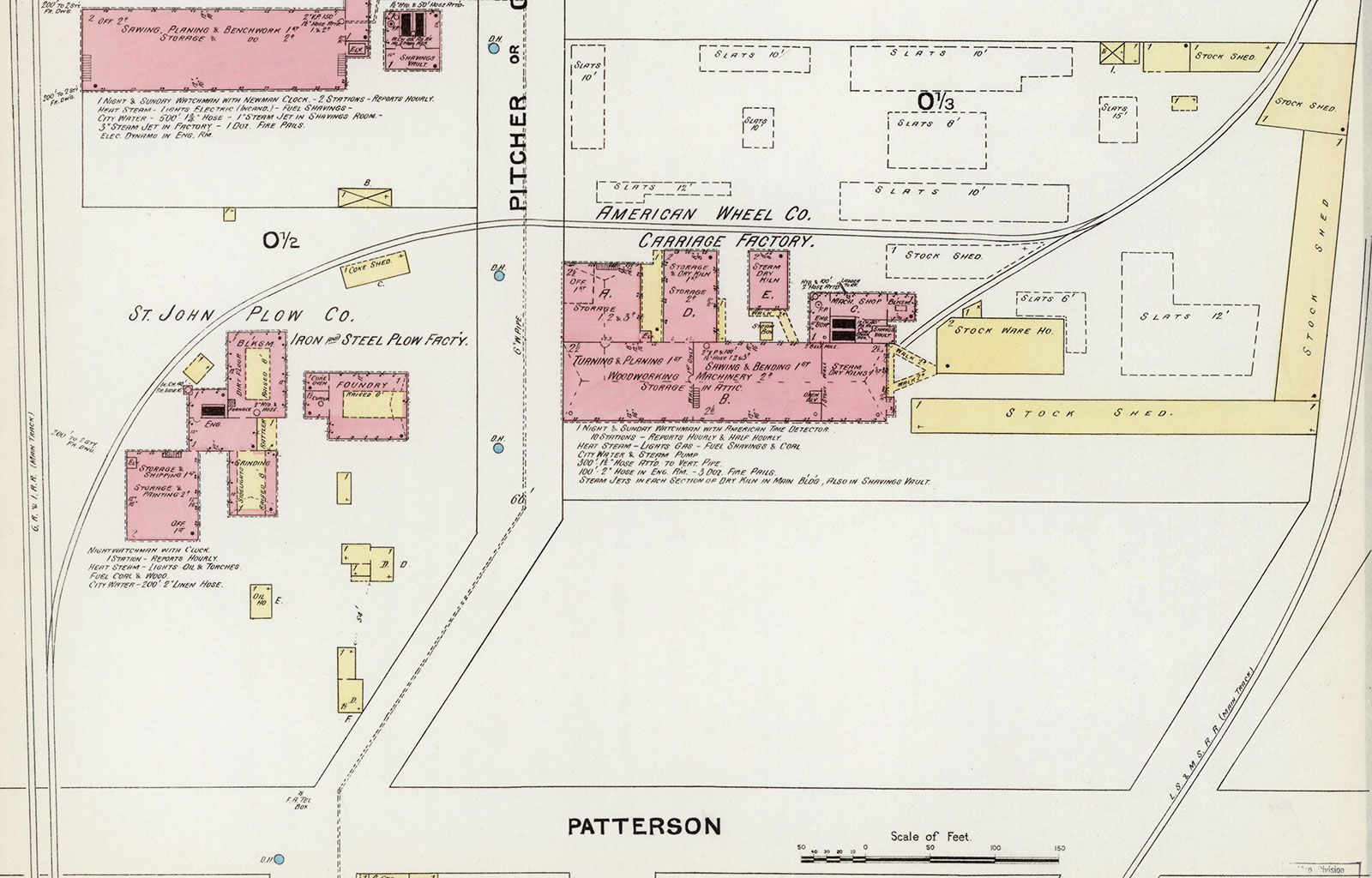 American Wheel Company, c.1887. Sanborn Map Co. 1887. Library of Congress
The local factory was still producing 100,000 sets of wheels annually when it was shut down in August 1891, a move that was said to be due to a temporary slump in sales. But in fact, American Wheel was in financial trouble. With its business spread across seven states, factories in Indiana, Ohio, and Michigan had failed by then and the company had run out of cash and was in receivership.
“No one will regret to hear of the failure of the American Wheel company. Less than a year ago the members formed a trust and advanced the price of wheels to all manufacturers of wagons and carriages in this country, taking a ‘snap judgement’ on them by failing to give them warning in time to place any orders at old prices. This trust overreached itself and has now gone into the hands of a receiver. — South Bend Tribune.
—Kalamazoo Gazette, 27 August 1891
 Standard Wheel Company (south and west sides), c.1894. Art Work of City of Kalamazoo, 1894. Kalamazoo Public Library
Standard Wheel Company
During the summer of 1892, the assets of the American Wheel company were sold and ownership of the plant in Kalamazoo was transferred to the Standard Wheel Company of Terre Haute, Indiana. New management was brought in, and the locals were assured that the Kalamazoo plant would not only be “kept busy,” but would continue to be “the largest and best wheel plant in the world” (Gazette). Production resumed in December 1892 as 225 hands returned to work.
 Standard Wheel Company employees on the north side loading dock, c.1898. Kalamazoo Public Library photo file P-1844
The Kalamazoo plant continued to operate off and on for several years until work ceased in August 1901. Workers were assured that the stoppage was temporary, but weeks turned into months and there was still no sign of work. By fall, the plant had been closed for so long that most of the workers had sought employment elsewhere. In November, Standard Wheel finally gave official notice that the local plant would not be reopened and that the Michigan Buggy Company would be taking over the facility for use as a woodshop.
“The fact seems to be that the trust, which a few years ago virtually controlled the wheel industry in the country, has been gradually crowded out of business by independent concern in various parts of the country, and especially in Michigan.”
—Kalamazoo Gazette-News, 10 November 1901
By 1907, the Standard Wheel Company’s factory building on North Pitcher Street was being used by the Standard Paper Company. Streets known as Trowbridge, Elnora, Irene, Josephine, Lucille, and Jerome that once criss-crossed the nearby neighborhood are no more. Today, the expansive facilities of Graphic Packaging International now occupy the land where the industry-leading “wheel works” was located.
Written by Keith Howard, Kalamazoo Public Library staff, February 2025
Sources
Articles
“Wants to locate in Kalamazoo”
Kalamazoo Gazette, 2 October 1887, page 7, column 2
“Ten dollars a head”
Kalamazoo Gazette, 26 October 1887, page 4, column 2
“Raising the bonus”
Kalamazoo Gazette, 29 October 1887, page 4, column 2
“The wheel company”
Kalamazoo Gazette, 16 December 1887, page 4, column 3
“The new wheel factory”
Kalamazoo Daily Telegraph, 6 February 1888, page 7, column 1
“Go down in your pockets”
Kalamazoo Gazette, 9 March 1888, page 1, column 5
“The Woolsey Wheel Company”
Kalamazoo Daily Telegraph, 23 March 1888, page 7, column 3
“Building the wheel works”
Kalamazoo Daily Telegraph, 22 May 1888, page 7, column 2
“Three large buildings”
Kalamazoo Daily Telegraph, 19 July 1888, page 7, column 2
“The Woolsey Wheel Company will go to Kalamazoo in September”
Kalamazoo Daily Telegraph, 23 July 1888, page 7, column 2
“Woolsey wheel works”
Kalamazoo Daily Telegraph, 29 September 1888, page 7, column 2
“Kalamazoo Wheel Company”
Kalamazoo Daily Telegraph, 20 October 1888, page 7, column 2
“Kalamazoo Wheel Company”
Kalamazoo Daily Telegraph, 27 October 1888, page 6, column 3
“Tighten up your belts”
Kalamazoo Daily Telegraph, 5 June 1889, page 7, column 2
“Will stay here”
Kalamazoo Gazette, 17 August 1889, page 2, column 3
“Spoke and hub”
Kalamazoo Daily Telegraph, 26 October 1889, page 6, column 2
“Downed the trust”
Kalamazoo Daily Telegraph, 31 October 1889, page 7, column 4
“The wheel ‘trust’”
Kalamazoo Daily Telegraph, 20 December 1889, page 2, column 1
“The wheel ‘trust’”
Kalamazoo Daily Telegraph, 26 December 1889, page 2, column 3
“North side notes”
Kalamazoo Daily Telegraph, 14 July 1890, page 7, column 2
“An important change”
Kalamazoo Daily Telegraph, 20 September 1890, page 7, column 3
“The American Wheel Co”
Kalamazoo Gazette, 21 September 1890, page 1, column 6
“Wheels go up”
Kalamazoo Daily Telegraph, 4 December 1890, page 7, column 4
“Corner on wheels”
Kalamazoo Gazette, 5 December 1890, page 1, column 4
“Hardly satisfactory”
Kalamazoo Daily Telegraph, 5 December 1890, page 7, column 2
“A perfect bee hive”
Kalamazoo Gazette, 21 January 1891, page 1, column 4
“More wheels for Kalamazoo”
Kalamazoo Gazette, 21 January 1891, page 7, column 3
“Increasing their business”
Kalamazoo Gazette, 8 February 1891, page 1, column 6
“Town topics”
Kalamazoo Daily Telegraph, 5 August 1891, page 7, column 2
“Are in need of cash”
Kalamazoo Daily Telegraph, 21 August 1891, page 3, column 3
“A temporary receiver”
Kalamazoo Gazette, 22 August 1891, page 1, column 2
“Forced to the wall”
Kalamazoo Gazette, 22 August 1891, page 8, column 1
“It is only temporary”
Kalamazoo Daily Telegraph, 22 August 1891, page 2, column 2
“The wheel trust”
Kalamazoo Daily Telegraph, 26 August 1891, page 4, column 1
“Local Gleanings”
Kalamazoo Gazette, 27 August 1891, page 5, column 1
“Creditors will meet”
Kalamazoo Daily Telegraph, 16 January 1892, page 8, column 3
“Creditors will accept”
Kalamazoo Daily Telegraph, 21 January 1892, page 8, column 4
“Sale of American Wheel Company plants and materials”
Kalamazoo Gazette, 10 July 1892, page 4, column 3
“American Wheel works”
Kalamazoo Gazette, 21 July 1892, page 1, column 3
“New bosses”
Kalamazoo Gazette, 7 August 1892, page 1, column 5
“Jottings”
Kalamazoo Gazette, 24 August 1892, page 5, column 1
“The Standard Wheel Co.”
Kalamazoo Gazette, 30 August 1892, page 5, column 2
“Turning again”
Kalamazoo Gazette, 8 November 1896, page 1, column 4
“Wheel works should stay”
Kalamazoo Gazette-News, 19 August 1900, page 4, column 4
“With 250 hands”
Kalamazoo Gazette-News, 11 December 1900, page 4, column 4
“Will remain in Kalamazoo”
Kalamazoo Gazette-News, 8 October 1901, page 4, column 7
“By Michigan Buggy Company”
Kalamazoo Gazette-News, 8 November 1901, page 5, column 2
“Has crowded out the trust”
Kalamazoo Gazette-News, 10 November 1901, page 4, column 3
“On the east side”
Kalamazoo Gazette-News, 15 November 1901, page 6, column 5
“First industry on North Side”
Kalamazoo Gazette, 27 November 1922, page 10, column 8
Local History Room Files
History Room Subject File: Wagons