Hosea B. Huston
County's First Merchant
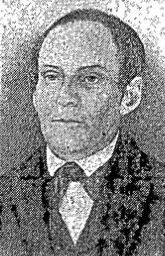 Hosea B. Huston, c. 1840
It could be argued that Kalamazoo’s earliest commercial activity began during the 1820s, when a fur trader named Rix Robinson built a trading post near the Kalamazoo River and today’s Riverside Cemetery. But for historians, Hosea B. Huston’s general store is considered the first permanent, pioneer storefront to do business in the county, first in Schoolcraft, and then in the nascent village of Bronson.
The enterprising Huston was born in 1807 and raised in Windsor County, Vermont before departing along with E. Lakin Brown and James Smith Jr. While walking the trail between Detroit and Bronson, Huston split rails to make ends meet. According to the recollections of his daughter Minnie, this kind of labor-intensive occupation drove her father toward enterprises that could afford him the opportunity to avoid such work. After a brief time in Schoolcraft, setting up his business, Huston and his partners (James and Thaddeus Smith) moved to Bronson and built a two-story wood frame building at the northeast corner of Main and Rose streets, selling clothing, drugs, groceries, and hardware. After a couple of years, the Smith brothers left the business, and E. Lakin Brown remained in Schoolcraft. The store was named the Wolverine Exchange, and it served not only the few white settlers, but also the Potawatomi, who negotiated trades for pelts, maple sugar and venison with Huston. The store’s success allowed Huston to branch out into other commercial activities, including real estate and the operation of a distillery located northeast of downtown, along the river, called Clipknockie.
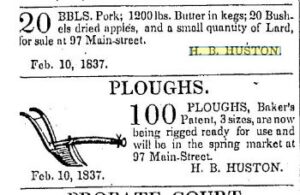 Advertisement, Kalamazoo Gazette, 4 March 1837
Mercantile interests were not the only activities Huston was engaged in. He was elected sheriff of the county, served as county treasurer, and later became the first village president of Kalamazoo in 1843. Huston’s important role in political affairs was illustrated by the pioneer artist Anthony Cooley, when he made a rendering of the first court case in the county, the depiction including Huston situated to the right of the judge’s bench. He was also a supporter of Henry Clay, who ran for president in 1844 as a candidate from the Whig Party.
The Huston family lived in a home near Main and S. Pitcher streets. He was married in 1835 to Mary Ann Parker, and together they had three children (Charles, Minnie and Ellen). In an article published in 1925, Huston’s daughter Minnie fondly recalled the early days of life in the young settlement.
“Almost from the first my father prospered. His store was an emporium of trade for a wide territory. The house was painted white, with green blinds and had a great rambling kitchen, with a huge fireplace in the living room. Indians used to come and lie down in front of the fire.”
“My mother lived as a gentlewoman, having all the servants needed to maintain our house in first class condition. Father was generous with her and us, aiming to keep us all in the best of circumstances.”
Huston died in 1849 at the age of 42, and was buried in Mountain Home Cemetery. Because of his early death, Minnie and her mother experienced financial hardship as a result of being taken advantage of by land purchasers who pressured her mother to sell property for far less than it was worth.
Written by Ryan Gage, Kalamazoo Public Library staff, October 2024