George W. Winslow
Kalamazoo's marble dealer
George Washington Winslow’s contribution to the early business landscape in Kalamazoo centered around the marble trade, a commercial interest with few competitors in west Michigan. Like many pioneers, Winslow came to Kalamazoo from the east.
“He chose the occupation of perpetuating the memories of the dead instead of trying to cure the ills, alleviate the sufferings, and lengthening the lives of the living, in the practice of the healing art as he first contemplated.”
Kalamazoo Telegraph, 24 December 1878
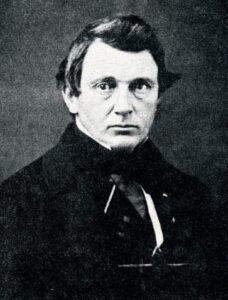 George W. Winslow, c. 1850
Born in Colrain, Massachusetts in 1809, the young Winslow initially gravitated toward the practice of medicine, studying under a Dr. Starkweather before switching to an interest in the marble business. Upon arriving in Kalamazoo around 1834, Winslow soon suffered financial setbacks, brought about by a loss of goods to a lake storm, as well as the economic downturn of 1836-37. A letter sent to his father, written in December of 1835, tells of his having gone into the goods business with Caleb Sherman. It isn’t clear from Winslow’s letter as to the nature of the mercantile enterprise between Winslow and Sherman, though Sherman does appear to have been associated with marble cutting years later. The two business partners rented store space for $100/year.
Winslow’s tone throughout the letter was optimistic, suggesting that his new home was a kind of “Eden.”
“There is a good society of young persons here of the Male kind but the other sex is scarcely seen,–they not being as well calculated to migrate about as males. Money is more plenty here than any place I have been in. All kinds of produce is up to the top notch, pork is work $8 per 100. Butter sells at 37 1/2 a pound. We have sold at that for a long time. I shall go to Buffalo and perhaps to New York City next Spring after goods, if alive and well.”
“Such a lovely place as this is not every day to be found,–it is destined to be a rich country and it certainly is beautiful–the land is not surpassed in fertility by any of the Deerfield Meadows–the deer are plenty and now and then a catamount. Wolves howl every night, hogs run wild, and corn grows without being hoed at all–in fact this is the Garden of Eden in all respects save the fruit, of course none of that. We have cranberries for everything, nothing else of a fruit kind to be had.”
Kalamazoo Telegraph, 24 December 1878
The goods to which Winslow planned to sell in Kalamazoo were purchased in Buffalo, and were being shipped to the mouth of the St. Joseph’s River, before being transported down the Kalamazoo River. It is possible, that the loss of goods occurred after Winslow wrote the letter to his family, as he does not mention it. The result of his financial losses from lost goods and failed dealings resulted in a debt of $3000. In 1838, the partnership between Sherman and Winslow was formally dissolved by public notice.
Kalamazoo’s Marble Dealer
After diligently paying off his debts over the next decade, and reengaging with the marble trade (est. 1849), Winslow traveled west to partake in the California Gold Rush in 1850 with the goal of growing his wealth. He returned from California having been successful, and focused the last two decades of his life on advancing his marble business along with his sons, George C. and Edward L. It is no coincidence that after the 1840s, Winslow once again turned to marble. The emergence of the Michigan Central Railroad in 1846, and the possibilities for importing and exporting goods to and from Kalamazoo was a momentous development in Kalamazoo’s overall commercial development.
The first location of Winslow’s marble factory was somewhere on North Rose Street. From the late 1840s until its closing as a burial ground in 1862, the West Street Cemetery (aka Pioneer Cemetery) was home to much of Winslow’s craftsmanship. The establishment of both Mountain Home and Riverside cemeteries provided Winslow with a growing market. It appears that the marble business was relatively small in Kalamazoo, with only Winslow’s business and one or two other marble engravers listed in the business directories for the 1860s and 1870s. The second factory location was just south of the corner of E. Main and Portage Street. Before passing away, Winslow had transferred the operation of the business to his sons. Needing even more room to address business growth by the 1880s, a third location was erected along the 500 block of E. Main Street, just east of Porter Street. By this point, the name of the business had changed to Winslow & Crooks. This third location was conveniently located in close proximity to the Lake Shore & Michigan Southern tracks, and included enough room to house a showroom, company offices, a machine shop, and a stock room.
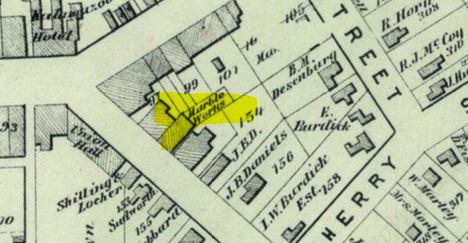 Winslow’s second steam marble factory on Portage Street, 1873
In addition to work on burial headstones, home fixtures and architectural projects, Winslow & Son won the bid to erect the monument memorializing Benjamin F. Orcutt in 1872. In 1893, the first Kalamazoo Public Library building was being built. Winslow & Crook were brought into the construction project to install a blue stone carriage block, gifted to the library by the owner of the New York quarry.
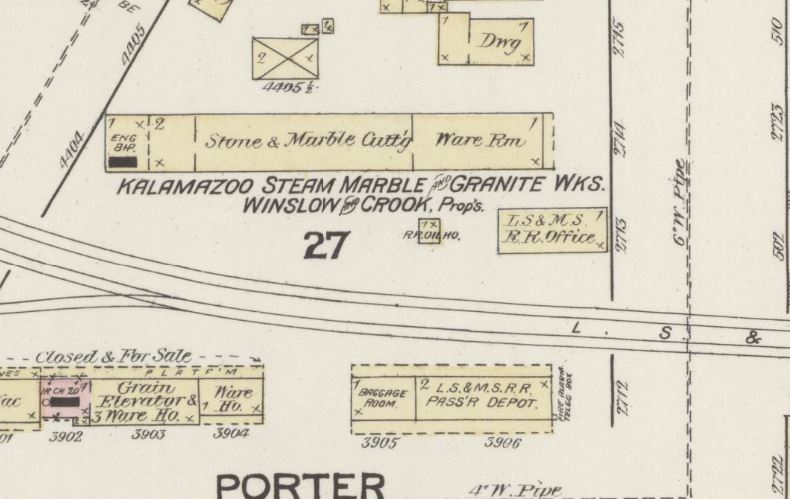 Winslow & Crook factory (503 E. Main). 1887 Sanborn Fire Insurance Map. Library of Congress Collection
Personally, Winslow married twice, first to Mary Gray Winslow (1814-1839), and then to Lovinia Smith Winslow (1816-1898). In addition to George and Edward, Winslow’s other children included Isabel, Harriet, and Mary. Winslow died in December of 1878 after suffering from heart disease and an amputated leg. Winslow was a well-known practitioner of Spiritualism, a religious movement popular in southwest Michigan during the second half of the 19th century. Winslow is buried in Mountain Home Cemetery.
Written by Ryan Gage, Kalamazoo Public Library staff, December 2024. Last updated 29 January 2025.