Chicago, Kalamazoo, & Saginaw Railroad
The “Cuss, Kick & Swear” Line
At the beginning of the nineteenth century’s seventh decade Kalamazoo could lay claim to being a railroad hub of sorts.
The Michigan Central bisected the community on an east/west line, the Lake Shore & Michigan Southern and the Grand Rapids & Indiana provided two busy north/south routes and a Michigan Central branch, the old Kalamazoo & South Haven, chugged off to the west and a rendezvous with Lake Michigan.
But Kalamazoo was not finished building railroads yet. She still needed a railroad to call her own. All the other lines spawned by local interests had been gobbled up by larger companies backed by investors from other cities and states.
Kalamazoo, Lowell & Northern
Kalamazoo’s own railroad began in November of 1871 as the dream of a narrow gage (three feet between the rails rather than today’s standard four feet, eight and one half inches) railroad running from Kalamazoo into the north woods.
The dream was called the Kalamazoo, Lowell & Northern and was touted as a route running north from Kalamazoo to Greenville in Montcalm County and thence into the pineries. The promoters had their eyes on the north’s rich limber harvest.
Breathing life into the scheme were three men from Kalamazoo and Hastings. Involved in the venture were Thomas S. Cobb of Kalamazoo, the owner of a paint, glass and crockery store; Andrew J. Bowne of Hastings, a banker, and George F. Kidder of Kalamazoo, a clothing store owner. Cobb was president of the firm, Bowne was vice president and Kidder served a secretary/treasurer.
Grading started furiously and soon more than 39 miles of rough roadbed stretched between Kalamazoo and Hastings. Then, in 1873, came that bugaboo of all railroad projects, a financial panic.
The firm went under and not a rail was laid on the new grade of the Kalamazoo, Lowell, & Northern.
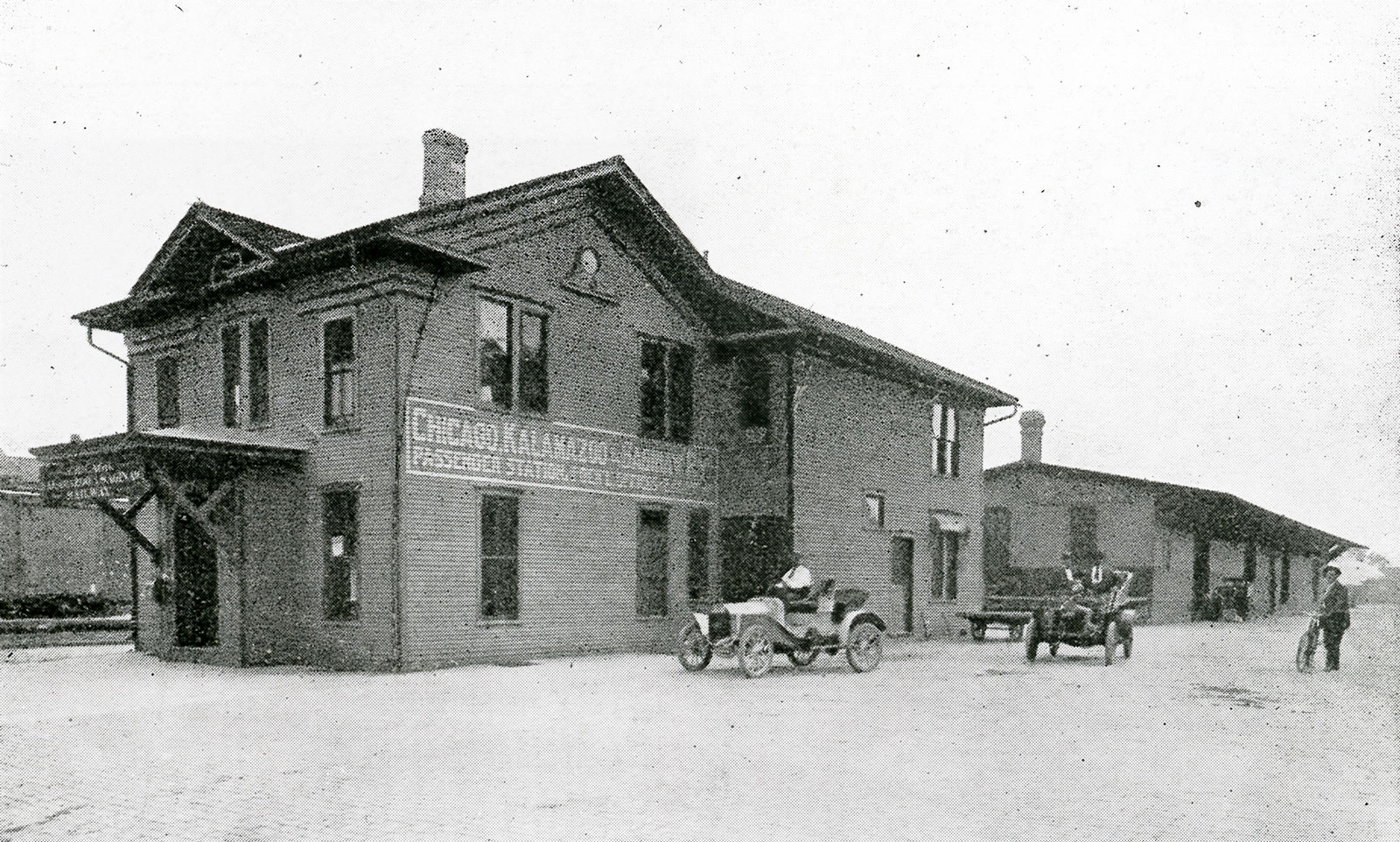 CK&S depot, south side of East Main Street at Kalamazoo Avenue. From Picturesque Kalamazoo, 1909. Kalamazoo Public Library
“Cuss, Kick & Swear”
The idea did not die. By 1883 the firm had been recognized as the Chicago, Kalamazoo, & Saginaw Railroad Company. Affectionately it was known as the “Cuss, Kick & Swear,” a play on the first letters of the railroad’s name. Cobb stayed on as president and the board of directors included men from Kalamazoo, Hastings and Grand Rapids.
By 1886 the directors were meeting regularly to discuss Frank Balch’s survey for a route. The idea of a narrow gauge railroad was dropped along with a route leading into the north woods. Instead, company officials set their sights on a line running from Kalamazoo through Hastings to a tie-up with the Detroit, Lansing & Northern Railroad at Woodbury, north and east of Hastings. Later this railroad was known as the Flint & Pere Marquette.
Leading subscribers to the CK&S included Andrew J. Bowne, Amasa B. Watson, and William S. Dewing. Other investors included Charles S. Burton, Leroy Cahill, William L. Eaton, G. Edwin Dunbar, Edward Woodbury, Frank Henderson, Oscar M. Allen, Thomas S. Cobb, Peyton Ranney and Henry F. Badger.
The men pledged $131,700 during 1886-87. By that time work was already under way on the CK&S. The Kalamazoo & Hastings Construction Company received the contract in October, 1886, and began pushing rails out of Kalamazoo.
Hastings’ financiers added more money to the project as the rails crept closer to their town. By July, 1887, The Gazette was able to print a story about a special train trip over the 11 miles of track that had been completed. The CK&S’ first passenger train contained dignitaries and a Gazette reporter who tagged along for the ride. He wrote this account:
“To the astonishment of all, the engine and caboose started out at a 25 mile an hour gait and kicked up a dust that would do credit to a road that had been longer in business… The first stop was made at the gravel pit about four and a half miles out where a large gang of men were at work digging away a bean patch and loading flatcars for ballast.
“In a few minutes the train had crossed the Cincinnati, Jackson & Mackinaw Railroad [Richland Junction on today’s maps] some eight miles out. It was thought best not to stop there until the return trip and the engine sped away to the terminus about 11 miles out just on the edge of Barry County.
“The party arrived [back] in Kalamazoo about 5:30 [p.m.] and all declared they had inhaled enough dust to make the original Adam, but were pleased with the trip.”
—Kalamazoo Gazette, 24 July 1887
The road inched toward Hastings and 19 of the 31 miles between Kalamazoo and the Barry County seat were finished by September, 1887. The company told residents along completed portions of the line that it could not be bothered with freight hauling duties; but some freight, including produce and other farm products, was shipped.
By October, 1887, the rails were within five miles of Hastings and by December, CK&S passenger trains were on a regular schedule into the Barry County town.
 Postcard view of the Chicago, Kalamazoo, & Saginaw train at the depot in Hastings, c.1910.
The fledgling railroad, eying the important connection with the Pere Marquette at Woodbury, now had to look a stumbling block square in the face. Michigan Central tracks ran though Hastings and the line had to be crossed before the CK&S could get on with the business of getting to its northern terminal.
The railroad law in those days was that once you built a crossing through the lines of another firm, you could keep the right of way. So, the Michigan Central kept an engine with a couple of cars working back and forth across the intended crossing spot. The train kept the CK&S crews from installing the crossing.
One Sunday, after the MCRR engine had moved to let another train through, CK&S crews jumped into action and in minutes installed the diamond crossing to let the CK&S roll on.
Golden spike day for the CK&S was September 1, 1889. The line was complete from Kalamazoo to Woodbury!
Manning the helm as superintendent of the road was Lewis Sergeant. He did not know at the time he was to be the only superintendent the CK&S would have. Sergeant served the railroad until he was 80 years old.
 Location of first CK&S depot on Walbridge Street. Sanborn Map Company, 1896. Kalamazoo Public Library / Library of Congress
The firm’s first depot was on Walbridge Street north of Kalamazoo Avenue. The old stone foundations were recently destroyed. In 1899 the company built a new depot where Michigan and Kalamazoo Avenues intersect. The structure, with freight house still intact at the rear, now houses the E.M. Sergeant Company.
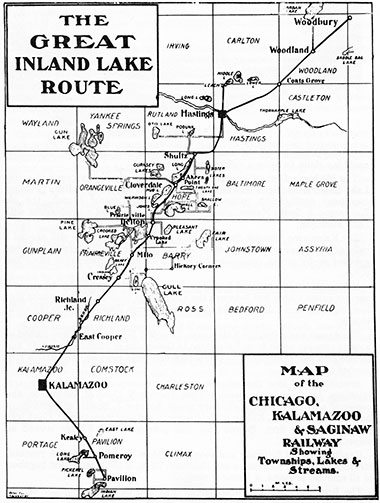
With Sergeant at the reins, the CK&S settled down to business. Passenger and freight service was on the daily timecard. A typical schedule of the era lists CK&S stops from Kalamazoo northward at East Cooper, Richland Junction, Cressey, Milo, Crooked Lake, Delton, Cloverdale, Ackers Point, Schultz, Hastings, Coats Grove, Woodland and Woodbury.
 Postcard view of the Chicago, Kalamazoo, & Saginaw train at the depot in Woodland, c.1910.
In the early years of service two passenger trains ran each day from Kalamazoo to Woodbury and back. The first trains left Kalamazoo at 6:10 a.m. and arrived in Woodbury at 8:35 that morning. The engine was turned on a hand-operated turntable and, after waiting for connection with a Pere Marquette train, the CK&S crew made the return trip to Kalamazoo. At 2:40 p.m. a second train left Kalamazoo to make the same round trip.
Running between the passenger trains was a local wayfreight [a freight train that travels the mainline, dropping freight cars at various sidings] which did all the switching and sidings along the mainline. The freight left Kalamazoo about 9 or 10 a.m., depending on how long it took the crew to make up the train, and returned in the evening.
A ride on the CK&S was a real bargain. A ticket that would take you from Kalamazoo to Woodbury cost 93 cents.
Sometime in the early 1890s the CK&S took a fling at the coal business. Because the railroad received freight charges for delivering the coal to town, the CK&S could undersell other coal dealers. While local dealers charged $6.50 a ton for hard coal in 1891, the CK&S advertised a price of $5.60. The dealers’ soft coal rates were $3.25 a ton. The railroad cut that to $2.75.
Feeling its economic strength, the CK&S tried to use the competitive prices as a threat to line up all Kalamazoo dealers so they would buy their supply from the railroad. The plan did not materialize.
The railroad continued in the coal business until 1915, when the Michigan Central finally purchased the CK&S. Superintendent Sergeant was forced to choose between the coal business and the railroad. Sergeant stayed in the railroad’s office. The coal firm was turned over to his son, Ed Sergeant. The switch marked the beginning of the E.M Sergeant Company.
 Second CK&S passenger depot and freight house. Sanborn Map Company, 1908. Kalamazoo Public Library / Library of Congress
In December, 1901, the CK&S opened passenger and freight service on a new line running south from Kalamazoo to Pavilion and a hookup with the Grand Trunk Western. The opening of the Pavilion line made the CK&S a full service railroad with a mainline linking Kalamazoo with the Pere Marquette on the north and the Grand Trunk on the south.
Speedy service was the watchword as CK&S engines brought cars from the two major lines into Kalamazoo. The little railroad’s management boasted that boxcars leaving Chicago would be stitched onto Kalamazoo area sidings the next day. Sometimes the little line would handle 70 freight cars a day in this type of service.
Besides the Grand Trunk Western and the Pere Marquette connections, the CK&S tied into the Detroit, Toledo & Milwaukee at Richland Junction and the Michigan Central at Kalamazoo and Hastings.
The 1901 addition of the Pavilion line gave the CK&S 56 miles of mainline iron plus about four and one half miles of spurs to Kalamazoo area industries. In 1901 a six stall roundhouse and a 60 by 80 foot shop building were built behind the depot. The building still stands.
The little line had plenty of business. In 1909, for example, the CK&S carried 109,432 passengers, 160,550 tons of freight (about 35 percent of this was coal) and had a net income of more than $50,000. The Gazette reported 52 employees on the payroll.
Two things made the CK&S unique among other short line railroads running in Michigan. The railroad was one of the few locally-owned lines in the country. It was also debt free.
Another thing that made Kalamazoo’s home-grown railroad stand out was that, until 1907, it was run by telephone instead of by telegraph. The company’s private phone line connected the superintendent’s house and every station on the line. Each station had its own distinctive ring such as one short, one long or two shorts or any other combination. The wall-mounted phones were operated by had crank. The system lasted until federal railway communications laws required the installation of a standard train communication system.
“The Great Inland Lake Route”
Because it ran through resort and lake county between Kalamazoo and Hastings, the CK&S did a good vacation trade and excursion business. One of the most popular trains was the Sunday Fisherman’s Special, which began in 1908.
 Kalamazoo Public Library
The train left the CK&S depot at seven in the morning and dropped fishermen at lakes and streams along the way. Stops were added at Wall Lake and Wilkinson Lake to accommodate the anglers. The special traveled south in the evening, picking up tired sportsmen and picnickers and depositing them at the Kalamazoo depot about ten o’clock at night.
To drum up some excursion business, the railroad published a Hunter’s and Fisherman’s Guide. The CK&S also came up to the motto: “The Great Inland Lake Route.”
The advertising writer’s work left no doubt in the reader’s mind that paradise could be found along the CK&S:
“That day” the railroad guidebook read, “is invariably rewarded with a good string of fish and after the tramp back to camp, the tired and hungry, but happy fisherman partakes of his supper, enjoyed as only a hungry person can enjoy a meal at the lake, settles back in contentment, and rejoices that the world is so beautiful and that he has so wisely chosen the CK&S route for his summer outing.”
The booklet, which did not mention mosquitoes, must have had a profound effect on those who carved a little relaxation and respite from the crowded streets of Chicago and Detroit.
A surge in the passenger business came each year when the Hastings fair was held. Passengers crowding the trains swore that the engineer reduced the speed to give the conductor a chance to collect all the fares before the train pulled into the Barry County seat.
In 1915 Michigan’s railroads hit the peak of passenger business. A total of 46 railroads operated an astounding 454 trains. Kalamazoo was served by 38 passenger trains a day – hard to believe in this day of rusting railroads.
 Postcard image of a CK&S locomotive on the turntable at Woodbury, c.1912. Public domain photo
“It Served Well”
The Chicago, Kalamazoo & Saginaw continued to roll, but the line was not independently owned any more. By 1915 the Michigan Central had acquired much of the CK&S stock and the line was finally absorbed by the giant system.
The Grand Trunk Western leased the CK&S Pavilion line and gained a rail route into the city which is still used today.
The drop in passenger patronage which was fatal to the interurban also hit the CK&S. By the late 1920s and early 1930s passengers on the Kalamazoo-Woodbury run were served by a mixed train – a passenger car hooked to the end of a freight train.
By 1934 the CK&S had retreated to Tuesday, Thursday and Saturday passenger service. After a short time this, too, was dropped. The last CK&S passenger runs were in 1934 when a special excursion train ran to Woodbury and back to pick up passengers bound for the Century of Progress Exposition in Chicago.
The CK&S cars were cut into a Michigan Central passenger train at Kalamazoo and pulled to Chicago. The cars returned the next day and CK&S crewmen hauled the passengers back over the line.
Then time was done with CK&S passenger service.
Freight revenues were down, too, and the handwriting was on the wall for the little railroad. By July, 1937, rip crews were pulling rails between Hastings and Woodbury. Later, the crews worked their way south through Delton to Richland Junction, leaving destruction in their wake.
The obituary of the CK&S can be written in one line: “It served well.”
CK&S Superintendent Lewis Sergeant, named to the post in 1887 at the completion of the line, stayed at his desk until he retired at 80 years of age in 1925 – the oldest active railway employee in the country.
From Next Stop Kalamazoo! A History of Railroading in Kalamazoo County
Written by David C. Hager. Published by the Kalamazoo Public Museum, 1976
Edited for context by Kalamazoo Public Library staff, February 2025