Lake Shore & Michigan Southern
Kalamazoo's Second Railroad
The coming of the railroad spawned another form of transportation for Kalamazoo. In 1850 a plank road – three-inch-thick boards nailed to stringers eight feet apart – was built from Kalamazoo to Grand Rapids. The wooden highway funneled freight into Kalamazoo and made money for its builders through tolls paid by the haulers.
Kalamazoo’s place on the commercial map was assured. Located in the middle of an iron road connecting two of the nation’s great cities, Kalamazoo would soon sprout railroads of its own, and as far as being a railroad hub, would resemble a miniature Chicago.
After the Michigan Central, the city’s second railroad was a feeder line for the Southern – now called the Lake Shore & Michigan Southern (LS&MS). The railroad advanced on the city by leaps and bounds and is a good example of how bigger railroads gobbled up smaller ones.
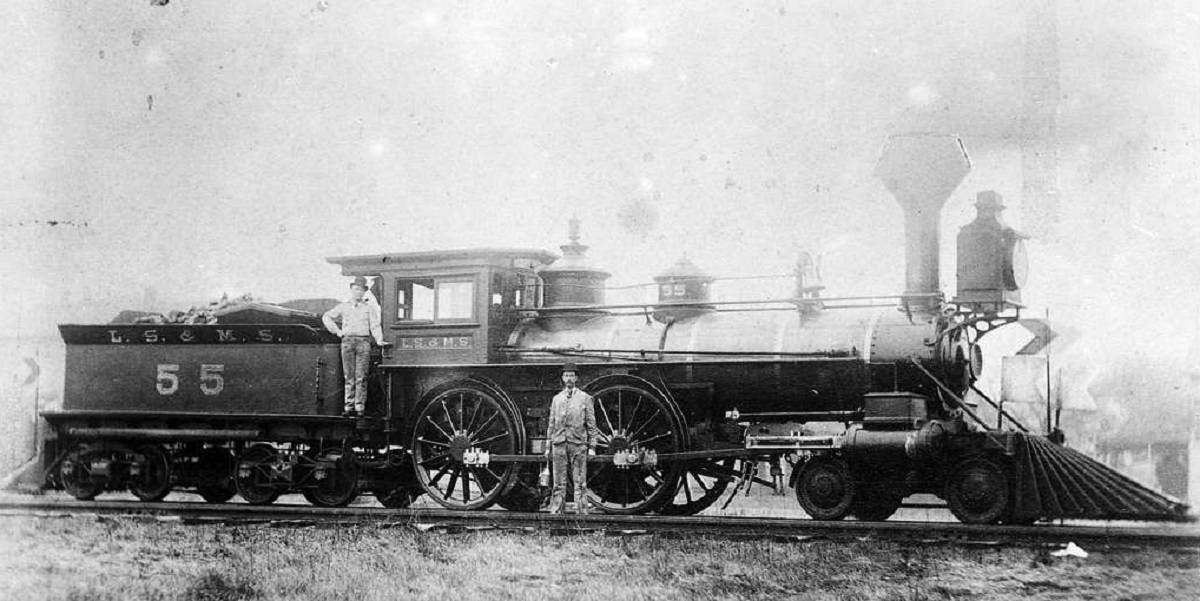 Lake Shore & Michigan Southern Railroad engine No. 55. Public domain photo
St. Joseph Valley Railroad Co.
What was to become Kalamazoo’s second railroad began shortly after the Civil War, when the Lake Shore & Michigan Southern began an active search for feeder lines. By 1864, the LS&MS had leased a line heading north from its main iron at White Pigeon. The spur ran four miles into Constantine.
In 1855 the St. Joseph Valley Railroad Company built a railroad from Constantine to Three Rivers with the hope of someday connecting the LS&MS with lines running from St. Joseph. The project folded in the 1857 financial panic.
Kalamazoo & White Pigeon Railroad Co.
Another firm built a line in 1865 from Three Rivers to Schoolcraft and in 1867 the Kalamazoo & Schoolcraft Railroad Company extended the rails to Kalamazoo.
Later, two separate companies laid tracks from Kalamazoo through Allegan to Grand Rapids.
 Lake Shore & Michigan Southern Railway map, June 1876. Rutherford B. Hayes Presidential Library
Now that the hard work was done, here came the LS&MS. The big line gained control of the stock of the lines from White Pigeon to Kalamazoo and, in 1869, leased the Kalamazoo–Grand Rapids segment for 999 years.
The LS&MS – Kalamazoo residents called it the Lakeshore – built a depot on the northeast corner of Porter and East Main (now East Michigan) Streets. A freight house stood to the south.
Kalamazoo now boasted two railroads. The city stood at the important crossing point of lines connecting Detroit and Chicago and a feeder running from Grand Rapids, the second largest city in the state.
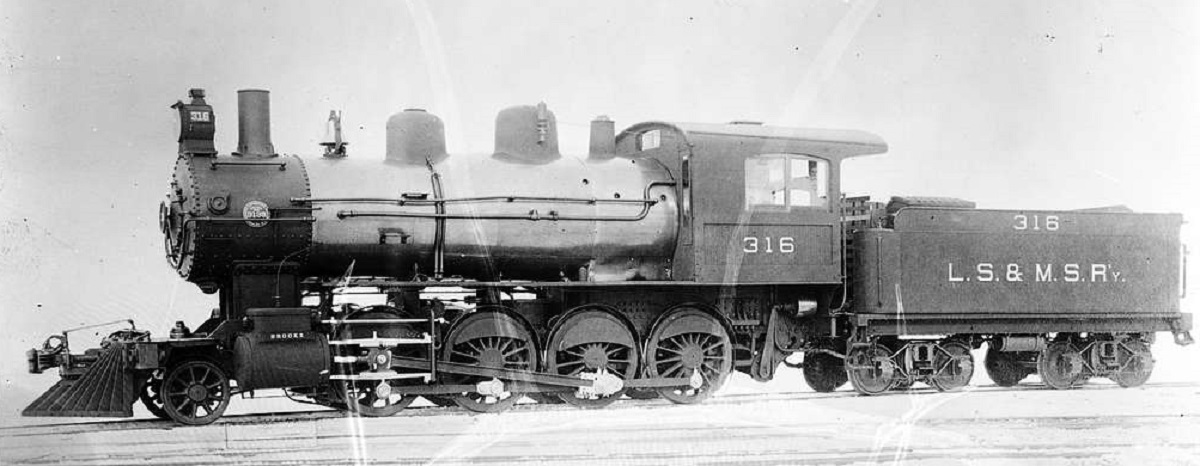 Lake Shore & Michigan Southern Railroad engine No. 316. Public domain photo
From Next Stop Kalamazoo! A History of Railroading in Kalamazoo County
Written by David C. Hager. Published by the Kalamazoo Public Museum, 1976
Edited for context by Kalamazoo Public Library staff, February 2025
Sources
Books
Next stop Kalamazoo! a history of railroading in Kalamazoo County
David C Hager, Kalamazoo Public Museum, [1976]
H 385 H144 (CEN)
385 H144 (CEN)