Samuel K. Selkrig
Kalamazoo's First Studio Photographer
The Early Daguerrean Years
While it is reasonable to speculate that prior to the summer of 1848, traveling daguerreotypists had passed through Kalamazoo County seeking out willing sitters, it appears that the village had failed to attract a permanent photographer willing to set up a storefront focused upon the selling of duplicated images of customers. If you were a local resident reading the 30 June 1848 issue of the Kalamazoo Gazette, you more than likely read the following endorsement on page two:
“Daguerrean Miniatures.–We would recommend to those who wish to procure a finished and perfect likeness of themselves or friends, to call on Mr. Selkrig over the Book Store. We can speak with confidence of the excellence of his pictures, having examined many specimens, and knowing his apparatus to be of superior character. Mr. S. would be happy to have people call and examine his pictures, even if they should not wish to procure any.”
Kalamazoo Gazette, 30 June 1848
Just who was this Mr. Selkrig? Samuel Kelsey Selkrig (aka Selkrigg, Selkrik, Selkirk) was born in New York in 1820. His father James was a reverend who at some point relocated to Wayland, Michigan as a missionary. Little is known about the younger Selkrig’s migration westward to Kalamazoo, but according to census records and city directory listings, Samuel was a jeweler, watchmaker, book seller, and teacher–and an early adopter of the brand new technology, at that time, only a decade old.
Louis-Jacques-Mandé Daguerre invented the daguerreotype process in France. The invention was announced to the public on August 19, 1839 at a meeting of the French Academy of Sciences in Paris. American photographers quickly capitalized on this new invention, which was capable of capturing a “truthful likeness.” Daguerreotypists in major cities invited celebrities and political figures to their studios in the hopes of obtaining a likeness for display in their windows and reception areas. They encouraged the public to visit their galleries, which were like museums, in the hope that they would desire to be photographed as well. By 1850, there were over 70 daguerreotype studios in New York City alone.
—Library of Congress website
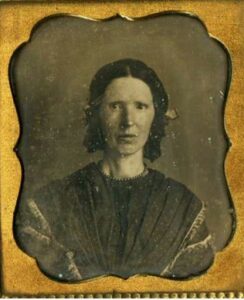 Example of a daguerreotype, c. 1850s. Kalamazoo Valley Museum Collection
We know that Selkrig’s father James was living in Michigan by 1840 because of the Richland post office notices listed in the Kalamazoo Gazette. Samuel first appears in the newspaper in 1846, in reference to an advertisement for the book store he was managing. His store’s stock included pens, stationary of all kinds, poetry, religious texts, signing books, and an assortment of school books. Several months after the first newspaper announcement that he would be adding studio portraits to his product line, Selkrig relocated his operations. Selkrig’s new studio was above the S.S. Cobb Store on East Main.
Selkrig’s advertising campaign included a rather manipulative approach which exploited customer fears about the brevity and precariousness of life.
“This establishment is now in successful operation, and the above signed would say to the old and the young–to fathers and mothers in particular, if they wish to preserve to their children the images of the generation now passing away, or to themselves, the likeness of their children who are so liable at any moment to be removed by death, that delays are dangerous! Beware of procrastination! How many say ‘if I had only a likeness of the dear departed, it would be an inestimatable prize’, and yet before another year rolls round, many that are now living, will be gone, and you can obtain a perfect likeness for a very few shillings.”
Given his other business pursuits (jewelry, clocks, watchmaking), it is reasonable to speculate that Selkrig may have only added the photography part of his overall commercial activities as a supplemental source of income. Author Richard W. Welch summarizes the two contrasting kinds of early daguerreotypists in his seminal book Sun Pictures in Kalamazoo: A History of Daguerreotype Photography in Kalamazoo County, Michigan 1839-1860.
“The first daguerreotypists were either self-taught or had learned the process from Francois Gouraud, a friend and pupil of Daguerre…most of the first daguerreotypists had other interests and, except for short intervals, were not interested in practicing photography as a profession. They did, however, teach the art to others.”
“The second group of daguerreotypists consisted of people who were interested in earning a livelihood from the art.”
Sun Pictures in Kalamazoo, p.3
A mere three years after the first announcement in the newspaper, a second one appeared in November of 1851, indicating that Selkrig had opted to sell his photography studio to a young photographer originally from New York named Schuyler Colfax Baldwin. Baldwin would go on to become one of the most important visual chroniclers of 19th century Kalamazoo life. It appears that Selkrig continued living and working in Kalamazoo until his death. Selkrig died age 76 in Charlotte, Michigan of apoplexy in 1896. He married twice (Frances Augusta Harrington and Nannie Webster), and had three children. He is buried in Mountain Home Cemetery.
Article written by Ryan Gage, Kalamazoo Public Library staff, January 2025