Kalamazoo Home for the Aged
1211 Douglas Avenue
Today we have elder care housing facilities for citizens who can no longer live alone or with the help of family members. Yet, such public welfare institutions have not always existed. “Poorhouses”, “Poorfarms” or Relief Houses” were the primary means by which communities often dealt with housing those who could not live independently until their deaths. By the early 1920’s, the notion of eldercare began to emerge amongst both religious communities and social welfare experts. Questions about what to do with older citizens who needed financial or housing resources grew as population dynamics changed over time.
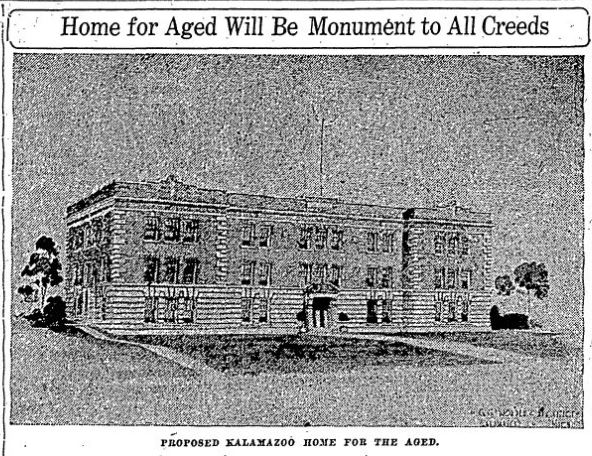 Kalamazoo Gazette, 29 April 1923, p.2
It was within this historical context, that in the fall of 1921, a group calling itself Kalamazoo Home for the Aged was organized for the purpose of developing a modern housing option for “indigent” and “dependent people of good character.” Ralph Kooi, a local clothing merchant, was selected as the chairman of the committee to secure funding and property for the building of the apartment complex. Kooi’s financial goal was to bring in $50,000 from the fundraising drive. He was assisted by Sam Mullie, Cornelius Luyendyke, Frank VerMuelen, and Peter Bosker. Another associated committee was appointed to draw up the new organization’s bylaws, with members including Rev. J.J. Hollebrand, Rev. William Van Vliet and Rev. J.B. Battema. The new association’s membership was comprised of the city’s Dutch-American community, and motivated by their religious faith and service to community. Locally, the Dutch-American community spearheaded an effort to address the housing and recreational needs of older residents, many of whom were members of the Reformed and Christian Reformed congregations.
At a meeting at the First Reformed Church, sixty men voted to purchase the property of the William E. Glover estate, a three and half acre parcel located along the west side of Douglas Avenue, in the 1200 block. Interestingly, Glover had been a successful brick dealer, whose brickyard contributed to approximately two-thirds of the brick structures erected around the village during the 19th century. The late Glover had also been the toll keeper at the nearby toll gate situated along the plank road to Grand Rapids (near Alamo Street and Douglas Ave.).
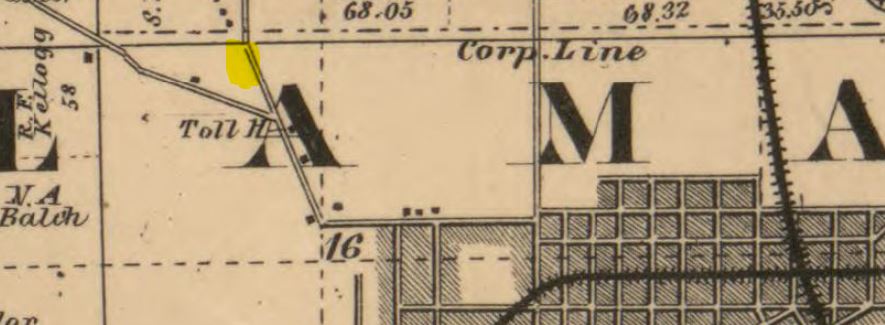 Future site of the Kalamazoo Home for the Aged along Douglas Avenue, 1861.
The organization’s goal was to house around 60-100 elderly residents. The building would be separated by gender, and managed by a “matron” responsible to trustees. The first to hold this position was Miss Rena Koster, who had experience as a nurse. Residents were required to be 65 years of age or older. Each resident would have their own bedroom and an adjoining living room. Efforts would be made if the residents were a married couple to accomodate their needs. Programs would be established to keep residents entertained, active and connected.
It wasn’t until April of 1923, when efforts to ramp up fundraising and support for the project were expressed at a banquet held at the Y.M.C.A., where leading Dutch-American residents spoke about the project’s importance. Attendees represented both Reformed and Christian Reformed congregations, including the president of the association, Judge John L. Hollander, and the chairmen of the capital campaign, Karl W. Lambooy, who replaced Kooi. Dr. Henry Beets of Grand Rapids spoke of the philosophical foundation for the mission to house those with limited means.
“1. Because you are Christian men
2. Because you are loyal sons of our Dutch forebearers, always famous for their philanthropic works
3. You owe to your city, and to make true its motto, “In Kalmazoo We Do”
4. It is good denominational cooperative work. Gives us a fine chance to show what we can do when united.
5. It supplies a real philanthropic need
6. Those who hunger for Christian life in their declining days, can have a home in which to enjoy such privileges
7. Because of the reward to come for good work done here”
-Kalamazoo Gazette, 21 April 1923
The campaign was unique according to a Gazette article that suggested that it was the first time in the city’s history that such an effort had been made to address shortcomings in care and housing for the aged, and at the same time, that it was primarily headed up by a large collection of influential Hollanders (as they were often referred to then) and their church congregations was notable. Judge Hollander announced that the association was non-denominational in how it was to be managed. Trustees were to be elected by the members, who were eligible because of their annual subscriptions. With the endorsements of Mayor Cornelius Verberg and the Chamber of Commerce (headed then by paper industry magnet, Jacob Kindleberger), the association was able to secure $65,000 to erect the apartment building through the donations of many within the Dutch-American community.
Gilbert G. Worden was appointed the architect of the three-story building, while A.J. DeKoning was chosen as the general contractor. The cornerstone was laid on 25 July 1923. The building was officially dedicated on May 27th of the following year. Late in 1924, the association thanked their donors which included the Star Service Club, Kalamazoo Public Schools, Daughers of Veterans, and the Ladies’ Aid Societies of the Third Christian Reformed, Second Reformed, First Reformed, and Park Reformed churches.
Originally funded primarily by local churches and Dutch-American led business owners, eventually increased costs forced the association to look more broadly within the community for funding, which they received through the Community Chest and annual drives. In 1960, the association would become incorporated within the Senior Citizens Fund, a county-wide organization established in 1948 and “designed to care for the recreational and financial needs of residents over sixty years of age.” By the late 1960s, the name of the apartment complex changed its name to the Douglas Residence. In 1974, the complex was removed from the SCF after years of difficulty with keeping the building up to code. Years of vacancy during the 1980s and 1990s ended when the building was once again opened to residents under the name of Douglas Apartments.
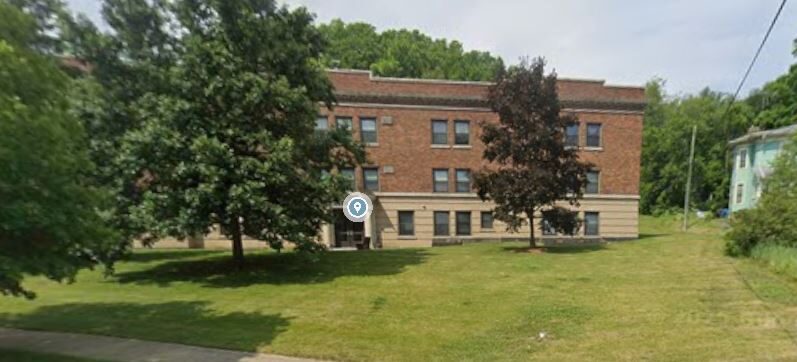 Apartment complex formerly known as the Kalamazoo Home for the Aged, 1211 Douglas Ave.
Article written by Ryan Gage, Kalamazoo Public Library staff, December 2025
Sources
Articles
“Launch drive in ten days for $50,00 home for the aged”
Kalamazoo Gazette, 11 October 1921
“Picks site for home for aged”
Kalamazoo Gazette, 25 October 1921
“Creeds join in drive for aged relief”
Kalamazoo Gazette, 21 April 1923
“Hollanders to feast Tuesday”
Kalamazoo Gazette, 11 June 1923
“Matron Koster assumes home for aged job”
Kalamazoo Gazette, 1 May 1924
“Holland home for aged wins praise”
Kalamazoo Gazette, 16 June 1929
“Plan to aid citizens 60 and over”
Kalamazoo Gazette, 19 September 1948