Kalamazoo County Poor Farm
Rest Home for the Elderly and Impoverished
“Poor House on Gull Prairie”
Prior to 1830, poor and destitute persons in Kalamazoo County could be housed individually with other community members or, in certain cases, kept in the county jail. In July 1830, an act was passed that made each county responsible for its poor with a board of directors (later commissioners) put into place to oversee their care. Kalamazoo County officials had the authority to purchase property and erect so-called “poor houses” by then, but instead chose to rent land and buildings for care of the poor.
This changed in March 1847, when Kalamazoo County purchased 111 acres in Richland Township. The $1,300 acquisition included 80 acres of prairie land “under good cultivation” in Section 25, plus 20 acres of fall wheat and eleven acres of timothy grass in Section 23, just east of Richland Village (then known as “Gull Corners”).
Alphadelphia Society
In 1848, the short-lived “Alphadelphia Association” socialist community disbanded, leaving behind its 188-acre farm along the north side of the Kalamazoo River on Section 23 in Comstock Township, a mile or so west of Galesburg. In February 1849, the county sold its property in Richland and purchased the former Alphadelphia property for use as its “county house and farm,” where the elderly and impoverished could then reside.
 Postcard view of the “Kalamazoo County House” c.1908. Western Michigan Archives & Regional History Collections
County House and Farm
According to the county’s 1851 year-end report, the mansion itself, built by Alphadelphia members in the fall of 1844, was a two-story, wood-framed structure, L-shaped, with an 80 by 23-foot main edifice and a 116 by 24-foot two-story wing over a stone cellar. The upper level was used for sleeping quarters, while the lower level was made up of individual apartments for the residents. Elsewhere on the property, two large barns provided shelter for livestock (cows, sheep, horses, and hogs), while a nearby shed held plows, shovels, harnesses, and other farm implements. A small cemetery was established along the back (southern) portion of the property near the river.
The report went on to say that the farm was “in as good order as most farms of the size in the county,” with 60 acres of wheat, 12 acres of corn, 16 acres of oats, 25 acres of grass, three acres of potatoes, and another 10 acres of winter wheat. An orchard along the southwest side of the property contained some 130 apple, peach, plum, and cherry trees, with plans to add another hundred or more. For the year 1851, the county reported a total of 136 residents, both year-round and seasonal, had received support at the County Poor House.
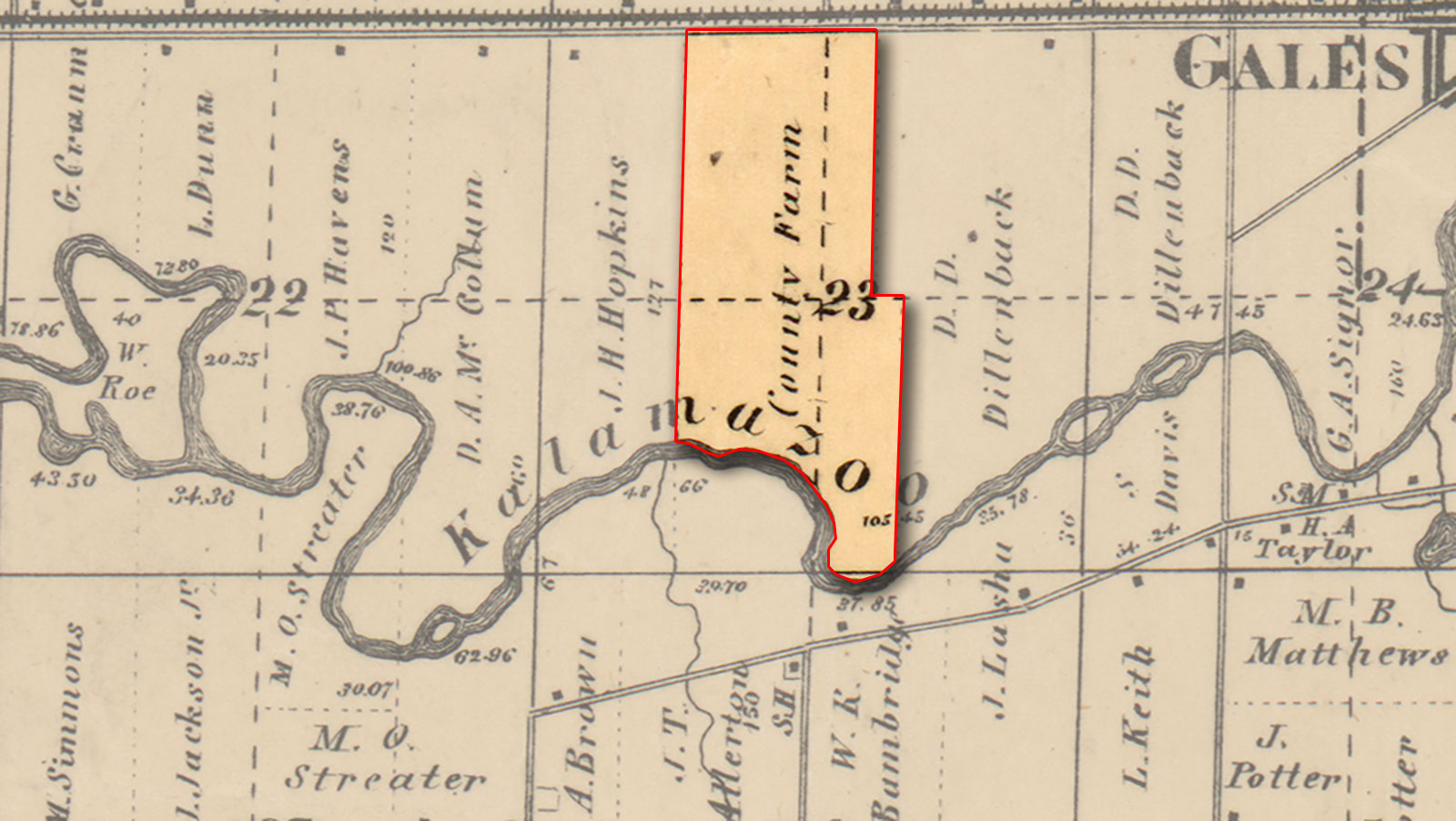 County Farm, c.1861. Map of Kalamazoo Co., Michigan. Published by Geil & Harley, 1861. Library of Congress
“Horsebarns, Stables, and Piggeries”
After the close of the Civil War, county poor house committee chairman Silas Hubbard reported that the poor house was in rough shape and in need of repair. “Nearly all the sills in the buildings are so much decayed,” wrote Hubbard, “that they need to be removed and new ones put in their places.” Hubbard continued, “A large part of the building also wants a new foundation to supply the places of the decayed timbers on which it now rests” (Telegraph). A new coat of paint and other repairs were also deemed necessary. The sum of $1,000 (nearly $20,000 in today’s dollars) was appropriated to make the repairs.
Several significant improvements were made to the property in 1872. A new barn was built at substantial cost, along with a new corn crib and a hog barn. An existing grain bin and horse stable were moved and given new foundations, and a separate infirmary (health care) building and wash house were added. There were a dozen buildings on the property by then, including “horsebarns, stables, grain barns, hospital, wash house, piggeries, etc.” More than a mile of new fencing surrounded the property, and a new apple orchard was planted, which was said to be in “a very thrifty condition.”
When the county board of supervisors visited the facility in October 1882, they said it was “in excellent hands” and called it “one of the best farms in the county,” but they also noted that the buildings were “not such as an able and prosperous county like Kalamazoo should have” and deemed them “unworthy of the purpose.” By then, the original mansion, erected in 1844, had seen better days and was judged to be “beyond repair” (Gazette).
“The building has been in use as a poor house for 40 years, and, as might be expected, is in a very dilapidated condition. The floors have dropped in places from their original resting places and in others the foundation have settled, leaving the floors in ridges, the windows partially fill badly wrecked openings and the doors are similarly disjointed. The walls are cracked and the whole structure is illy ventilated and it is almost impossible to make it comfortably warm for the aged and infirm people who are spending their last days there.”
—Kalamazoo Gazette, 17 February 1888
A New Structure
Despite objections from some who felt a new facility should be built in Kalamazoo proper, the board elected to replace the “40-year-old dilapidated structure” with a substantial new building on the existing property in Comstock. A two-story brick structure with “a capacity to care for 150 persons in a manner which would be a credit to Kalamazoo county” (Gazette) was proposed. With voter approval, the project was to be financed with the proceeds of a countywide liquor tax.
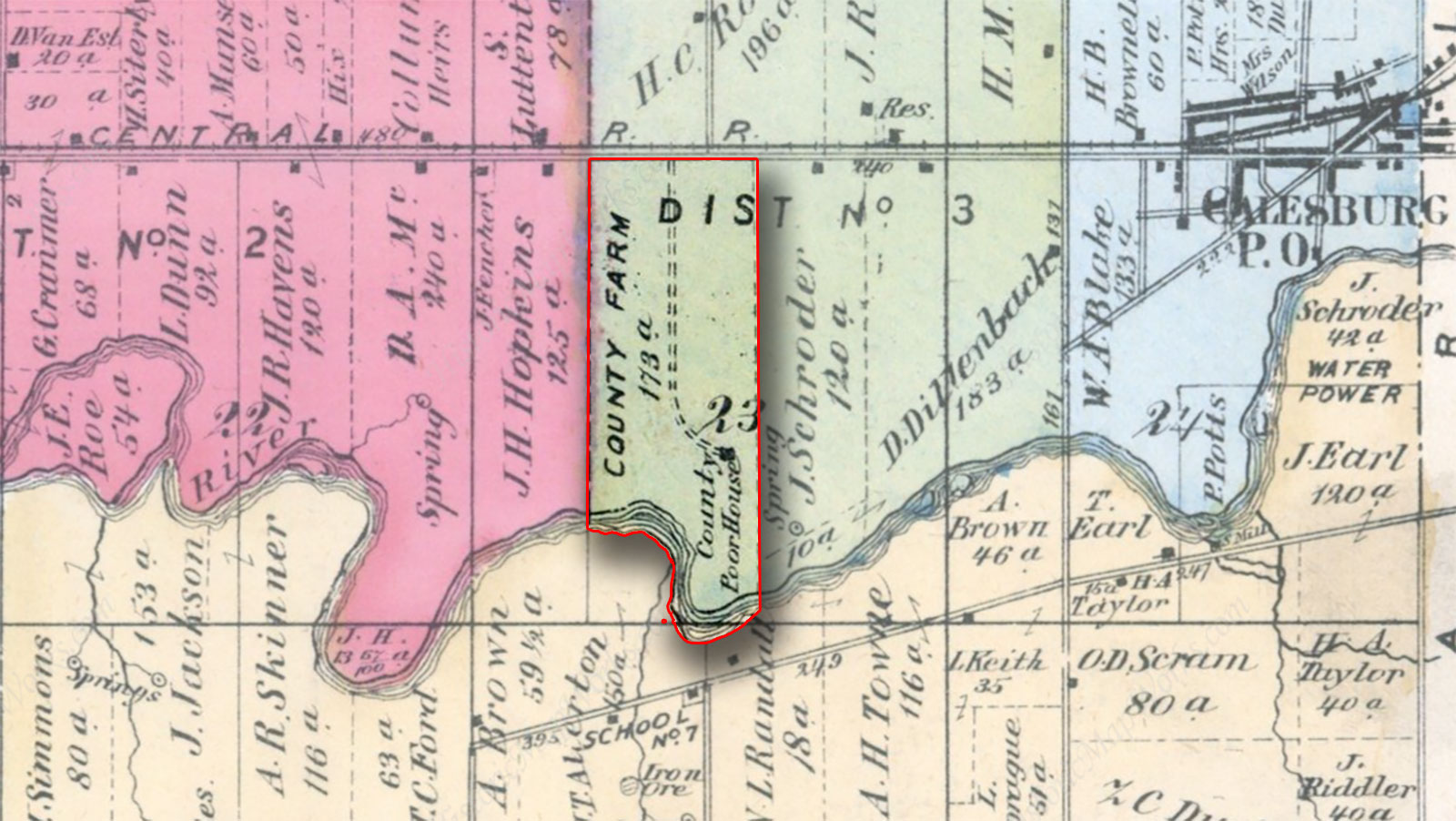 County Farm, c.1873. Atlas of Kalamazoo County, Michigan. Published by F. W. Beers & Co., 1873. Local History Room
By the spring of 1890, the new 54 by 145-foot $25,000 building was finished and ready for occupation. The two upper stories featured 10-foot ceilings with sleeping quarters for 50 people. The east wing was designated for women, and the west wing was for men. Offices and a common area behind the main entrance kept the male and female areas separated, while nine-foot ceilings in the basement created spaces for dining rooms and storage facilities. For the first time, there was hot and cold running water in the building, steam heat, and adequate ventilation. The food was simple but wholesome, clothing was sufficient, healthcare was available, and there was a school nearby for the children. A new laundry building was built in 1907 and electric lighting was installed.
Fire of Unknown Origin
In December 1910, a fire of unknown origin swept through the old horse stables and nearby hay barn. Both structures were lost in the $5,000 blaze, along with “Old Pet,” the oldest horse on the farm, and 5 yearling calves. Several farm implements were destroyed, as well, along with 400 bushels of oats and 18 tons of hay. Thankfully, the residence home was upwind from the fire and remained unharmed. A larger single barn was built to replace the two that were lost.
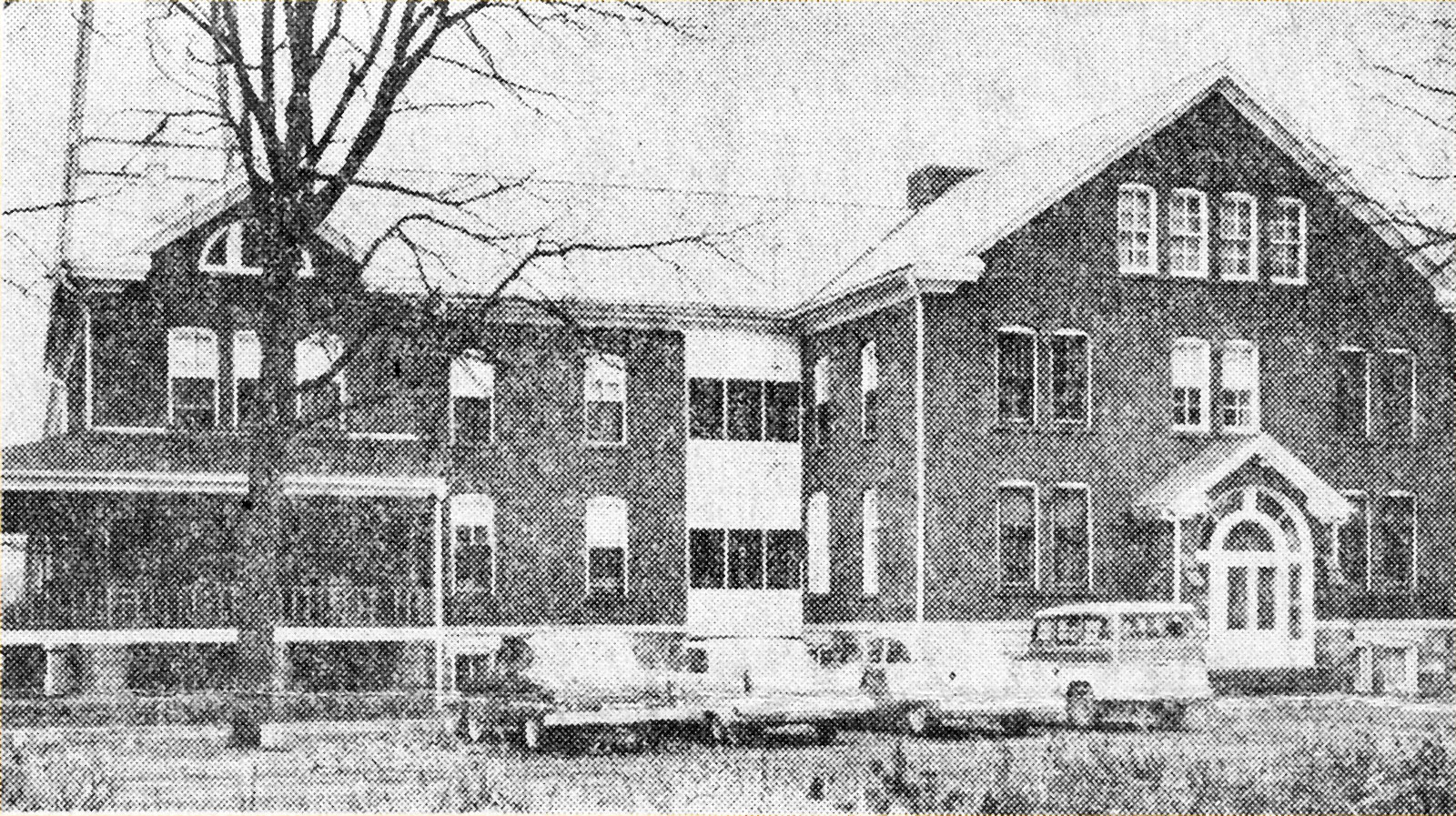 County Rest Home, c.1971. Kalamazoo Gazette, 30 April 1971. Kalamazoo Public Library
A National Welfare System
Ironically, the population at the county poor farm (by then known as the Kalamazoo County Infirmary) declined steadily after the Great Depression. “A total of 218 men and women were cared for in the infirmary during 1936,” wrote the Gazette. A decade later, that number had dropped to around 75. After the Great Depression, President Franklin Roosevelt signed the Social Security Act of 1935, which established a federal retirement program for seniors and put in place a national welfare system. Over time, local, state, and federal programs replaced county relief efforts. The poor farm eventually became a nursing home for those who needed medical care but could not afford it.
River Oaks Park
Eventually, the cost of maintaining the 130-year-old facility had become a burden on the county, prompting several years of discussion about possible solutions. By 1970, the cost to the county for housing its 45 resident patients, many of whom would have otherwise qualified for state and federal aid in private nursing homes, had exceeded $250,000 per year and the facility was closed. The structure itself was razed in 1974 to make way for River Oaks Park, which opened the following year.
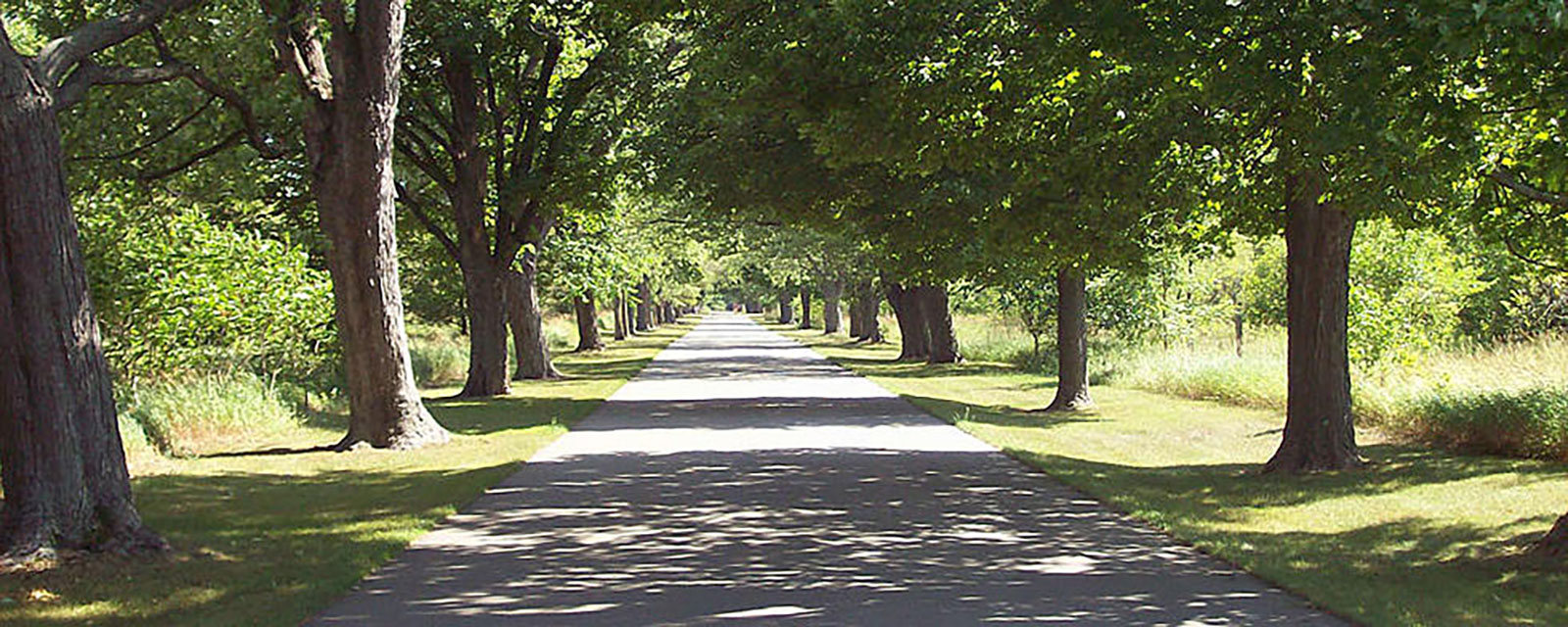 Entrance drive to River Oaks Park. Kalamazoo County Parks Department
Named for the century-old oak trees that line the shore of Morrow Lake, River Oaks Park now features extensive soccer facilities, a boat ramp, picnic shelters, softball fields, a 5-acre dog park, and more. Meanwhile, genealogists have documented the remains of more than 40 persons who were buried at the Poor Farm Cemetery, and researchers continue to seek stories about the people who lived there.
Written by Keith Howard, Kalamazoo Public Library staff, October 2024
Sources
Books
The poorhouses and poor farms of Michigan
Alan Naldrett, 2019
H 362.5 N168 (CEN)
History of Kalamazoo County, Michigan : with illustrations and biographical sketches of its prominent men and pioneers.
Samuel W Durant, 1880
H 977.417 H67U (CEN)
Articles
“$000.00!! Farm wanted!!!”
Kalamazoo Gazette, 22 January 1847, page 3, column 1
“Poor house”
Kalamazoo Gazette, 12 March 1847, page 3, column 2
“Wanted at the County Poor Farm”
Kalamazoo Gazette, 21 January 1848, page 3, column 1
“Paupers California!”
Kalamazoo Gazette, 2 February 1849, page 3, column 2
“Superintendents county poor”
Kalamazoo Gazette, 23 November 1849, page 3, column 2
“County poor”
Kalamazoo Gazette, 27 September 1850, page 2, column 1
“Who is to blame?”
Kalamazoo Gazette, 17 January 1851, page 2, column 2
“Notice”
Kalamazoo Gazette, 22 August 1851, page 2, column 5
“County poor”
Kalamazoo Gazette, 12 December 1851, page 2, column 6
“Report of Board of Supervisors of Kalamazoo County”
Kalamazoo Gazette, 23 January 1852, page 2,3, column 1
“Statement of accounts audited and allowed by the Board of Supervisors, at the October session, 1852”
Kalamazoo Gazette, 28 January 1853, page 1, column 2
“Statement of accounts audited and allowed by the Board of Supervisors, at the October session, 1852”
Kalamazoo Gazette, 28 January 1853, page 1, column 2
“Report of the Board of Supervisors”
Kalamazoo Gazette, 2 November 1855, page 1, column 3
“Annual Report of the Board of Supervisors of the County of Kalamazoo for the A.D. 1856”
Kalamazoo Gazette, 20 March 1857, page 4, column 6
“County Poor Farm to let”
Kalamazoo Gazette, 13 November 1857, page 2, column 8
“Proceedings of the Board of Supervisors”
Kalamazoo Telegraph, 7 November 1866, page 5, column 2
“Proceedings of the Board of Supervisors”
Kalamazoo Telegraph, 27 November 1867, page 1, column 2
“Report of the annual meeting of the Board of Supervisors, Oct. 11, 1869”
Kalamazoo Daily Telegraph, 26 November 1869, page 2, column 1
“Board of Supervisors”
Kalamazoo Gazette, 22 November 1872, page 1, column 3
“Board of Supervisors”
Kalamazoo Gazette, 24 October 1873, page 2, column 2
“The County Poor House”
Kalamazoo Gazette, 12 June 1874, page 3, column 2
“To the rescue – The County Poor House one of the most tidy and cleanly institutions in the country”
Kalamazoo Gazette, 12 June 1874, page 3, column 4
“The County Poor House”
Kalamazoo Gazette, 19 June 1874, page 2, column 4
“Proceedings of Board of Supervisors”
Kalamazoo Gazette, 23 October 1874, page 1, column 5
“Proceedings of Board of Supervisors”
Kalamazoo Gazette, 22 October 1876, page 4, column 3
“The supervisors”
Kalamazoo Gazette, 19 October 1877, page 2, column 1
“Proceedings of the Board of Supervisors”
Kalamazoo Gazette, 18 January 1878, page 1, column 2
“History of Alphadelphia”
Kalamazoo Gazette, 7 September 1878, page 4, column 3
“The Poor Farm”
Kalamazoo Gazette, 20 October 1882, page 4, column 2
“The supervisors”
Kalamazoo Gazette, 13 January 1888, page 2, column 3
“Shall it be yes or no?”
Kalamazoo Gazette, 17 February 1888, page 1, column 1
“To be built on the poor farm”
Kalamazoo Gazette, 9 March 1888, page 1, column 2
“Not fit for a poor house”
Kalamazoo Gazette, 16 March 1888, page 8, column 1
“New home for the poor”
Kalamazoo Gazette, 28 June 1889, page 4, column 4
“New home of the poor”
Kalamazoo Gazette, 30 April 1890, page 1, column 1
“Care of the poor”
Kalamazoo Gazette, 25 July 1897, page 1, column 3
“Cost of the poor”
Kalamazoo Gazette, 16 October 1897, page 1, column 3
“Poor masters’ report”
Kalamazoo Gazette, 28 July 1899, page 1, column 3
“What it has cost to run poor farm”
Kalamazoo Gazette, 13 October 1900, page 1, column 6
“Supervisors at poor farm”
Kalamazoo Gazette, 23 October 1902, page 3, column 2
“County farm was inspected today”
Kalamazoo Gazette, 3 October 1906, page 8, column 5
“Annual report of the county poor”
Kalamazoo Gazette, 7 October 1906, page 9, column 4
“Committee decides on new building”
Kalamazoo Gazette, 5 February 1907, page 3, column 1
“Plans for the lighting”
Kalamazoo Gazette, 17 February 1907, page 3, column 3
“New keeper to have charge of poor farm”
Kalamazoo Gazette, 4 January 1910, page 6, column 2
New superintendent of poor farm assumes his duties tomorrow”
Kalamazoo Gazette, 14 September 1910, page 3, column 2
“Fire burns stock and barns at county farm”
Kalamazoo Gazette, 7 December 1910, page 3, column 5
“Plan to build new barn at poor farm”
Kalamazoo Gazette, 21 December 1910, page 3, column 2
“Meet to make plans for poor farm barn”
Kalamazoo Gazette, 15 January 1911, page 4, column 1
“Raise insurance for poor farm buildings”
Kalamazoo Gazette, 18 January 1911, page 3, column 1
“Valuation of poor farm shows big gain”
Kalamazoo Gazette, 17 May 1911, page 1, column 4
“Keeper and matron of poor farm quit”
Kalamazoo Gazette, 7 March 1926, page 14, column 8
“State approves infirmary plans”
Kalamazoo Gazette, 21 March 1928, page 4, column 8
“Infirmary issue up to voters at Nov. 6 election”
Kalamazoo Gazette, 4 November 1928, page 1, column 6
“Population at county farm at lowest total in years”
Kalamazoo Gazette, 1 January 1937, page 16, column 7
“Communistic colony near Galesburg abandoned in 1848”
Kalamazoo Gazette, 24 January 1937, page 40, column 1
“History of county infirmary started with idealistic dream”
Kalamazoo Gazette, 17 October 1948, page 3, column 1
“Future of rest home unsettled”
Kalamazoo Gazette, 6 December 1970, page 61 (C-15), column 1
“County rest home is closing”
Kalamazoo Gazette, 30 April 1971, page 21 (B-1), column 1
“Rest home not phased out”
Kalamazoo Gazette, 1 May 1971, page 5 (A-5), column 4
“Commissioners okay closing of rest home”
Kalamazoo Gazette, 5 May 1971, page 55 (D-11), column 2
“Future of county rest home property at stake”
Kalamazoo Gazette, 18 May 1971, page 48 (C-16), column 4
“Rest home property discussed”
Kalamazoo Gazette, 19 May 1971, page 7 (A-7), column 3
“The ancient rest home”
Kalamazoo Gazette, 12 September 1971, page 65 (E-5), column 1
“Development of rest home property okayed by county”
Kalamazoo Gazette, 15 December 1971, page 50 (D-12), column 1
“Will county voters buy parks for future plan?”
Kalamazoo Gazette, 15 October 1972, page 18 (B-8), column 1
“County has eyes on 13 park sites”
Kalamazoo Gazette, 22 October 1972, page 13 (B-1), column 1
“Will old county rest home go?”
Kalamazoo Gazette, 5 March 1974, page 23 (C-1), column 2
“County okays building jobs”
Kalamazoo Gazette, 6 March 1974, page 26 (B-10), column 7
“Rest home gets reprieve”
Kalamazoo Gazette, 6 March 1974, page 17 (B-1), column 5
“County recreation facility progresses”
Kalamazoo Gazette, 4 May 1974, page 5 (A-5), column 4
“Rest home rubble”
Kalamazoo Gazette, 31 August 1974, page 5 (A-5), column 4
“New county park is named ‘River Oaks’”
Kalamazoo Gazette, 31 March 1975, page 18 (B-1), column 2
Local History Room Files
Subject File: Kalamazoo County Poor Farm