Eugene C. McElhaney (1856-1935)
Kalamazoo Musician, Teacher, Bandleader, and Inventor
During the community’s formative years, Kalamazoo was full of highly talented musicians, bandleaders, teachers, and inventors, yet few could lay claim to all those talents. One of the few who could, however, was Professor E.C. McElhaney.
“Kalamazoo’s most popular violinist”
Born in Cleveland on the 11th of September 1856, Eugene C. McElhaney (often spelled McElhany) quickly became an accomplished violinist and bandleader. He studied music in Springfield, Illinois, under Professor Louis Lehmann, a well-known director of the Illinois 5th Regiment Band, and with Professor Roff at the Chicago Musical College (now housed at Roosevelt University).
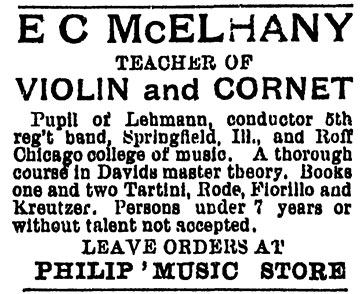 Kalamazoo Gazette, 29 September 1891
During the mid-1880s, E.C. McElhaney toured the country with James R. Waite’s Comedy Company Band and Orchestra. By the time Waite’s outfit visited Kalamazoo’s Academy of Music in May 1887, McElhaney was director of the orchestra and a featured violin soloist.
After his 1890 marriage to Mary Blanche Powell (1871-1958) in Hancock, Ohio, the McElhaneys settled in Kalamazoo, where Eugene took up work as a professor at Henrietta C. Sheldon’s School for Young Ladies. Their marriage produced six children: four sons and two daughters.
In the spring of 1891, McElhaney was performing with the Kalamazoo Musical Association when he was called to replace George B. Newell as director of the Academy of Music Orchestra, a highly coveted position he held for twelve consecutive seasons. In December that year, McElhaney also joined the newly formed Academy Band, a popular local dance orchestra led by Chester Z. Bronson, of which McElhaney served as the band’s conductor and treasurer.
“The Academy of Music orchestra, which is under the leadership of Prof. E.C. McElhaney, has been greatly improved and now equals any orchestra of the same size that appears in any theatre. Their selections last evening were greatly appreciated and show the careful training of their instructor.”
—Kalamazoo Gazette, 27 September 1893
McElhaney had a determined passion for classical music. It seems he could tolerate the requisite popular stuff (although he disliked ragtime), but he truly loved playing and directing more challenging repertoire, “such as the concerted works of the masters, including symphonic compositions” (Kalamazoo Telegraph). That desire led him to become involved with Kalamazoo’s Philharmonic Orchestra.
Organized in 1894, the Philharmonic Orchestra featured some of Kalamazoo’s finest musicians. What began as a collaborative effort between the well-known Phillips Brothers’ Orchestra and members of Kalamazoo’s predominantly African American Harmonic Brass Band soon became known as the Kalamazoo Philharmonic Orchestra, one of the community’s early efforts to embrace and perform symphonic music.
“The Philharmonics have organized permanently for the purpose of producing the standard overtures, suites, and symphonies of the masters.”
—Kalamazoo Gazette, 3 August 1894
Bandleader
McElhaney eventually became director of the Philharmonic Orchestra after first sharing concertmaster responsibilities with violinist and orchestra leader Oscar G. Clement. The orchestra eventually became known simply as “McElhaney’s Orchestra,” especially when the organization performed for social gatherings.
By January 1895, the Philharmonic Orchestra had become a 26-member organization, including musicians from the Academy of Music Orchestra and several who had been part of Kalamazoo’s by-then defunct (1894) Symphony Orchestra. McElhaney’s Philharmonic Orchestra was seen as the right combination of string and wind instruments, just right for popular summertime concerts. The Kalamazoo Telegraph complimented McElhaney on his repertoire, saying it included “the highest form of classic overtures… selections from the popular operas… and many ‘hits’ and light novelties as are required in the library of any enterprising musical organization.” McElhaney’s (Philharmonic) Orchestra performed weekly Sunday afternoon concerts throughout the summer at Lake View Park near Woods Lake.
Like the Symphony Orchestra before it, the Philharmonic Orchestra didn’t last, but McElhaney’s passion for classical music was unwavering. In 1896, he formed a violin, cello, and piano trio known as the Schubert Club, which focused on the works of Beethoven, Mozart, Liszt, Schubert, and Mendelssohn, among others. In fact, McElhaney performed with and directed several local and regional orchestras over the years. In 1898, he could be found playing saxophone with the Chamber of Commerce Band, an all-star, 30-member mélange of Kalamazoo’s top musicians. By 1901, he was directing the K.O.T.M. (Kalamazoo Order of Temple Maccabees) Orchestra, along with Vicksburg’s Imperial Orchestra and the Germania Orchestra of Battle Creek.
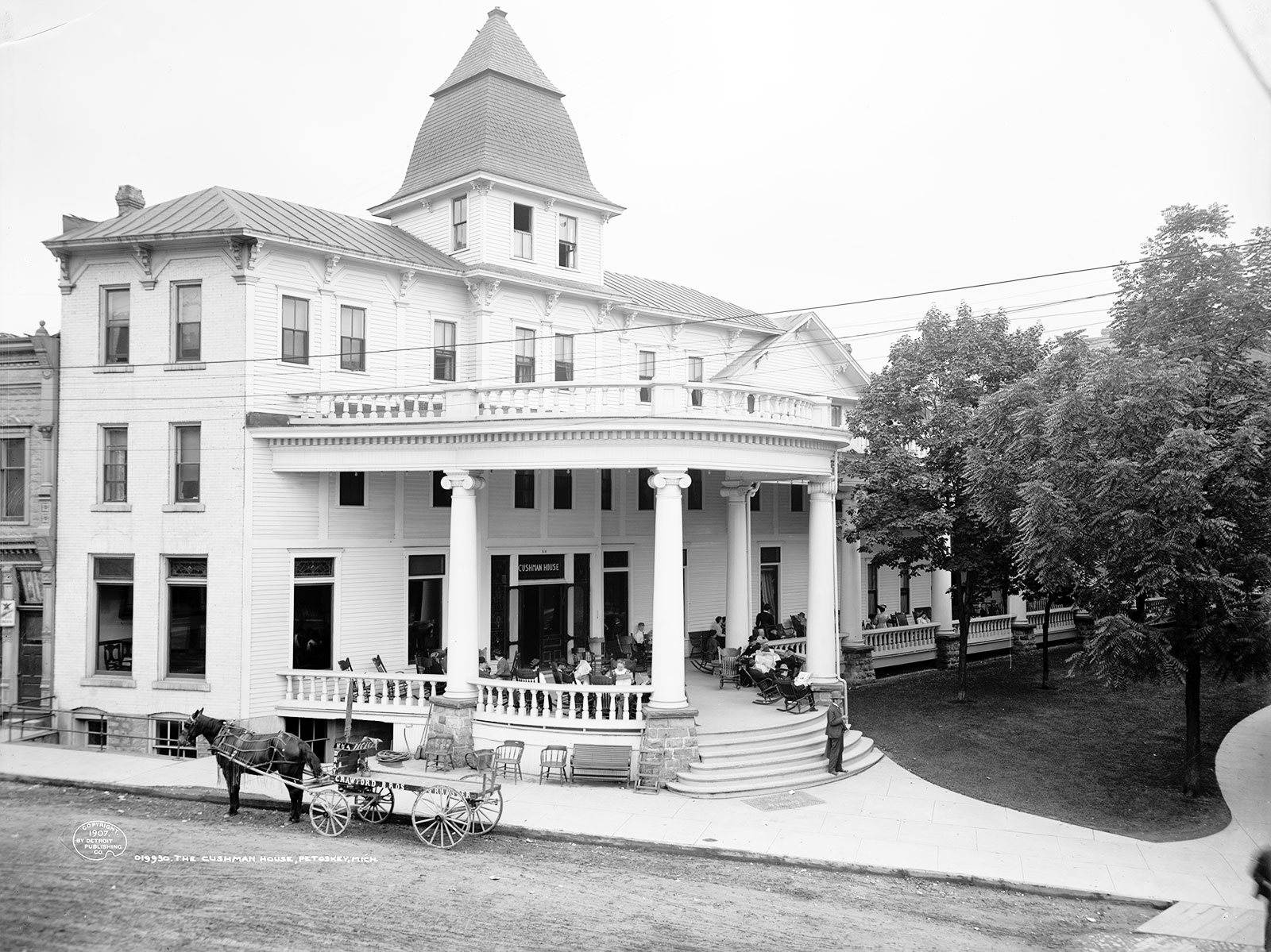 The Cushman House, Petoskey, Michigan, c.1907. Detroit Publishing Co. Library of Congress
Summertime Resorts
During the warm weather months, McElhaney began performing with a small (typically four-piece) orchestra at popular summer resorts in Michigan’s lakefront communities. After an extended engagement in 1898 at Ottawa Beach in Holland, word of his popularity spread quickly. McElhaney was able to secure subsequent summertime work at the famous Cushman House in Petoskey (1899-1903), and the Roaring Brook Inn near Wequetonsing (1903-1906).
Instructor
In addition to his work with the Academy of Music Orchestra, McElhaney offered violin, cornet, and saxophone lessons at his home studio on North Rose Street. McElhaney took great pride in the accomplishments of his students and was not one to mince words when it came to defending his role as a music teacher. At one point, McElhaney evidently became rather perturbed with his contemporaries at the LeFevre Institute Conservatory of Music, a parochial school associated with the St. Augustine Church, and Edward B. Desenberg’s Kalamazoo Conservatory of Music. McElhaney made it known that he alone was the “only successful teacher in Kalamazoo,” and was in no way connected with “any ‘Institutes’ or ‘Conservatories’” or any other such “cheap advertising scheme” (Kalamazoo Telegraph).
“E.C. McElhany has scholars in and out of Kalamazoo that are better musicians than some of the ‘teachers’ here, but then as one of the ‘faculty’ informed me, they ‘have to live,’ poor things.”
—Kalamazoo Daily Telegraph, 9 December 1899
 Patent No. 710,499, “E.C. McElhany, Bow for Violins.” Application filed 5 October 1901, patented 7 October 1902. US Patent Office.
Inventor
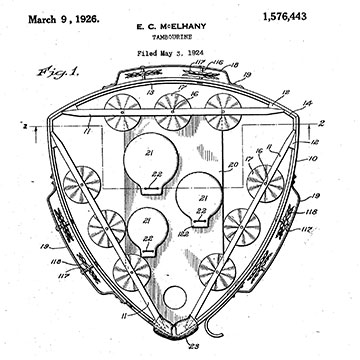 McElhaney’s tambourine, 1926. US Patent Office
McElhaney was not only a qualified musician, teacher, and bandleader, but also an accomplished inventor. In 1902, he was granted patent protection for a newly designed violin bow. His invention called for “a bow constructed of metal for violins or similar instruments which shall possess elasticity and lightness [and] possess all the desirable qualities of the highest grade bows and which at the same time shall be simple and cheap to construct.”
In May 1924, McElhaney applied for a patent on his newly designed tambourine, a three-sided affair “improved in various particulars having in view the provision of an assemblage of jingle elements so positioned as to produce effective jingling.” His “jingling” tambourine received patent protection on 9 March 1926.
An excellent musical menu was dished up by E.C. McElhany and his trained band of musicians, 16 numbers being served upon the American plan.
—Kalamazoo Gazette, 8 April 1904
In the fall of 1903, McElhaney was about to begin his 13th season as director of the Academy of Music Orchestra when a dispute arose with Academy of Music proprietor B.A. Bush. As a result, McElhaney resigned his position, organized a new band, and became musical director at the newly created Palace of Amusement on North Rose Street. “There was never a better lot of players assembled in the town,” McElhaney proclaimed. But after a few seemingly successful months, McElhaney found himself in hot water with the local musicians’ union over supposedly hiring nonunion musicians and was threatened with legal action.
McElhaney’s involvement with the Palace of Amusement was short-lived. Following a six-week engagement in Saginaw with Louis F. Boos’ regionally famous orchestra, the McElhaneys packed up their belongings and moved to Findlay, Ohio, most likely to help care for his wife’s aging grandmother. From their home on Wilson Street, McElhaney continued to work as a music teacher and perform with local Ohio orchestras.
McElhaney Returns to Kalamazoo
While in his mid-60s and evidently divorced by then, McElhaney returned to Kalamazoo after the end of the First World War and continued to work as an orchestra director and music teacher from his home studio in the 100-block of East South Street. By August 1918, his membership in the American Federation of Musicians union had been transferred to Local No. 228 in Kalamazoo. Further evidence of his return is found in the 1919 Kalamazoo City Directory, where he’s listed as a violin and saxophone instructor, and director of “McElhany’s[sic] Orchestra.” During the summer of 1920, McElhaney appeared three nights each week with his orchestra in the new dancing pavilion at White’s Lake south of Kalamazoo. A year later, McElhaney had taken over the White’s Lake Pavilion as the lessee and manager.
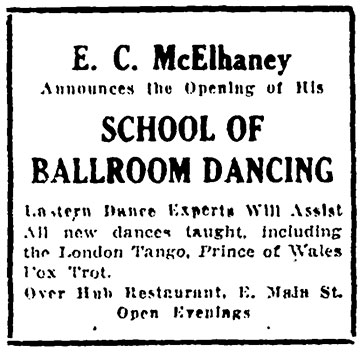 Kalamazoo Gazette, 26 October 1924
McElhaney formed a new municipal band in 1922 and arranged a series of outdoor summer concerts. More than 3,000 attended the first performance on the 11th of August in Bronson Park. Additional performances followed at the North Westnedge School and the Frank Street School.
After managing the Odeon Music and Dance Studios for a time and opening his School of Ballroom Dancing on East Main Street, McElhaney took time off to focus on his writing skills as a member of the Kalamazoo Creative Writers’ Club and to devote time to his stamp collecting hobby as a member of the Kalamazoo Philatelic Society. In 1932, he submitted skits to the Kalamazoo Civic Players for review and possible use during the 1932-33 season, although it does not appear that they ever were produced for stage.
Eugene McElhaney spent his final years at the Kalamazoo Home for the Aged on Douglas Avenue. He died at Bronson Hospital on New Year’s Eve in 1935 at the age of 79 and was buried in an unmarked grave at Riverside Cemetery.
Written by Keith Howard, Kalamazoo Public Library staff, December 2024
Sources
Articles
Display ad
Kalamazoo Gazette, 27 May 1887, page 2
Display ad
Kalamazoo Daily Telegraph, 27 May 1887, page 6
“The limited mail”
Kalamazoo Gazette, 28 March 1891, page 1
“Ho! for South Haven”
Kalamazoo Gazette, 26 June 1891, page 4
“Prof. E. C. McElhany…”
Kalamazoo Daily Telegraph, 13 July 1891, page 7
Display ad
Kalamazoo Daily Telegraph, 11 August 1891, page 1
Display ad
Kalamazoo Gazette, 29 September 1891, page 4
“New band organized”
Kalamazoo Gazette, 11 December 1891, page 2
“The Academy orchestra…”
Kalamazoo Daily Telegraph, 30 September 1893, page 1
“Prof. McElhany’s orchestra at Lake View this season”
Kalamazoo Daily Telegraph, 11 July 1895, page 8
“It always pleases…”
Kalamazoo Gazette, 31 July 1895, page 5
“20 musicians”
Kalamazoo Daily Telegraph, 6 August 1895, page 8
“The Schubert club”
Kalamazoo Daily Telegraph, 13 October 1896, page 8
“Prof. E.C. McElhany…”
Kalamazoo Gazette, 29 November 1899, page 9
“Officers elected”
Kalamazoo Gazette, 2 April 1901, page 6
“Old music and new”
Kalamazoo Daily Telegraph, 25 October 1901, page 1
“McElhany goes north”
Kalamazoo Gazette, 5 July 1903, page 8
“Season a success”
Kalamazoo Gazette, 16 September 1903, page 4
“McElhany resigns”
Kalamazoo Telegraph, 24 October 1903, page 12
“Not approved by musicians”
Kalamazoo Gazette, 25 November 1903, page 5
“Meeting not called”
Kalamazoo Gazette, 16 December 1903, page 2
“Music at ‘Palace’”
Kalamazoo Gazette, 12 January 1904, page 3
“Personal”
Kalamazoo Gazette, 12 September 1905, page 5
“Orchestra at White’s Lake”
Kalamazoo Gazette, 6 July 1920, page 12
“White’s Lake pavilion”
Kalamazoo Gazette, 15 May 1921, page 28
“New band will give three local concerts”
Kalamazoo Gazette, 2 August 1922, page 12
“3,000 listen to McElhaney concert”
Kalamazoo Gazette, 12 August 1922, page 9
“Odeon music and dance studios”
Kalamazoo Gazette, 21 September 1924, page 31
Display ad
Kalamazoo Gazette, 26 October 1924, page 29
“E. C. M’Elhaney, musician, dies”
Kalamazoo Gazette, 2 January 1936, page 16
Census Records
Eugene McElhany household, 1910 United States Federal Population Census, Handcock County, Ohio
Census Place: Findlay Ward 4, Hancock, Ohio, sheet 7B, 765 Wilson St., family 172
Online database, Ancestry Library (in library only)
Eugene McElhany, 1920 United States Federal Population Census, Kalamazoo County, Michigan
Census Place: Kalamazoo Ward 4, Kalamazoo, Michigan, sheet 9B, 117 1/2 E. South St., dwelling 241
Online database, Ancestry Library (in library only)
Patent Records
E. C. McElhany. Bow for violin. (No Model). No. 710,499. Application filed 5 October 1901, Patented 7 October 1902
United States Patent and Trademark Office
E. C. McElhany. Tambourine. (No Model). No. 1,576,443. Application filed 3 May 1924, Patented 9 March 1926
United States Patent and Trademark Office
Other Publications
International musician : official journal of the American Federation of Musicians of the United States and Canada. v.17-18(1918-1920). August 1918, page 14