Lydia A. Smith's Memoir
Asylum Patient Turned Whistleblower
One of the most sensational narratives of 19th century Kalamazoo was written by a woman who had spent four years as a patient in the Michigan Asylum for the Insane (aka Kalamazoo State Hospital) in the late 1860s. Her detailed rendering of life in the facility often reads like a Gothic horror film, packed full of villainous characters bent on terrorizing the author before she “miraculously” escapes her captors. The author of this expose of life behind the doors of the asylum was Lydia A. Jackson Button Smith, a housewife from Jonesville, Michigan (Hillsdale County). Personal testimonials like Smith’s, that shone a critical light on the treatment of asylum patients, would become increasingly more common in the later decades of the 19th century (see: Nellie Bly’s infamous 10 Days In a Mad-House), and would eventually lead to governmental reforms and regulations regarding hospital practices. In fact, Smith’s tell-all account may have helped to contribute to a state-led inspection of the asylum in Kalamazoo, resulting in a thorough examination of its practices and policies a year after the book’s publication. While most of the administrators of the hospital were ultimately exonerated of any wrongdoing, state officials called upon the hospital to institute changes where it concerned the treatment of patients.
The following is a summary of Smith’s dramatic accounts. As with any historical memoir, the reader must engage the author’s powerful claims and their degree of veracity within a critical framework that accounts for biases, individual perspectives and personal experiences. Throughout the 19th century, there were a handful of tell-all memoirs published by women in an attempt to inform the general public about the mistreatment of patients whose voices were mostly ignored, marginalized or muted. For many 19th century women (and other marginalized groups), there existed a real possibility that they could be forcibly admitted into an insane asylum by their husbands or family members with few legal options to contest their captivity.
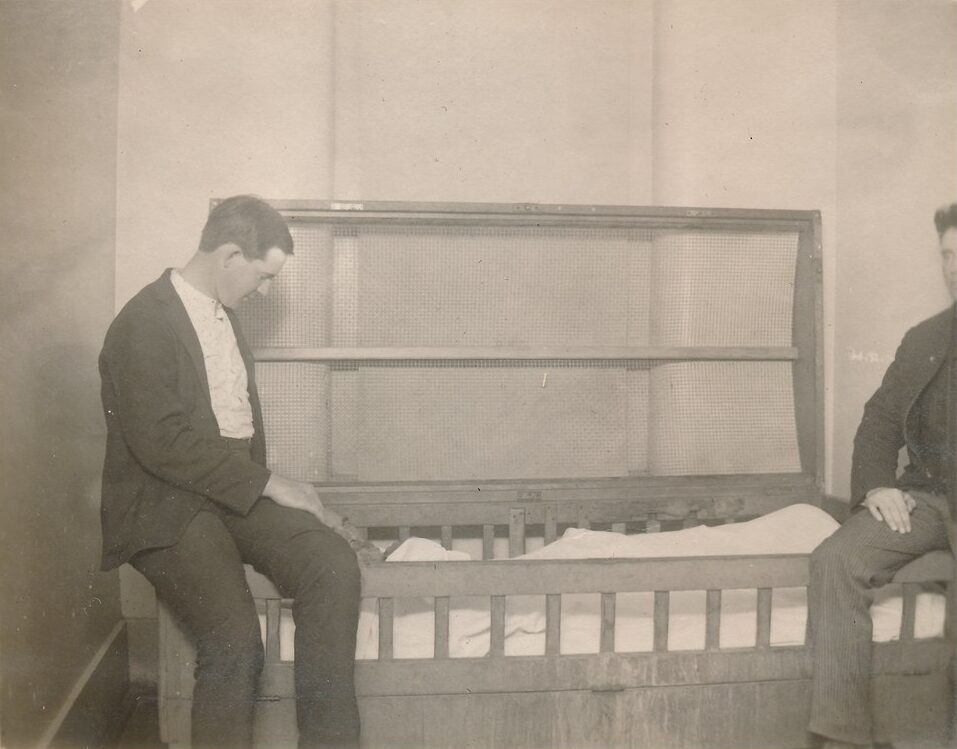 Two men pose next to an asylum bed crib that holds another person, Michigan Asylum for the Insane Siggins Album, c.1899-1909.
Smith’s scathing disclosure was published in 1878 by a Chicago-based firm called Culver, Page, Hoyne & Co. Prior to the memoir’s preface, there is a lithograph of the author. She is adorned in mid-Victorian clothing–a black blouse with a high collar that ruffles around the neck and collarbone. Her hair is pinned up with a small part down the middle. A round broach is affixed to her blouse. Her mouth is closed and neutral. Underneath the image is four lines of verse, including a line excerpted from William Cullen Bryant’s poem Battle-Field: “Truth, crushed to earth, shall rise again.” The preface, drafted by the publishers, is sympathetic to Smith’s goal of raising awareness of the abuses taking place at facilities like Kalamazoo’s asylum.
“The design of this work is to awaken an interest in the public mind in behalf of the insane, how they are treated, and what AMENDMENTS are NECESSARY to SECURE SAFETY from FRAUD and a thorough reformation in this department of State work. It is the author’s design to call attention to this subject for the benefit of the really insane who are not capable of self defense, and who have none of the privileges granted to a free and enlightened people, but are cruelly and inhumanely treated under the ordinary asylum usages.
It is the author’s design also to call attention to another class who are more unfavorably situated, if possible, than the really insane. It is those who are not insane, and who are kept confined in an asylum either from a false belief in regard to their condition on the part of their friends, or from a desire on their part to keep them thus confined. It is high time the public was awake to the uses and abuses of an asylum management. ”
Preface of Behind the Scenes, Or, Life in An Asylum
The publisher proceeds to extol Mrs. Smith’s virtuous principles and moral character, establishing context for what is to come in the form of Smith’s harrowing descriptions of her confinement. The publisher describes her as amiable and a pious and religious woman with many friends. Her religiosity is evident throughout the text, as it is woven between the more restrained prose.
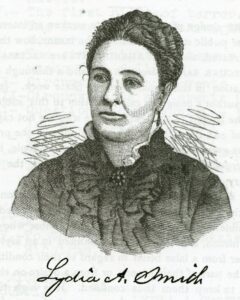
What we know of Smith’s early life and family background is also provided before chapter one. Lydia was born Lydia Adeline Jackson on 31 December 1835 in either Kent County, Pennsylvania or Chautauqua County, New York. Lydia’s father Peter was a hatter who married Phebe Mills of Lyons, New York. Lydia was their eighth child out of nine. The Jackson family arrived in Michigan in 1856, west of Adrian (Lenawee County), but later relocated to Moscow Township (Hillsdale County), where Lydia “knew what it was to suffer from poverty.”
The 1850 Federal Census lists Lydia as residing in Jonesville, Michigan with her husband Horace M. Button and a three year-old child named Jessie (step-daughter). Horace was a widower and married Lydia when she was 16. By the 1860 Federal Census, Lydia had given birth to a daughter (Adalaide) and a son (Charles Edwin Button). Five years later, Lydia’s unsettling story of forced confinement began.
According to her memoir, Lydia was first taken from Jonesville to Canandaigua, New York in 1865, where she remained for a year and half before being taken by her husband’s brother; a man who upon their way back to Jonesville, deceived Smith by forcing her to be admitted to the insane asylum located just west of the Village of Kalamazoo, on a dirt road that later would become Oakland Drive.
While in the New York hospital, Lydia was violently accosted by the attendant, a Miss Sophia Peabody. Smith was sadistically bathed in scalding water, removed from the ability to move her arms by a “stout leather belt attached to an iron buckle”, and locked inside of a bed “crib” that possessed a cover that closed while allowing for just enough ventilation through which to breath. Miss Peabody then used a five inch wooden stick with a wedged tip to pour medicine down the mouth of Smith. In the process, Smith lost five teeth due to Peabody’s violent jamming of the wooden device into her mouth. After some time confined to the crib, suffering the ill effects of the chloroform, the superintendent, a Dr. Cook, paid Smith a visit. After more than a year suffering various degradations and violent abuse at the hands of cruel attendants, Dr. Cook concluded that she was healthy enough to leave, and that she bore no symptoms of someone requiring of institutionalization. Dr. Cook and his kindly wife attempted to contact Smith’s husband, who had apparently left Jonesville due to the village’s antagonistic feelings toward him. Instead, the hospital was able to connect with Smith’s brother-in-law, a man she claimed deceived her into believing that she was to be returned to Jonesville, but who instead, kept her on the train until reaching Kalamazoo.
After her brother-in-law dropped her off at the hospital, Smith accepted her fate while biding her time, all the while mapping out her escape plan. The first year at the hospital was relatively uneventful, but as time wore on, Smith grew increasingly melancholic, frustrated that she was kept from her children. She spent her days attempting to be as helpful as she could, devoting much of her time to self-examining her mental state and comparing herself with the other patients.
“I would try and be cheerful and help those around me, trying to comfort and cheer them, at the same time inquiring into the cause of their disease–comparing their symptoms with mine; for I would sometimes think that perhaps I was mentally afflicted. I had been an invalid so long, and thought, perhaps, after all, my husband was sincere in keeping me there; thinking it for the best and hoping I would be fully restored–knowing the danger of a half cure.”
“Still I worked on from day to day, helping those who needed help; watching the symptoms of those who were really insane, as well as those who were partially so; endeavoring to gain some knowledge of myself; comparing my own symptoms and feelings with their’s.” (Smith, 24)
But unlike her time at the New York asylum, Smith had few opportunities to wander unattended and freely upon the hospital grounds. After a year in Kalamazoo, Smith’s commitment to escaping grew in intensity. What makes her memoir such a compelling piece of literature is Smith’s talent for providing rich details, and a tenor of reflective self-awareness. Despite feeling deeply wronged, her memoir resists reading like an angry screed against the asylum system and her devious husband, but rather a thoughtful, well-examined analysis of both her own understanding of herself, and the shortcomings of an institution requiring of reform. She is if nothing else, evenhanded in her characterizations of those individuals who had the greatest impact upon her experiences.
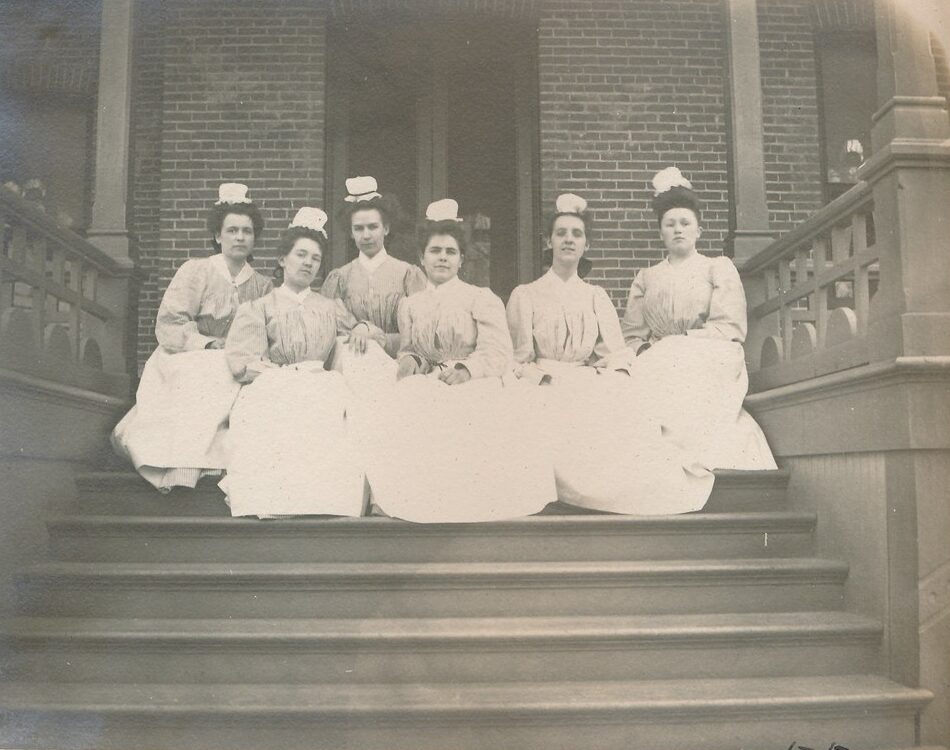 Asylum Staff, c.1899. Local History Photograph Collection (Siggins Album)
The Story of Hattie Russell
Over time Lydia became a trusted confidant of a young patient named Hattie Russell. Russell was from the Detroit area and had come to consider Lydia a de facto mother-figure, to whom she could express her feelings and reveal her secrets. After a long time of appearing to be improving, an agitated Hattie came to see Lydia, asking her to acquire some medicine directly from Dr. George C. Palmer (the Assistant Superintendent), telling Lydia to keep this request concealed from the intimidating attendant whom Lydia described as someone who never questioned authority, and whom Lydia genuinely feared. Hattie had told Lydia to tell Palmer that she had acquired a cold, and that she required medicine. Unfortunately, Lydia never had the opportunity to ask Palmer, but instead brought it up with the cruel attendant who angrily demanded to know, “did Hattie tell you so?” Later that evening, Hattie was violently removed from her room that was situated next to Lydia’s, and placed in another wing of the hospital. Lydia only saw her once more after that, looking quite different and unwell. Several weeks later, Hattie was taken to an asylum in Wayne County, where she died soon thereafter.
“Hattie’s room was next to mine. I listened; a smothered cry, as of some one being gagged, and then a tussel, as of some one being dragged along the floor, through the hall and down stairs. I could not imagine what it was, but the next morning Hattie Russell was missing. Inquiries were made with regard to what had become of her, by all the patients on the hall but me; I dared not ask any questions about her. It was understood that she had been removed to another hall, and this was confirmed a few days afterwards by one of the attendants from another hall (the hall where Hattie had been removed to). It was her wont to speak with the lady patients. Not seeing me on the hall, she stepped into my room, saying, “good morning Mrs. B____; don’t you feel sorry for poor Hattie; did you hear her screams and cries last night? Hattie is very sick.” (p.35-36)
Lydia had concluded that what had happened to Hattie was no accident, that her death was intentionally administered by order of the hospital’s Superintendent, Dr. Edwin H. Van Deusen, a man she described as sometimes having whiskey on his breath, and who possessed a Dr. Jekyll and Mr. Hyde-like personality. Her characterization of Van Deusen, as someone who was capable of charming state health officials and hospital trustees during the day as he terrorized patients with an iron fist at night, runs throughout the course of her writing from this point onward. Smith asserted that whenever hospital inspections were scheduled, Van Deusen was well-equipped to make sure the state officials and trustees saw only that which he wanted them to see, and nothing that would suggest that he oversaw or sanctioned abusive conditions and coverups of staff malfeasance. According to Smith:
“He would do more every day of his life to keep these unpleasant facts from getting circulated or known outside the asylum than he would for the good of every soul and body in that institution (I know this to be a fact also). When the trustees came it was always at a stated time, and they knew when to expect them. They were shown through the best part of the institution, and everything was presented in its most favorable light.” (p.37)
After she had escaped the hospital, Smith claimed that she was approached by several former attendants who corroborated her claims, with one in particular who told Smith that if called upon to officially testify, that she would tell the truth about what happened to Hattie Russell. Smith suggested that many of these attendants feared being punished by hospital brass if they spoke up against those who held power. During this time period, Smith knew that some of the staff would likely be allies in helping her to escape, but that she was unsure which of these persons to approach for assistance, fearing that she would confide in the wrong person, only to be reported.
Attempted Murder?
One evening, not long after the Hattie Russell incident, Smith overheard Van Deusen speaking with the attendant on duty, telling her to prepare a wet cloth with some sort of substance (likely chloroform), and then to “flirt through the ventilator over Mrs. Button’s door once every hour.” She then heard him state, “It will not do for Mrs. Button (her married surname) to leave this institution alive; for if she does, she will be telling these things all around.” Shocked and terrified, Lydia concluded that Van Deusen believed that she knew something much more ominous about what had happened to Hattie Russell than she did. In a state of disbelief, Smith hurried to barricade her door with furniture, as well as blocking the ventilation hole to her room with paper. In an attempt to verbally dissuade Van Deusen and the attendant from their plan, Smith succeeded in getting the two to give up for the night. Over the course of the next three nights, Smith continued to barricade the door to her room, refusing to sleep so as to be able to resist Van Deusen’s attempt at snuffing out her voice. On the fourth night however, Van Deusen and his accomplice returned to Smith’s room, attempting to enter. Blocked from entrance, according to Smith, Van Deusen angrily said, “Damn her. I’ve given her enough to kill forty such women. I’d like to know what in hell she is made of. Are you sure she swallows what I sent her in the medicine cup?” The attendant replied, “Yes, I know she does, for I watch her until she swallows it, as you me to.” Van Deusen then concluded, “By God, I’ll fix her tomorrow night!”
On the fifth night, several attendants entered Lydia’s room, and asked her to take her medication. Knowing she would not be capable of resisting, she relented, and swallowed the pills. Fearing for her life, she had another attendant return with a mug of warm water and a dish of mustard. After mixing the two together and swallowing it, she continued to keep moving within her room despite the terrible pain of cramping. And then Van Deusen arrived at her door, slowly peeking his head in, Lydia assumed a position of attack with the mug in her hand, but Van Deusen remained in the hallway. Adrenaline-fueled, Lydia barked at the doctor and the attendant, “Now, if you want to come in, sir, come! The way is clear–walk right in, sir! There is a chair for you, sir! Come in, come in sir! What, sir, afraid of a woman? For shame, for shame. Walk in, and bring your tool of an attendant right along with you, sir! I am not afraid of either of you. I will wring the heads off both of you in just one minute.” After some time berating Van Deusen, he once more attempted to enter Smith’s room. Bent on crushing his hand in the doorway, Smith lunged at the door, but Van Deusen quickly removed his hand and stepped back into the hallway, where he yelled, “By God, that’s damned smart! What in hell is that woman made of? The devil himself couldn’t kill her! Hell, how am I to manage? It has got to be done tonight. Dr. Marshall will be back, and then the devil will be to pay. What I sent her would have settled a dozen women. What in hell can she be made of?” The following day, Smith spoke with Dr. Palmer, who Lydia believed was unaware of Van Deusen’s activities, urging him to monitor her hall during the night hours so as to observe the kinds of villainy that was taking place right under his nose.
On the sixth night, several attendants entered her room, asking Lydia if she preferred to sleep in a different room. Skeptical of their intentions, Smith finally agreed after some hesitation and fiery exchange with an attendant who attempted to remove Smith’s stockings. Relocated to a different room in a another portion of the facility, Smith soon realized that she had a roommate; one who spoke to herself, and who began to excitedly whisper that someone was coming to kill her. On high alert, and quietly listening to those walking throughout the hall, at one point Lydia heard Dr. Van Deusen approach her room, put a key into the lock, begin to turn the key, only to retreat when approached by an attendant.
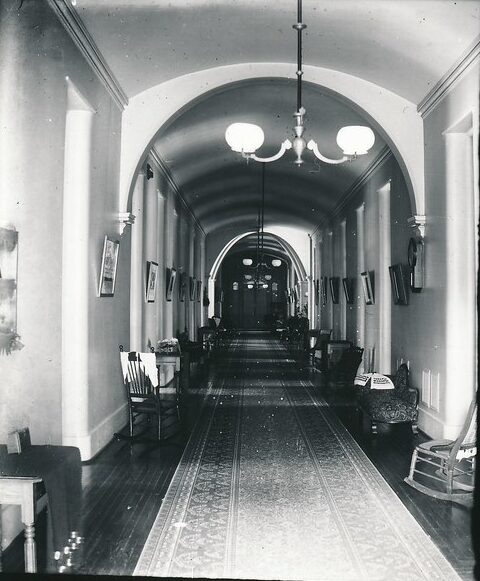 Female Wing of the Asylum, 1892. Local History Photograph Collection, P-464
In desperate need of sleep, Lydia was embraced by two attendants who kindly watched over her. Three weeks went by after this latest interaction with her nemesis, and Lydia began to feel stronger and more rested. A rocking chair was assigned to her so that she could spend time outside of her room, in the hallway. One day, while sitting in her chair she noticed Van Deusen speaking to an attendant. She described him as looking pale, underweight and sickly. The doctor approached her and told her that she was looking better, but an indifferent Smith ignored his attempt at small talk. Smith had heard that Van Deusen had been gone from the asylum for those three weeks to address a lawsuit, and possible seek treatment for whatever ailments he had incurred.
By the fall of 1870, Lydia made the decision that she would attempt an escape, but not until she had developed a foolproof strategy. Over the course of the next two years, Lydia foisted lavish praise and compliments upon Dr. Van Deusen, hoping to sway his alleged vanity in her favor.
“I must be discreet, must be wise, not appearing to be so; must feel my way along carefully, and more than all, must stoop to do things distasteful to me. I must act a part. I must flatter this man’s vanity. I must seem not to remember the past,, or only as an insane freak, and think it all a delusion. I would be cheerful, and even gay, and tell them how much their treatment was helping me, and praise their skill. Every opportunity that presented itself to me I would take advantage of in one way and another, just as the circumstances called for. But above all I must flatter them.” (p. 87)
During this time, when Lydia strategized her escape through a charm offensive of subterfuge and excessive flattery, she cited that a motivating factor was the separation from her three children. Throughout the next two years, Lydia made an effort to connect with attendants who were susceptible to sympathizing with her desire to escape. She continued to have a neutral relationship with Dr. Van Deusen’s assistant, Dr. Palmer. She thought positively of Palmer at times, but feared that his relationship with with his superior was such that he couldn’t be completely trusted to serve her interests. It is at this point in the memoir when Smith covers several anecdotes that convey Smith’s heartfelt belief that many of the patients who greatly suffered, and who in some cases died in custody of the hospital, could have been saved, or treated more humanely. She suggests in one of her tales that two patients either died or were killed by asylum staff, and then had their bodies cremated just outside of her window. For several pages, Smith argues that many of the changes to the hospital were done so as cosmetic fabrications, in order to distract trustees, visiting physicians and state inspectors from seeing the much harsher conditions the patients were inhabiting. One such anecdote saw visiting doctors taken only around to patient-free spaces, as well as to a newly constructed flower garden that cost over $700 to create just days before the visit so as to impress the newcomers. Smith goes on to level an assortment of accusations toward Van Deusen that include the financial mismanagement of the hospital.
The Escape
Prior to Smith’s escape, her brother arrived in Kalamazoo to check on his sister’s condition, but Van Deusen thwarted him, explaining to her brother that Lydia was a privately held patient, meaning that her husband was paying to have her held. Her brother then procured the assistance and influence of a Judge Dickinson from Hillsdale to accompany him to the asylum to see Lydia. The two convinced that she should be released, Van Deusen once more argued that Lydia required continued observation in the hospital. Around this time, Lydia was able to get several letters out of the asylum to friends back home, the contents of which summarized her distaste for the institution.
In the winter of 1872, Lydia figured her escape would be better executed without snow on the ground to reveal her footprints. She waited patiently, sneaking out messages to her friends back in Jonestown. As days wore on, she used her time outside of the hospital, picking strawberries, to design her departure. She and her “company” of other patients were allowed to meander the grounds while seeking out berries as long as they behaved. On one occasion, she felt that she had broken free of the view of Van Deusen’s hired monitors, and considered running, when she looked up to see a man standing nearby, watching her. She decided that the time for escaping was not right, and that she would instead continue to curry favor with the hospital staff by faking contentedness. Overtime she gathered the sympathy and support of attendants with her magnetic personality, suggesting that she was one of the more popular patients. Ultimately, the time spent engendering fellowship and understanding with the asylum attendees paid off, and with it, a relatively drama-free escape which was overseen by supportive attendants, namely a Miss Wells. Smith had gotten word to a Quaker friend who agreed to stop their carriage near the front of the hospital. They waited until Smith and a group of patients were allowed to leave the facility for their daily walk.
“My Quaker friend, according to agreement, was already there, and had been slowly riding along for some time. Looking in the direction of the carriage, I said to Mis Wells, who was walking with me, “I declare, there is somebody I know,” loud enough to be heard by the attendant. Then calling out to the Quaker in disguise, I said: “Good morning, cousin George, how do you do? Wait a moment, I want to speak with you.” Turning to the attendant just back of me, I said I would like to speak with this gentleman a moment. She nodded assent, and I very quietly walked to the carriage. Turning to the company, I said to the attendant, “Don’t be alarmed; I want to ride around for a while; I’ll come back again.” One of the attendants stood with outstretched arms, as though to pull me back. The other smiled and nodded assent. Of course it was against the rules, but then she was a dear, good girl. How could she refuse me such a slight favor? It was too late to refuse, you see. As I glanced back some of the ladies were clapping their hands. There stood dear Miss Wells and Miss Richards, all aglow with smiles, and little Allie Marvin jumping up and down, clapping her hands for joy.”
Redress and Reform
After her escape from the asylum, Smith returned to Jonesville, where she received a divorce decree from Horace. Her memoir also swerves backward to consider the reasons why she was initially placed in the asylum, suggesting that a dysfunctional relationship with her husband’s family, notably her sister-in-law, likely contributed to her illegitimate imprisonment. Despite being free of the asylum, unfortunate circumstances befell Lydia shortly upon her return to Jonesville. Her brother, sister, and daughter all died in quick succession. In would appear that her marriage to Mr. Smith was due in large part to financial security.
A year after the publication of her story and Van Deusen’s retirement, a state commission was put together to investigate claims of patient abuse and asylum mismanagement. Lydia provided her testimony. The Kalamazoo Gazette published a summary of the commission’s report on 15 May 1879, which largely exonerated Van Deusen of any serious wrongdoing, despite suggesting ways the institution could better its practices and policies. Earlier in the year, the Gazette republished an article that first appeared in the Detroit Free Press. The article told the story of an attendant who had worked at the Kalamazoo asylum. The staff provided the reporter with a long list of detailed anecdotes about the kinds of abusive practices that were performed on patients. According to the author of the expose, occasional state inspections of asylums were largely a “farce” administered by staff and superintendents to conceal the more ominous ongoings behind closed doors. A discourse had begun between community stakeholders, legislators, and medical professionals about how to better administer care for asylum patients throughout Michigan, and Lydia’s personal account fit perfectly into that historical zeitgeist.
Life after her time in the asylum included marriages to Adnatt H. Smith in 1873, George Isaac Sager in 1888, and Hessen Baker in 1911. Lydia is buried in Hillside Cemetery near Highland, Michigan (Wexford County).
Article written by Ryan Gage, Kalamazoo Public Library staff, August 2025