The Star Brass Works
Manufacturers of Street Railway Supplies
By the dawn of the 20th century, “Kalamazoo” had become a familiar brand. Well-known companies emblazoned their hometown name on a host of consumer goods, from trucks and sleds to stoves and guitars. Meanwhile, other products, perhaps not-so-well-known to the average American, had become famous within their respective industries. Such was the case with The Star Brass Works, manufacturers of, among other things, the “Kalamazoo Long Distance Trolley Wheel,” a device used to connect streetcars to the overhead electrical lines.
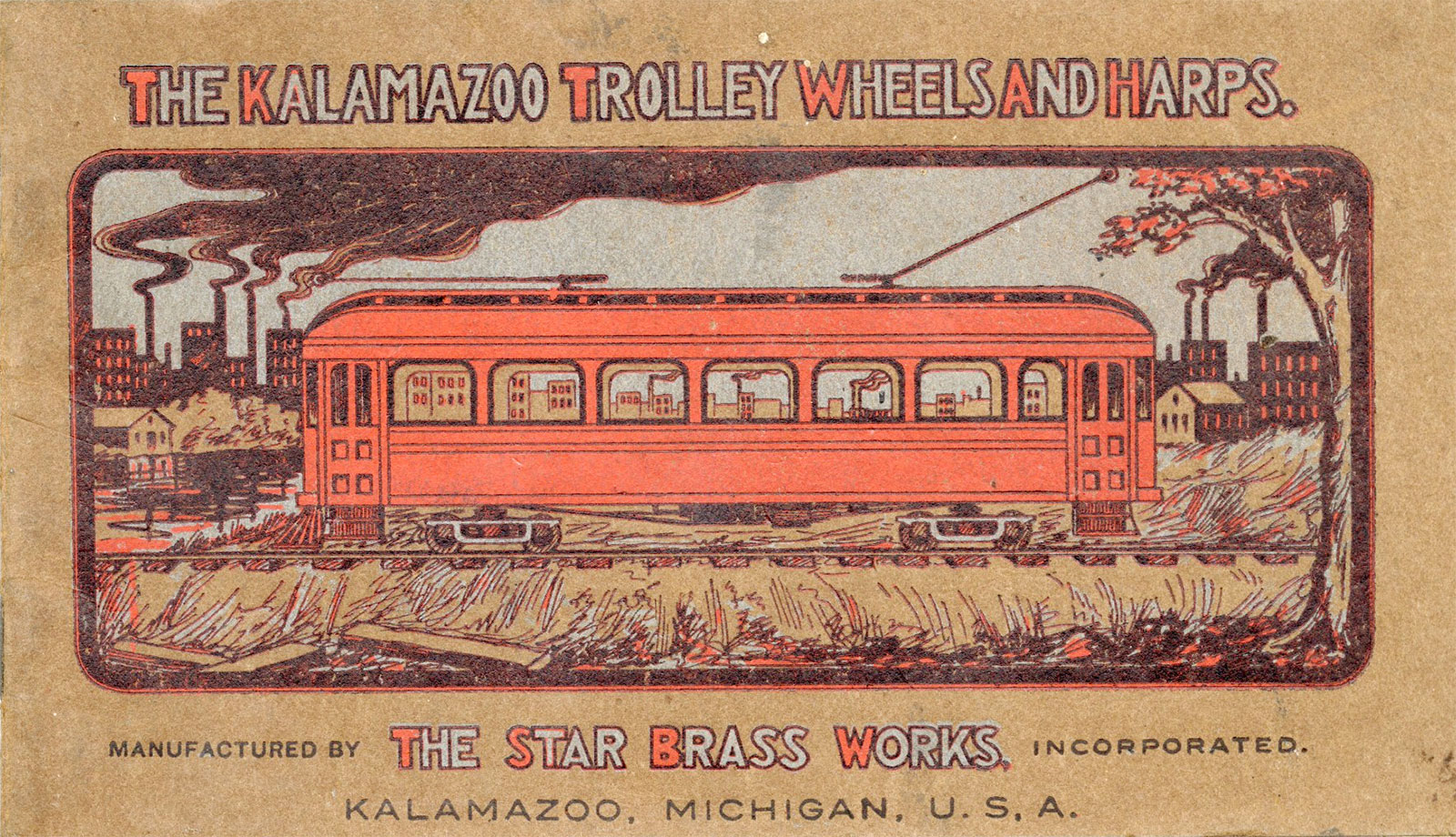 Star Brass Works catalog, c,1900. Kalamazoo Valley Museum
Riding the Rails
By the mid-1890s, urban commuters were “riding the rails” on electric street railway systems and interurban lines. The cars drew their power from electrified overhead wires via poles attached to the top of the car. A specially designed cable harp (bracket) atop the pole held a small trolley wheel that traveled along the wire to provide an electrical connection. These components were prone to wear and required periodic replacement.
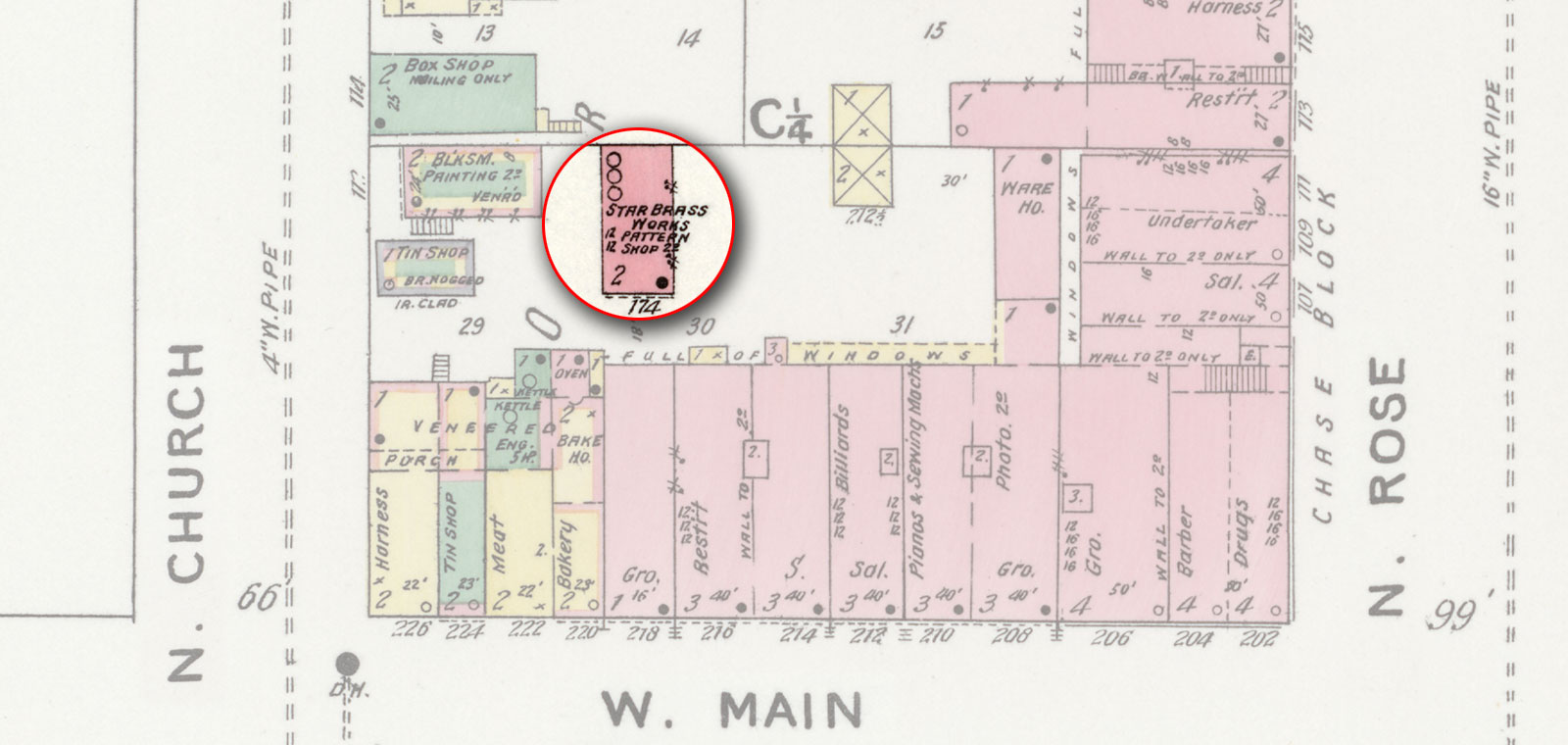 The Star Brass Works, 108 N. Church St. Sanborn Fire Insurance Map, 1896. Kalamazoo Public Library / Library of Congress
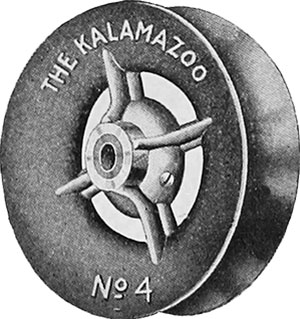 In 1895, Detroit-based manufacturers Fred P. Crockett and Osro Prentiss Johnson opened a small brass foundry on North Church Street in Kalamazoo, where they specialized in “brass and aluminum castings, white metal and bronzes, also novelties in light hardware.” Their business grew quickly, especially after they devised a method to make trolley wheels and harps that were seemingly superior to most others on the market.
Star Brass Works was incorporated in September 1898, with $10,000 in initial capital stock. A local physician and surgeon, Dr. Cornelius Van Zwaluwenberg, was elected company president, Kalamazoo’s 9th district court judge, George M. Buck, became vice president, Prentiss Johnson became secretary, and Kalamazoo’s register of deeds, Henry P. Shutt, was treasurer. Fred Crockett oversaw production as general manager, while Alfred Hicks and Samuel Barker rounded out the company’s board of directors.
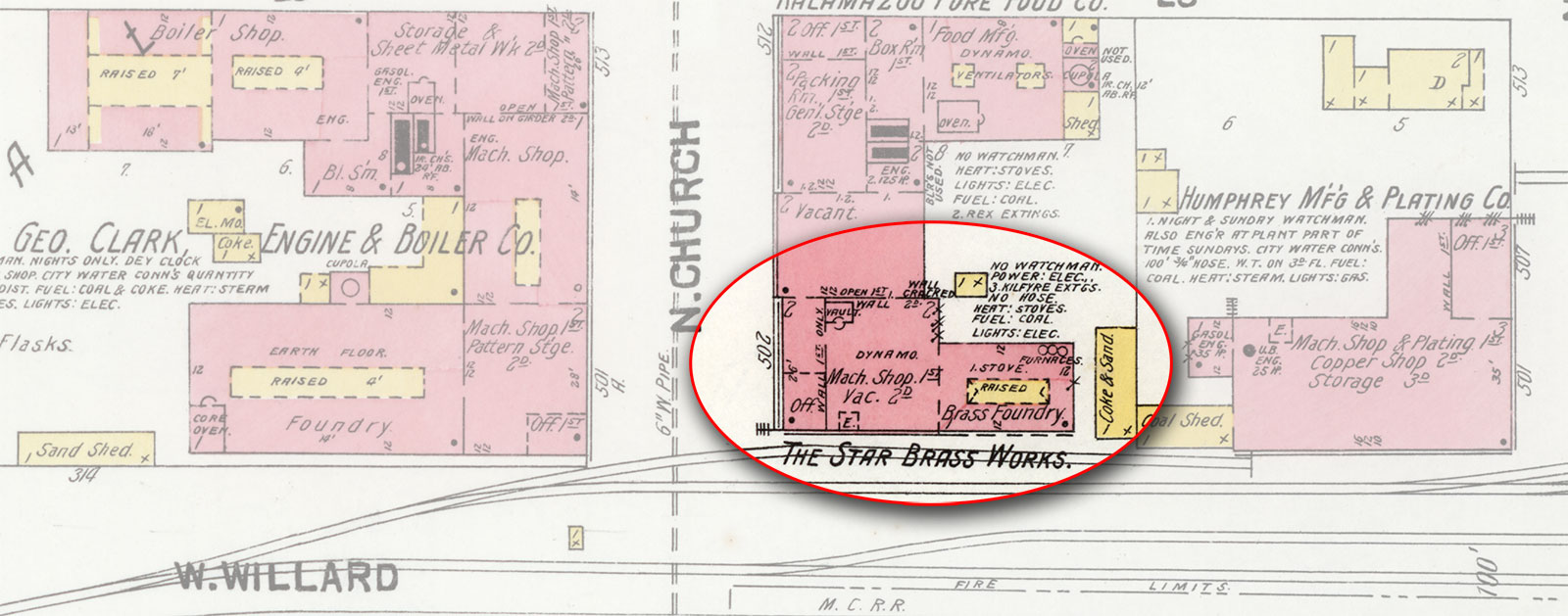 The Star Brass Works, 504 N. Church St. Sanborn Fire Insurance Map, 1902. Kalamazoo Public Library / Library of Congress
The firm grew quickly and was restructured the following year with Horace B. Peck, president; Henry Shutt, vice president; Prentiss Johnson, secretary; and attorney Alfred B. Connable, treasurer. Charles Peck and William S. Dewing joined as directors and capital stock was increased to $20,000. The factory was moved a few blocks northward to a larger facility on the corner of North Church Street and West Willard, next to the Michigan Central Railroad tracks.
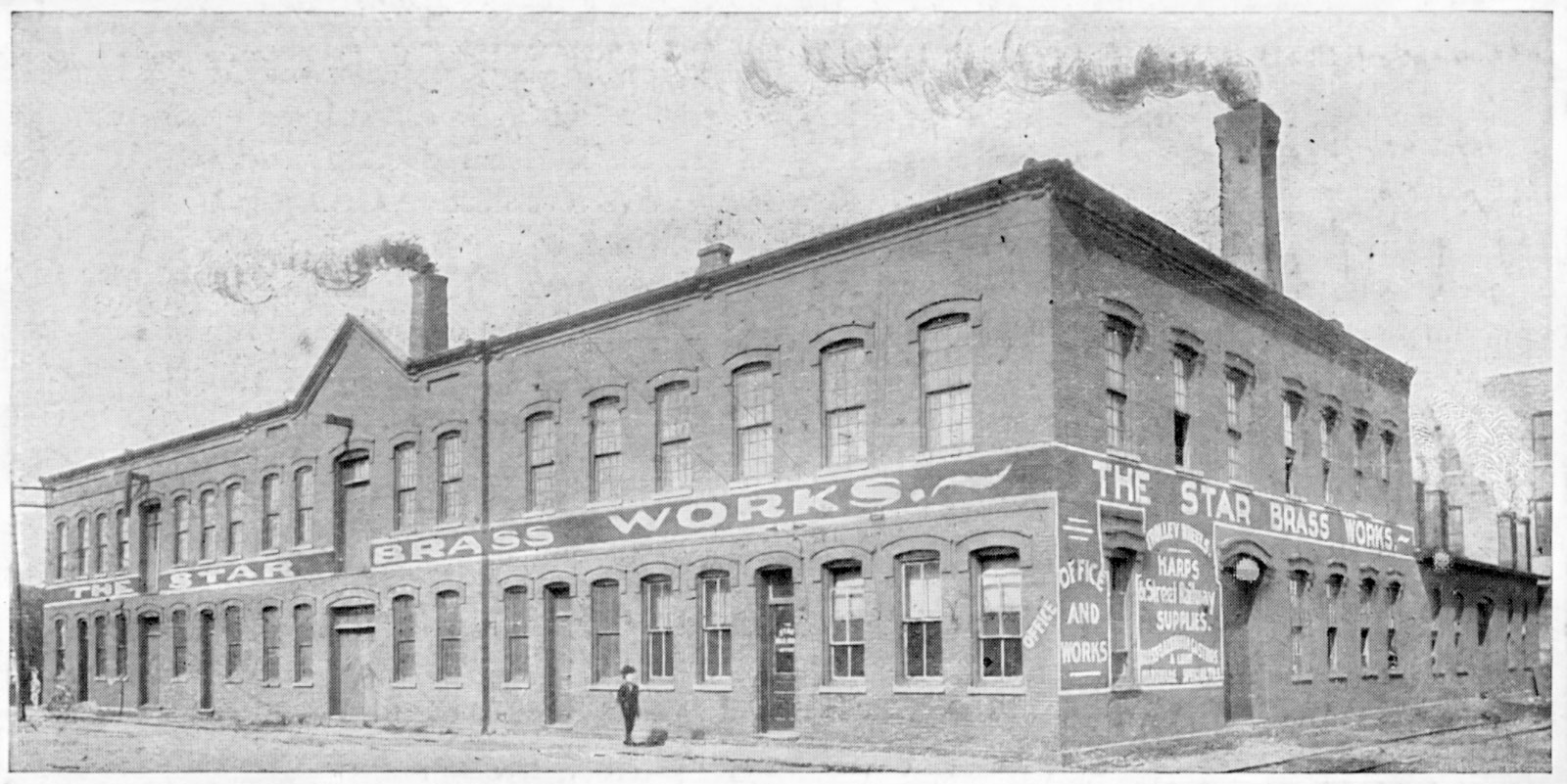 The Star Brass Works, 504 N. Church St., c.1900. Kalamazoo Valley Museum
“The Star Brass Works is well known for its business tact and enterprise, as well as integrity, and its standing in the commercial world is of the highest order. – Southern Trade Record.”
–Kalamazoo Gazette, 14 December 1899
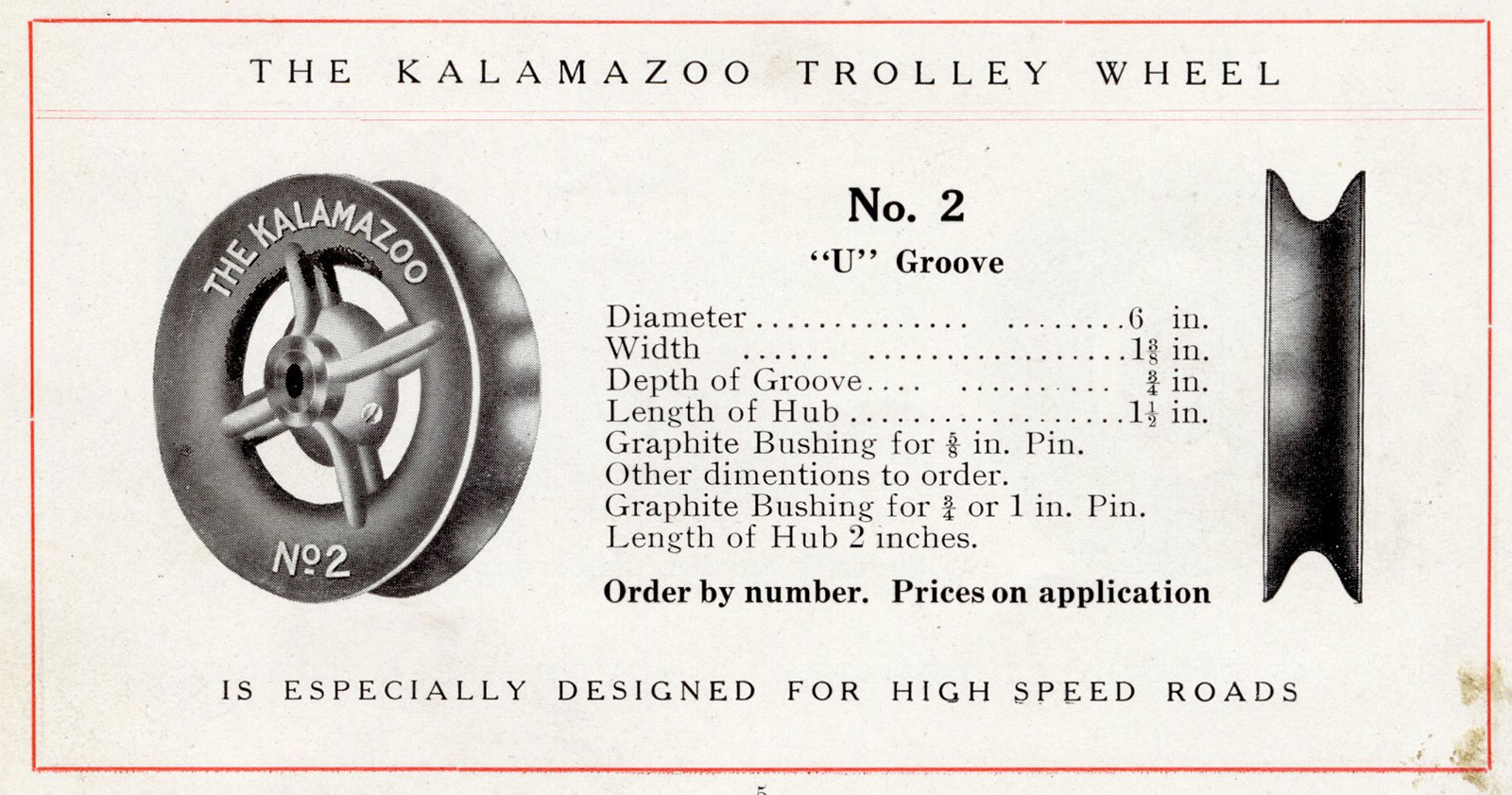 Star Brass Works catalog, c,1900. Kalamazoo Valley Museum
“Largest in the World”
Star Brass Works soon became one of the largest such manufacturers in the country. Their closely guarded trade secret was a unique alloy composed of copper, zinc, tin, and lead, that resulted in a brass wheel that was extremely conductive to electricity yet was remarkably resistant to wear. By 1903, Crockett and Johnson had been granted patents for their designs. D.L. Merrill of Battle Creek had replaced Henry Shutt as vice president, Charles Peck had become president, and Prentiss Johnson was secretary and treasurer. Star Brass Works components were being used by more than 300 streetcar companies nationwide by then, helping power some 28,000 electric streetcars. By 1908, the company was being touted as “the largest exclusive trolley wheel makers in the world.”
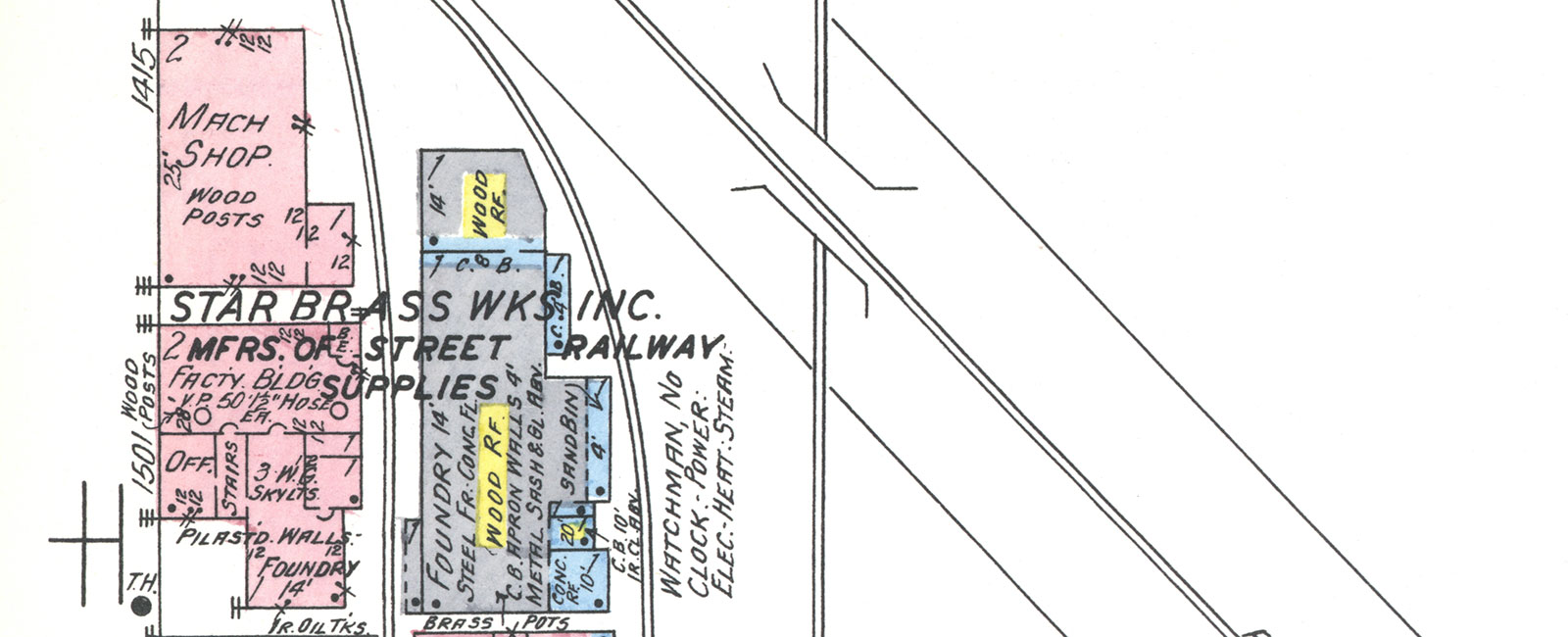 The Star Brass Works on Fulford St., c.1932. Sanborn Fire Insurance Map, 1958. Kalamazoo Public Library / Library of Congress
Fulford Street
As time went on, Star Brass Works diversified and kept growing, despite the decline in the street railway industry. In 1913, the company acquired the Charles B. Ford property and factory building (former Ford Buggy Company) on the east side of Fulford Street next to the Grand Rapids & Indiana Railway line. A second building was added next door at a cost of $7,000 and the firm moved its operation there in October that year.
During the late 1920s and early 1930s, Star Brass Works famously manufactured tone rings for Gibson’s popular prewar Mastertone banjos. A third building was added in 1941, but sales dropped steadily after World War II. The company declared bankruptcy in 1954 and was consolidated as SBW, Inc. The firm ultimately closed its doors in December 1961.
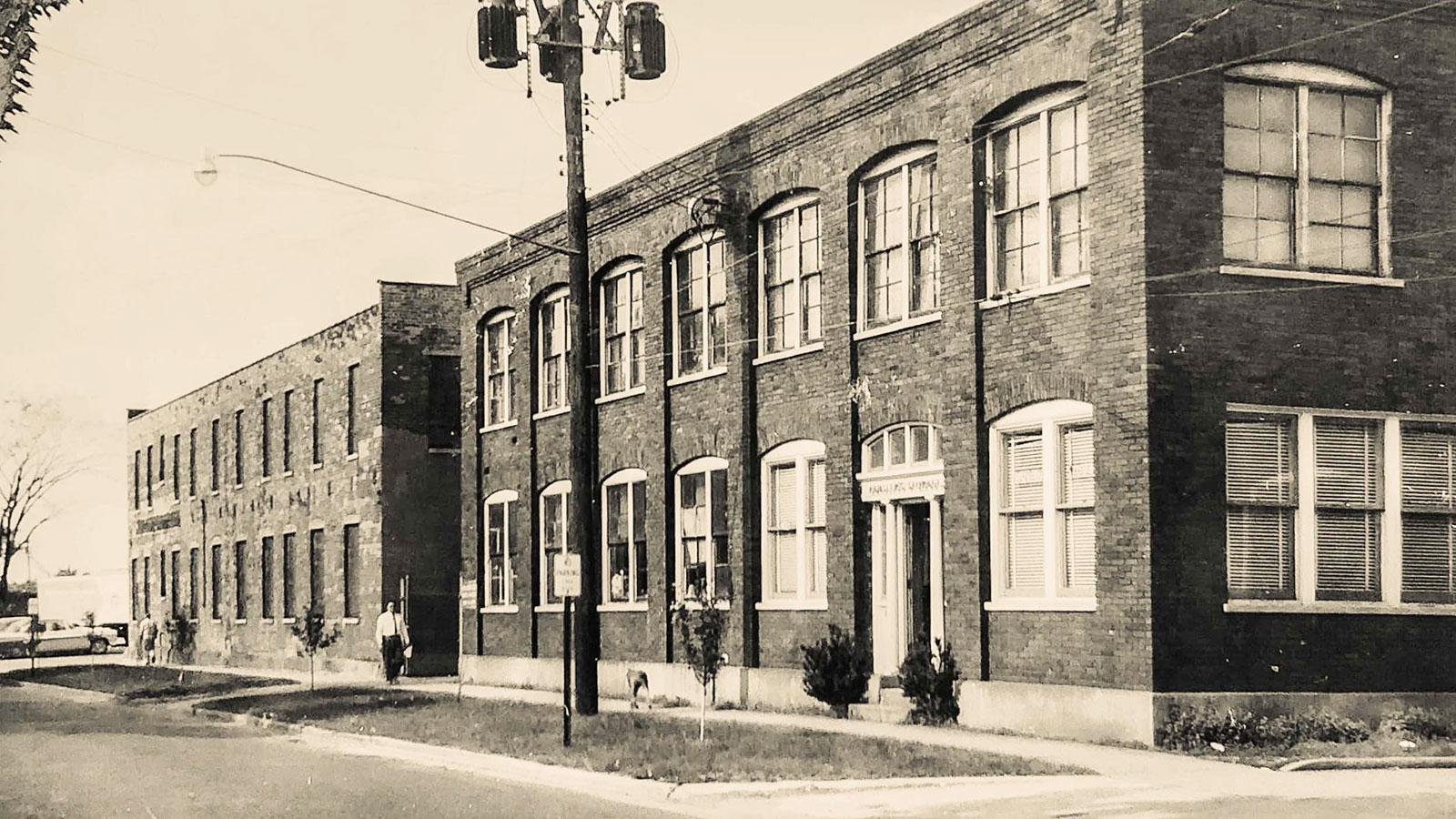 The Star Brass Works buildings on Fulford St., c.1970. Image courtesy, Jerico
Jerico
Today, the former Star Brass Works buildings on Fulford Street have been renovated and repurposed as Jerico, “a community of creative entrepreneurs, makers and artists.” The complex currently houses 23 individual and shared spaces, including artist studios, a coffee shop, music and video production studios, The Clover Room performance space, and more.
Written by Keith Howard, Kalamazoo Public Library staff, December 2025
Sources
Articles
“Jottings”
Kalamazoo Gazette, 3 March 1895, page 5, column 3
“Star Brass Works”
Kalamazoo Gazette, 11 September 1898, page 1, column 3
“Jottings”
Kalamazoo Morning Gazette, 9 July 1899, page 4, column 1
“An industry expanding”
Kalamazoo Morning Gazette, 14 December 1899, page 7, column 3
“Jottings”
Kalamazoo Gazette, 28 June 1900, page 8, column 3
“Very prosperous year”
Kalamazoo Gazette-News, 6 February 1903, page 5, column 2
“Men who help to make Kalamazoo prosper”
Kalamazoo Morning Gazette-News, 8 March 1903, page 12, column 1
“Trolley wheels”
Kalamazoo Gazette-News, 2 August 1903, page 14, column 7
“Star Brass Works”
Kalamazoo Gazette, 24 February 1904, page 2, column 4
“Hold annual meeting”
Kalamazoo Gazette, 9 February 1906, page 3, column 4
“Star Brass Works election”
Kalamazoo Gazette, 8 February 1907, page 8, column 4
Display ad
Kalamazoo Gazette, 6 November 1908, page 8, column 1
“Jottings”
Kalamazoo Gazette, 17 April 1913, page 10, column 3
“Permit record broken”
Kalamazoo Gazette, 7 June 1913, page 1, column 4
“North side news”
Kalamazoo Gazette, 5 October 1913, page 14, column 3
“Star Brass Works purchases factory”
Kalamazoo Gazette, 15 December 1915, page 3, column 2
“Shortage in raw material hampers”
Kalamazoo Gazette, 31 March 1916, page 8, column 1
“‘Trolley Song’ to be swan song for SBW”
Kalamazoo Gazette, 11 June 1961, page 52, column 4
Local History Room Files
History Room Picture Book file: Commercial Kalamazoo
Patents
F.P. Crockett & O.P. Johnson. Trolley Harp. (No Model.) No. 690,639. Patented 7 January 1902.
(Application filed 21 October 1901)
United States Patent and Trademark Office
O.P. Johnson & F.P. Crockett. Trolley Harp or Fork. (No Model.) No. 708,048. Patented 2 September 1902.
(Application filed 26 April 1900)
United States Patent and Trademark Office
F.P. Crockett & O.P. Johnson. Trolley Wheel. (No Model.) No. 725,938. Patented 21 April 1903.
(Application filed 23 January 1899)
United States Patent and Trademark Office