Kalamazoo's Big Three
Ambitious Proprietors Steered Early Village
Even the most casually acquainted student of Kalamazoo history has likely heard about its first white settler and founder, the potato farmer Titus Bronson, a man described as “eccentric” and argumentative, and whose eventual frustration with fellow villagers led to his departure five years after his platting of land we know today as downtown Kalamazoo. But, less attention and historical ink has been paid to three men whose influence arguably far exceeded Bronson’s impact on the growth of the nascent village. Their approach to community development was commercially-focused, eschewing whatever quixotic vision the idiosyncratic Bronson may have held for his settlement, and its evolution. The three pioneers who built the foundation for the small hamlet to evolve into a growing village by 1840 saw in the embryonic Bronson, a real estate opportunity that would both enrich their pockets, and contribute to the social and economic character of early Kalamazoo were “General” Justus Burdick (1793-1849), Thomas C. Sheldon (1794-1854) and Lucius Lyon (1800-1851). If not for these three wily businessmen, the name of the city may well have remained that of the quirky founder, a farmer whose skepticism toward shifty land speculators likely led to his abandoning of all that he found suitable about his settlement.
‘General’ Justus Burdick
The son of John and Phebe Freeman Burdick, Justus hailed from Canaan, New Hampshire, but later moved to Vermont along with his younger brother Cyren. John Burdick was a successful attorney, while his ambitious son embraced a life of business and commercial transactions. Justus married Adeline Mower in 1824 in Woodstock, Vermont, before landing in Detroit, Michigan in 1831. An old friend of Burdick’s, Elon Farnsworth, had written to Burdick, urging him to consider relocating to Detroit.
Upon arriving in Bronson in the summer of 1831 with a considerable amount of capital to spend, there was little to observe but a handful of log cabins, including Bronson’s home. The only commercial building Burdick would have found upon his arrival was Hosea Houston’s store at the corner of Rose and W. Main streets. It was fellow businessman and land speculator Lucius Lyon who had told Burdick about Bronson’s plat while the two of them conducted business in Detroit. The two businessmen were clearly smitten with the area and its potential for commercial and civic expansion. After purchasing most of Bronson’s property for $850, Burdick returned to Vermont. He then entrusted his younger brother Cyren to go to Bronson and oversee his interests. Once settled in town, Cyren set about the construction of the Kalamazoo House, the first major building project in town, and the primary gathering space for business, rest and imbibing. While Justus remained in Vermont until 1837, his capital and influence remained in Michigan, shaping the budding community’s commercial and civic character by infusing various development projects with cash. Some of that wealth was put toward the building of the first St. Luke’s Episcopal Church, located on Park and W. Main. Burdick later played a major role in the financing of the first courthouse building, erected in 1838-39. Leftover lumber from the courthouse construction was used to build his home along the 100 block of W. Main, a building which still stands today, albeit removed from its original setting.
1834 was an important year in determining the small village’s future. Despite beating out Comstock as the county seat in 1831, development had been slow. Several key developments would ultimately contribute to the population boom and popularity of Bronson. Thomas C. Sheldon, receiver of the land office in White Pigeon, partnered with Burdick, Lucius Lyon and Bronson to replat the town, “extending the village to the east and assuring the intersection of Portage and East Main at just the point where Sheldon now owned the Kalamazoo House.” (Massie, 22) This second plat created the dogleg at E. Main and Portage Street, a configuration that would suggest that Sheldon, Burdick and Lyon had much to do with the layout, given their financial interests in steering travelers from the south, east and west to the nearby Kalamazoo House. Shortly after Sheldon relocated the land office to Bronson, just across the street from the Kalamazoo House, the Michigan Statesman newspaper, owned by Henry Gilbert, also abandoned White Pigeon for Bronson. With the land office in town, and the price of an acre at $1.25, people began to pour into Bronson carrying with them their various aspirations, financial schemes, trade skills, and can-do pioneer spirit. At this same time, the territorial legislature approved the establishment of a State Bank of Michigan branch in Bronson, further insulating the local economy from the “wildcat bank” fever (Massie, 23). In 1837, Burdick, Sheldon and Sheldon’s nephew Theodore P. Sheldon were trustees of the local State Bank of Michigan, thus deepening their sway over local financial affairs.
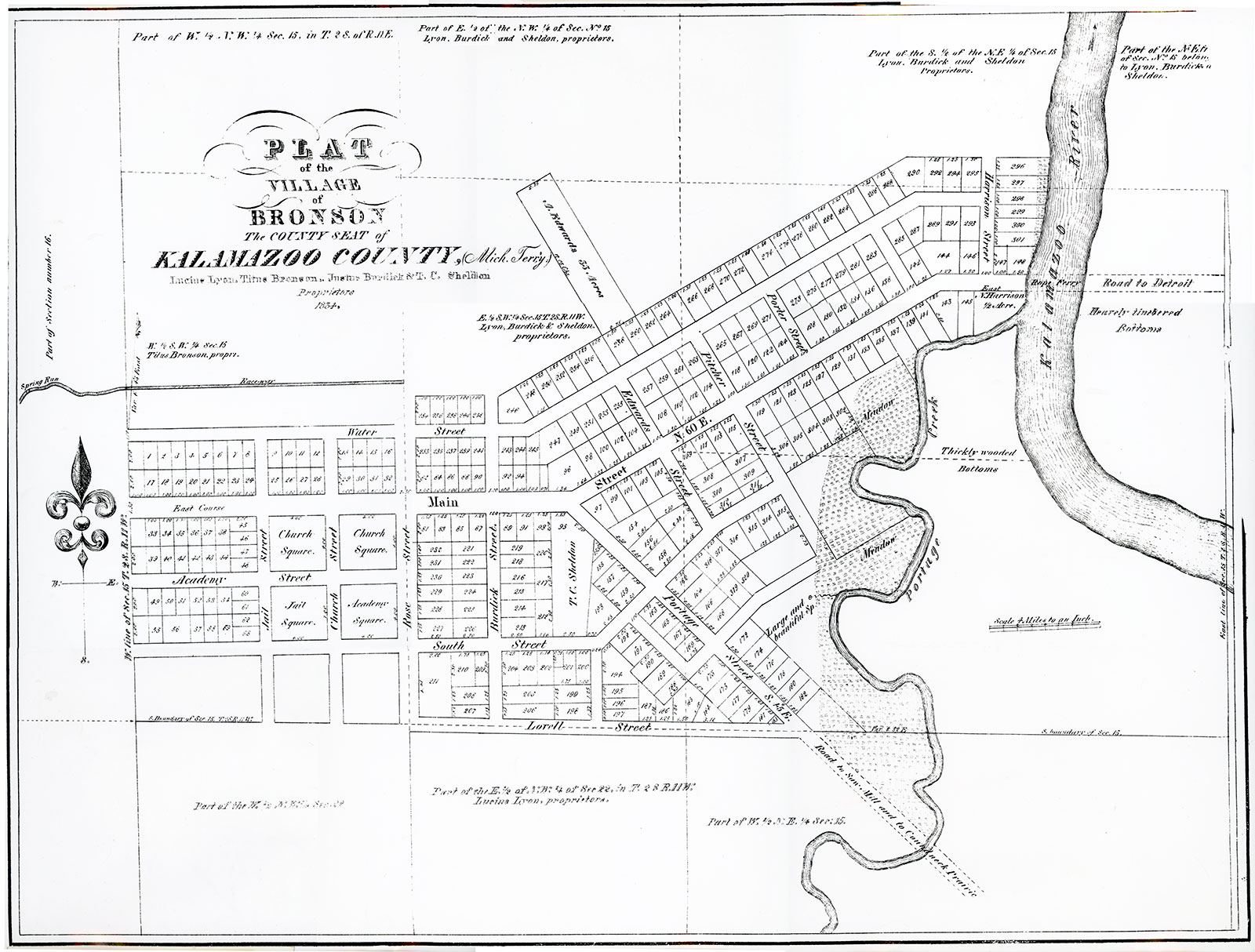 1834 plat map of the Village of Bronson, showing the new dogleg at Main and Portage. Local History Collection
Thomas C. Sheldon
Sheldon, who held the position of land office receiver until 1849 had been born in Little Falls, New York. Sheldon had been a sutler in the war of 1812. He left New York for Mackinaw, and then later to Detroit, where he was the sheriff of Wayne County from 1826 to 1829. He then assumed the role of Receiver of Public Moneys in the land office, then located in Wayne County before being transferred to White Pigeon in 1831. His nephew Theodore P. Sheldon was his chief clerk while administering the land office.
“Thomas C. Sheldon was a man of massive build, of average height, but with extraordinary shoulders and torso. Sometimes, just to show what he could do, he would take up a barrel of pork and hold it on his knees apparently with the utmost ease.”
The Story of Detroit, p.288
Sheldon built a home “on the beautiful knoll that sloped toward the Kalamazoo House near East Main and Portage streets. This place was long known as ‘Tom Sheldon’s residence.’”
Lucius Lyon
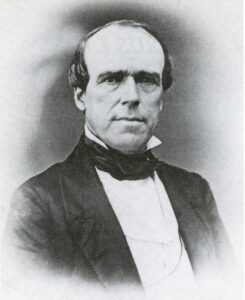 Lucious Lyon, c.1840s
The founder of the towns of Schoolcraft (Lyon was friends with Henry Rowe Schoolcraft) and Lyon was Lucius Lyon. One of territorial Michigan’s most important figures, he also served as a land surveyor in the early 1820s and Michigan’s first U.S. Senator. Lyon was also an influential and powerful force in land speculation, having had financial interests in Schoolcraft, Kalamazoo, Grand Rapids, Ypsilanti, and Madison, Wisconsin. Like his business partner Justus Burdick, Lyon hailed from Vermont. Born on a farm in 1800 near Burlington, Lyon eventually made his way westward as an educator. He landed in Detroit in 1821 with John Farmer, the two of them working at a ladies seminary. Two years later, he became a surveyor, contracted by the federal government. His travels took him all over the midwest before he focused on business and politics around 1832. Along with John S. Norvell, Lyon represented Michigan as a U.S. Senator from 1837 to 1839. His business affairs were varied and many, and included helping to finance Hiram Moore’s innovative combine harvester, and a less successful venture at manufacturing salt from a well in Grand Rapids. While managing his interests in Bronson, Lyon wrote to his sister Lucretia in 1833:
“The place where I now write is the seat of justice for one of the richest and most productive counties in our Territory and although there are now but two stores and about a dozen dwelling houses, it will in a few years be one of the finest villages in the western part of the peninsula. It is situated on the southwest side of the Kalamazoo river about 50 miles above its mouth and about 140 miles west from Detroit. I own one third of the village plat and about 160 acres of land adjoining, which must in a few years be very valuable.” (Lane, 143-44)
It appears there was tension between Bronson and the other three proprietors of the village. A deep schism between the four had formed around the view that Bronson’s eccentric, outspoken personality ran counter to his partners’ determination to promote the village as a place to settle and to spend money. Bronson has been depicted as oppositional toward the business and political classes by historians, an outlook that likely irritated his pro-growth business partners.
“Bronson had many enemies, for he was a talker and freely expressed his views against liquor and tobacco and against politicians as a class. He was besides, scrupulously honest and upright, had no patience with dishonesty and meanness, was generous to a fault.”
—Living In Kalamazoo
The campaign begun in late 1835 to rename Bronson and Arcadia Township eventually succeeded in March of 1836, the likely result from pressure put on the legislature by Bronson’s three partners. There was also the issue of confusion over having two villages named Bronson (Bronson, Branch Co.), and the problems it played in providing effective postal service. Lyon and others, including Epaphroditus Ransom pushed to have the name changed as soon as possible. And with that, a deflated Titus Bronson, sold the rest of his interests and left the newly renamed village for Iowa. Shortly thereafter, Lyon also sold most of his interests in the village of Kalamazoo, severing ties with Sheldon and Burdick, focusing mostly on his properties in Grand Rapids. By the early 1840’s all three businessmen had abandoned their financial stock in the Kalamazoo House.
Article written by Ryan Gage, Kalamazoo Public Library staff, November 2025
Sources
Books
Kalamazoo: the place behind the products
Larry B. Massie and Peter J. Schmitt
Sun Valley, Calif. : American Historical Press, 1998
H 977.418 M417A
The Story of Detroit
George B. Catlin
[Detroit] Detroit news, 1923
H 977.434 C365
Lucius Lyon: an eminently useful citizen
Kit Lane
Douglas, Mich. : Pavilion Press, c1991
H 921 L989L
Living in Kalamazoo
Ethel Balls and Marie Lassfolk
1958
H 977.418 B19
Articles
“Gen. Justus Burdick one of four first proprietors here”
Kalamazoo Gazette, 18 October 1925
“Kalamazoo owes much to Burdick”
Kalamazoo Gazette, 18 October 1925
“Thomas C. Sheldon came here in ’34 with land office”
Kalamazoo Gazette, 18 October 1925
“Lucius Lyon, early leader in Michigan, was Schoolcraft founder”
Kalamazoo Gazette, 14 February 1929
Local History Room Files
Name File: Burdick, Justus (Gen.)
Name File: Lyon, Lucius
Name File: Sheldon, Thomas C.