Samuel J. Dunkley (1861-1923)
Kalamazoo Inventor and Entrepreneur
Samuel Dunkley was both an entrepreneur and an inventor. The son of Kalamazoo’s well-known “Celery King,” Dunkley not only took over the family celery business, but also developed his own railroad line, operated a Lake Michigan steamship line, invested in a medicinal chemical company, established several fruit and vegetable canneries around West Michigan, and played an active role in developing South Haven as a summer resort. Dunkley also held more than 30 patents for devices and processes that revolutionized the fruit preservation and canning industry.
 Dunkley Celery and Preserving Co. letterhead, c.1896. Kalamazoo Public Library
Born in Kalamazoo in 1861, Samuel Dunkley was the son of Joseph Dunkley (1836-1898) and Mary Wilson Dunkley (1835-1877). Samuel received his education in Kalamazoo Public Schools, and in 1879, he married Ida E. Wing (1856-1935), a resident of Schoolcraft. The couple settled in Kalamazoo, where they raised two children: son Melville E. Dunkley (b.1881) and daughter Pearl O. Dunkley (b.1883).
Dunkley operated a house decorating company in Kalamazoo for a time and worked as a traveling salesman for his father, one of the community’s leading celery and flower growers. By 1891, Samuel had started his own business of manufacturing “Celery Tablets” (celery-flavored candies) on South Rose Street near the Academy of Music.
 Shakespeare Block (northeast corner of North Rose and Water streets), c.1891. Kalamazoo Public Library photo file P-176
Smith & Dunkley
Turn-of-the-century Americans had a curious taste for celery, so Dunkley’s business grew rapidly. He moved for a brief time to rooms in the Shakespeare Block on North Rose Street, then formed a partnership with Robert W. Smith as Smith & Dunkley and moved again to a larger space on Exchange Place at the rear of Smith’s East Main Street wallpaper and paint store. By December 1891, Dunkley and Smith were manufacturing a variety of celery-based products, including a soft drink they first called “Celery Tonic,” which would later become famously known as “Celerytone.” The firm employed 45 workers by then and was shipping celery confections to New York, Colorado, Texas, and throughout the Midwest.
In January 1893, Smith left town and seemingly disappeared, leaving Dunkley on his own to reorganize the firm as Dunkley & Co. Dunkley then contracted with A.M. Todd to build a new factory building on the south side of Eleanor Street, west of North Church Street.
 The Dunkley Celery Company, 315 Eleanor St., c.1900. Glass plate negative courtesy, Kalamazoo Valley Museum, object ID 61.401.A
By the summer of 1895, Dunkley was processing up to 50 bushels of fruit per day, putting up plums, pears, cherries, strawberries, blackberries, red raspberries, and peaches in Dunkley’s own patented glass bottles. The jars themselves were manufactured exclusively for Dunkley at a glass factory in Anderson, Indiana, and shipped to the factory in Kalamazoo by the railroad carload.
 Dunkley Celery Company, 315 Eleanor St., Kalamazoo. Sanborn Fire Insurance Map, 1896. Library of Congress
Dunkley the Inventor
During his lifetime, Dunkley designed and patented more than 30 devices that would revolutionize the canning industry, from fruit jars and peach peelers to canning machines and pitting tools. In 1905, the Chicago-based Automatic Vacuum Canning Company sold rights to Dunkley’s patented canning machine to some 35 canning factories in California, a deal at the time said to be worth $875,000 (roughly $31 million today).
 S.J. Dunkley, “Jar.” No. 673,048, patented 30 April 1901. United States Patent and Trademark Office
Dunkley Celery and Preserving Co.
In May 1896, the firm was incorporated as the Dunkley Celery and Preserving Company, with Samuel Dunkley as company president, sled manufacturer Hale D. Kauffer as vice president, attorney Elbert S. Roos as secretary, and grocer Edward H. Ranney as treasurer. The company was manufacturing all things celery by then, from canned celery and celery mustard, to celery salad, celery salt, celery pepper, “Celeryade Drops” candies, and “Dunkley’s genuine celery remedies.”
 Dunkley Celery and Preserving Company, South Haven. Sanborn Fire Insurance Map, 1896. Library of Congress
“South Haven by the Sea”
By the 1890s, not only was South Haven a crucial shipping port on the Great Lakes for fruit and vegetable growers, but also it had become a choice vacation spot—a seaside resort of sorts—for many thousands of Chicagoans, thanks to the booming steamship trade. Advertisers called it “South Haven by the Sea.”
As the fruit processing business grew, Dunkley and his associates expanded the firm with a new canning factory in South Haven, next to the Michigan Central Railroad line. Construction began in the spring of 1896, and by August, the South Haven factory was up and running, with 65 laborers working around the clock, putting up fancy Michigan berries, peaches, plums, and pears for market. At the time it was said to be the largest canning factory in the world. Dunkley Avenue and Celery Pond now marks the factory’s former location near the Kal Haven Trailhead. Along with its operations in Kalamazoo and South Haven, the Dunkley company eventually established canning factories in Hartford, Mattawan, Grant, and Frankfort.
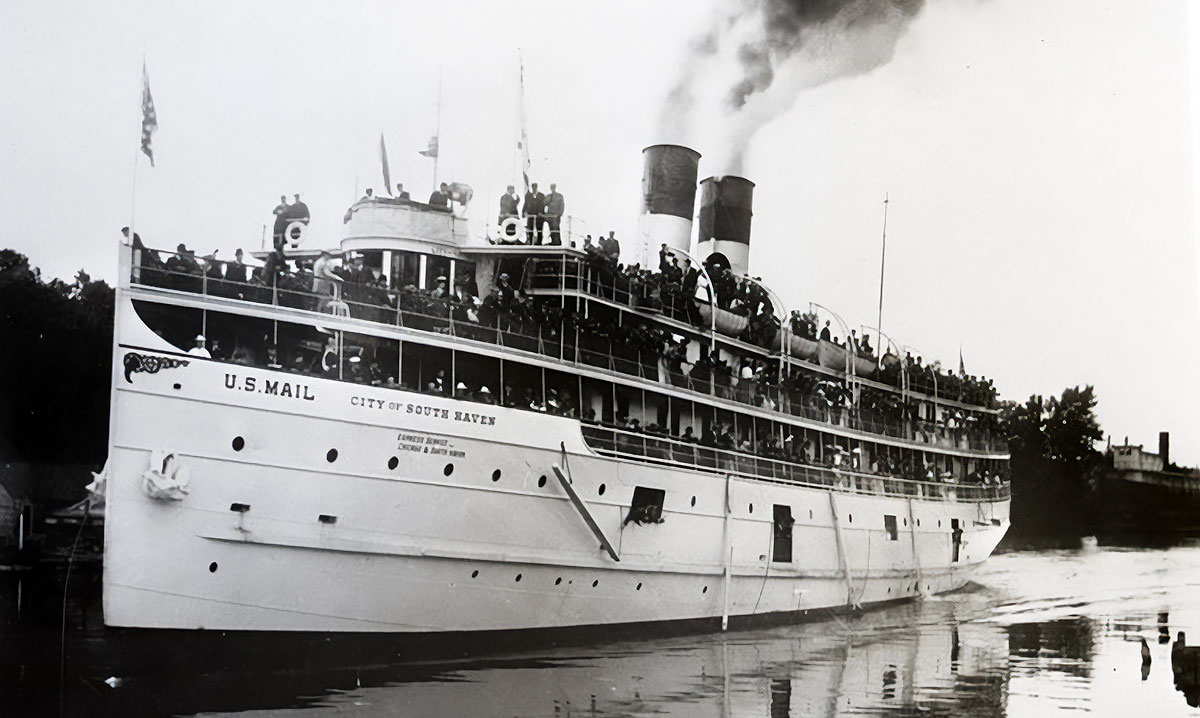 Dunkley-Williams steamer “City of South Haven” c.1905. Historical Association of South Haven
“About 50 Kalamazoo citizens took passage on the new steamer City of Kalamazoo at South Haven Monday evening for Chicago. It was the first trip of the boat across the lake. This steamer belongs to the H.W. Williams Transportation company and is a beauty.”
—Kalamazoo Gazette, 19 May 1893
Dunkley-Williams Transportation Co.
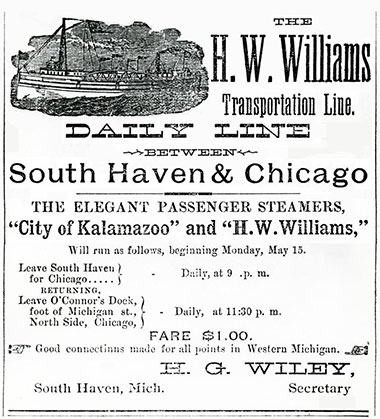 Ad c.1893. Historical Association of South Haven
In 1885, American timber magnate Henry W. Williams sold his lumber business and set up the Williams Transportation Line in South Haven. With elegant excursion steamers like the “H. W. Williams” and the “City of St. Joseph,” Williams began shuttling passengers and freight back and forth across Lake Michigan between South Haven and Chicago. By 1893, the recently launched “City of Kalamazoo” was making daily runs across the lake, filled bow to stern with passengers bound for the Chicago World’s Fair.
Meanwhile, Samuel Dunkley had entered the Lake Michigan steamship trade by opening his own shipping line between South Haven and Chicago with a single steamer named “Petoskey.” In 1902, while flush with cash from his booming patent medicine and canning trade, Dunkley purchased a controlling interest in the long-established Williams Transportation Line to form the Dunkley-Williams Transportation Company. The new company would offer freight and passenger service between Chicago and South Haven, along with a new passenger line between South Haven and Milwaukee. This gave Dunkley’s fruit operation even greater access to the lucrative markets in Chicago and beyond.
 Postcard view of the Dunkley-Williams docks at South Haven, c.1907. Author’s collection
By 1903, the Dunkley-Williams company was operating a fleet of at least six steamships on Lake Michigan, including the “City of South Haven,” the “City of Kalamazoo,” the “Eastland,” the “H. W. Williams,” the “Petoskey,” and the “Glenn.” Round trip fare from Kalamazoo to Chicago via South Haven in 1902 was $3.88.
“Fruit Belt Line”
To help feed his new shipping company, Dunkley attempted to open an electric interurban line that would offer fast and efficient freight and passenger service between Kalamazoo and South Haven. For a variety of reasons, Dunkley’s electric line never materialized, but he did manage to get the Kalamazoo, Lake Shore & Chicago Railroad (KLS&C) steam train up and running by 1907. This became known as the “Fruit Belt Line.”
 KLS&C locomotive #37 near the Michigan Basket Warehouse in Paw Paw c.1906. Charles Grice is standing between the coal tender and the locomotive, others are unidentified. It’s plausible that Samuel J. Dunkley is the man standing on the front of the locomotive to the far right. Published in the Kalamazoo Gazette, 23 June 1996. Postcard photo courtesy, Tom Maas.
From there, things gradually began to fall apart for Samuel Dunkley. The Dunkley-Williams Transportation Company went into receivership in 1909 and was dissolved. Dunkley and others attempted to revive the “Celerytone” beverage as an “antidote for nervousness, exhaustion, headaches, insomnia and impotency,” but the claims were largely baseless, and its success was short-lived. The Kalamazoo, Lake Shore & Chicago Railroad ran for some 17 years, although it seldom turned a profit. It, too, was eventually abandoned. Dunkley retired from the fruit canning business and moved to California, where he spent the last years of his life defending patent rights as his health began to decline. Samuel Dunkley passed away in January 1923 at the age of 64.
Written by Keith Howard, Kalamazoo Public Library staff, July 2025
Sources
Articles
Display ad
Kalamazoo Gazette, 3 June 1885, page 2, column 6
“Fine house decorating”
Kalamazoo Gazette, 10 April 1887, page 6, column 2
“Local gleanings”
Kalamazoo Gazette, 3 April 1891, page 3, column 3
“Five tons of celery tablets”
Kalamazoo Gazette, 20 December 1891, page 2, column 5
“That trial trip”
Kalamazoo Gazette, 19 May 1893, page 1, column 5
Display ad
Kalamazoo Gazette, 21 May 1893, page 8, column 3
“Michigan corporations”
Kalamazoo Gazette, 24 May 1896, page 3, column 4
“Annual meetings”
Kalamazoo Gazette, 10 January 1899, page 4, column 4
“Will can much small fruit”
Kalamazoo Morning Gazette, 27 May 1899, page 1, column 6
“Dunkley celery”
Kalamazoo Morning Gazette, 1 August 1899, page 1, column 4
“Dunkley celery & preserving co.”
Kalamazoo Morning Gazette, 27 August 1899, page 8, column 4
“With a capital of $250,000”
Kalamazoo Gazette-News, 26 May 1901, page 3, column 3
“Steel steamer”
Kalamazoo Gazette-News, 31 May 1901, page 1, column 2
“Dunkley Co. may purchase Williams line”
Kalamazoo Gazette-News, 15 March 1902, page 1, column 1
“Consolidation is effected”
Kalamazoo Gazette-News, 23 March 1902, page 2, column 4
“New electric road to enter”
Kalamazoo Gazette, 7 April 1905, page 2, column 2
“Dunkley-Williams receivership is on”
Kalamazoo Gazette, 23 January 1909, page 3, column 2
“To sell valuable marine properties”
Kalamazoo Gazette, 10 February 1909, page 10, column 2
“Trustee’s sale”
Kalamazoo Evening Telegraph, 24 February 1909, page 8, column 7
“Dunkley-Williams line will be bought”
Kalamazoo Gazette, 15 April 1909, page 3, column 3
“Celerytone Co. is incorporated”
Kalamazoo Evening Telegraph, 28 June 1910, page 1, column 7
“‘Celerytone from Kalamazoo straight from the heart of the plant to you’ new catch phrase”
Kalamazoo Gazette, 7 July 1912, page 13, column 1
“S.J. Dunkley, 64, dies of pneumonia”
Kalamazoo Gazette, 19 January 1923, page 1, column 5; page 25, column 6
“Dunkley company property sold”
Kalamazoo Gazette, 29 December 1926, page 2, column 3
Patents
S.J. Dunkley. Jar and fastener. No. 533,282. Patented 29 January 1895.
United States Patent and Trademark Office
S.J. Dunkley. Celery package. No. 546,463. Patented 17 September 1895.
United States Patent and Trademark Office
S.J. Dunkley. Fruit jar or can. No. 610,897. Patented 20 September 1898.
United States Patent and Trademark Office
S.J. Dunkley. Jar. No. 673,048. Patented 30 April 1901.
United States Patent and Trademark Office
S.J. Dunkley. Design for a basket cover. No. 35,098. Patented 17 September 1901.
United States Patent and Trademark Office
S.J. Dunkley. Jar. No. 721,166. Patented 24 February 1903.
United States Patent and Trademark Office
S.J. Dunkley. Fruit basket. No. 724,170. Patented 31 March 1903.
United States Patent and Trademark Office
S.J. Dunkley. Canning machine or apparatus. No. 779,537. Patented 10 January 1905.
United States Patent and Trademark Office
S.J. Dunkley. Peach splitting and pitting machine. No. 794,598. Patented 11 July 1905.
United States Patent and Trademark Office
S.J. Dunkley. Automatic processing or cooking and cooling machine. No. 805,844. Patented 28 November 1905.
United States Patent and Trademark Office
S.J. Dunkley. Machine or apparatus for automatically processing or cooking and cooling canned food. No. 805,845. Patented 28 November 1905.
United States Patent and Trademark Office
S.J. Dunkley. Peach splitting and pitting machine. No. 921,523. Patented 11 May 1909.
United States Patent and Trademark Office
S.J. Dunkley. Cherry pitting machine. No. 974,759. Patented 1 November 1910.
United States Patent and Trademark Office
S.J. Dunkley. Machine for peeling peaches and other fruit. No. 1,104,175. Patented 21 July 1914.
United States Patent and Trademark Office
S.J. Dunkley. Driving means for motor driven railway cars. No. 1,222,610. Patented 17 April 1917.
United States Patent and Trademark Office
S.J. Dunkley. Process of peeling peaches or other fruits or vegetables. No. 1,237,623. Patented 21 August 1917.
United States Patent and Trademark Office
S.J. Dunkley. Machine for halving or splitting peaches. No. 1,329,755. Patented 3 February 1920.
United States Patent and Trademark Office
S.J. Dunkley. Pitting knife. No. 1,353,328. Patented 21 September 1920.
United States Patent and Trademark Office
S.J. Dunkley. Water spray section of peeling machines. No. 1,362,930. Patented 21 December 1920.
United States Patent and Trademark Office
S.J. Dunkley. Pitting knife. No. 1,370,098. Patented 1 March 1921.
United States Patent and Trademark Office
S.J. Dunkley. Pitting knife for pitting peaches or similar fruits. No. 1,370,099. Patented 1 March 1921.
United States Patent and Trademark Office
S.J. Dunkley. Peach pitting tool. No. 1,374,288. Patented 12 April 1921.
United States Patent and Trademark Office
S.J. Dunkley. Paring and pitting knife. No. 1,374,289. Patented 12 April 1921.
United States Patent and Trademark Office
S.J. Dunkley. Pitter knife. No. 1,374,290. Patented 12 April 1921.
United States Patent and Trademark Office
S.J. Dunkley. Mixing tank. No. 1,374,291. Patented 12 April 1921.
United States Patent and Trademark Office
S.J. Dunkley. Apparatus and process for peeling fruit and vegetables. No. 1,396,268. Patented 8 November 1921.
United States Patent and Trademark Office
S.J. Dunkley. Lyeing section of peeling machines. No. 1,427,269. Patented 29 August 1922.
United States Patent and Trademark Office
S.J. Dunkley. Peeling apparatus and process. No. 1,427,270. Patented 29 August 1922.
United States Patent and Trademark Office
S.J. Dunkley. Means for regulating and controlling the strength of lye solution. No. 1,429,129. Patented 12 September 1922.
S.J. Dunkley. Lye regulator for peach peeling machines. No. 1,439,618. Patented 19 December 1922.
United States Patent and Trademark Office
S.J. Dunkley. Electrically controlled regulating valve. No. 1,509,345. Patented 23 September 1924.
United States Patent and Trademark Office
S.J. Dunkley. Hydrometer. No. 1,827,841. Patented 20 October 1931.
United States Patent and Trademark Office