Henry W. Coddington (1828-1895)
19th-Century Kalamazoo Architect and Builder
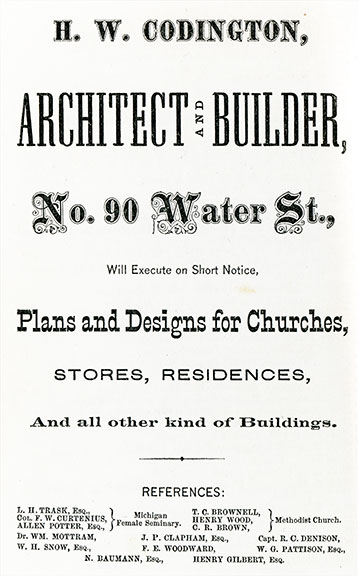 Kalamazoo County Directory, 1869-1870.
Kalamazoo Public Library
During the second half of the 19th century, Henry W. Coddington was a “reliable and well-known architect and builder,” who was responsible for numerous churches, commercial buildings, and fine residential homes in Kalamazoo and elsewhere in Michigan, Indiana, and Illinois. Wrote the Kalamazoo Gazette in 1895, “many costly and beautiful edifices testify to his skill, both as a designer and builder.”
Born on 20 August 1828, Henry Coddington was the son of Martha and Samuel Osborn Coddington of Geneva, Ontario County, New York. The Coddingtons raised a large family—seven or more children—and at least three of their sons became career carpenters, two of whom (William W. Coddington and Henry W. Coddington) ended up in Kalamazoo.
After completing his formal education in Geneva, Henry Coddington learned his trade in the town of Dansville in Livingston County, New York, 50 miles or so south of Rochester. He also spent time working as a carpenter in New York City and Chicago. By 1850, Coddington had found his way to Michigan and was working in Grand Rapids.
While in Dansville, he met Jane Augusta “Jennie” Clute (1828-1902) of nearby Covington, New York, and on Christmas Eve, 1856, they were married. The service was officiated by the bride’s brother, Rev. N.M. Clute. Also in attendance was Jennie’s sister, Sarah A. Clute, who would later become one of the first instructors at the Michigan Female Seminary in Kalamazoo.
In September 1857, Henry and Jennie Coddington moved to Kalamazoo, where Henry took up work with the leading local builders, Bush & Paterson. The Coddingtons settled in a modest home with an expansive front dooryard, located at the northwest corner of Walnut and Burdick streets (86 South Burdick Street), where they raised their three sons: Hebber H. Coddington (born 1861), Wilbur A. Coddington (born 1865), and Louis A. Coddington (born 1870).
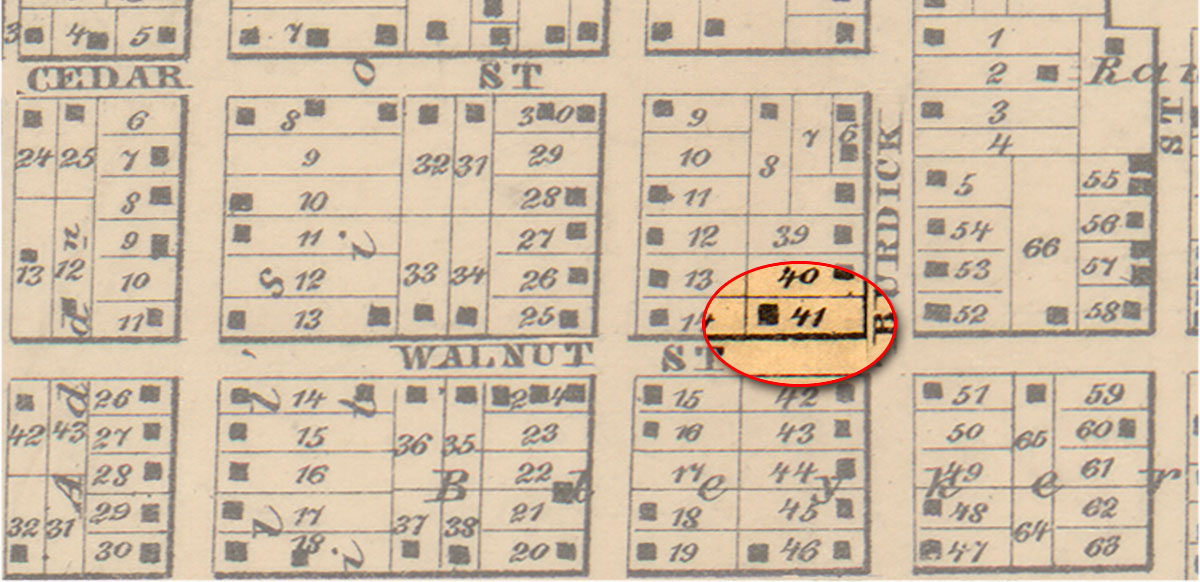 Coddington’s first home (lot 41). Map of Kalamazoo Co., Michigan. Published by Geil & Harley, Philadelphia, 1861. Library of Congress
After a brief time with Bush & Paterson, Coddington formed a partnership with William O. Tuttle, a well-known local builder and contractor. The partnership proved short-lived, however, and in November 1861, the two went their separate ways. Tuttle moved on to Chicago, while Coddington remained in Kalamazoo and continued the business on his own. He set up a workshop and office on the north side of West Water Street (90-94 Water Street), a block west of the Lawrence & Chapin building. During the Civil War, Coddington registered for military service on 1 July 1863 at Kalamazoo, although there is no evidence that he was called for service.
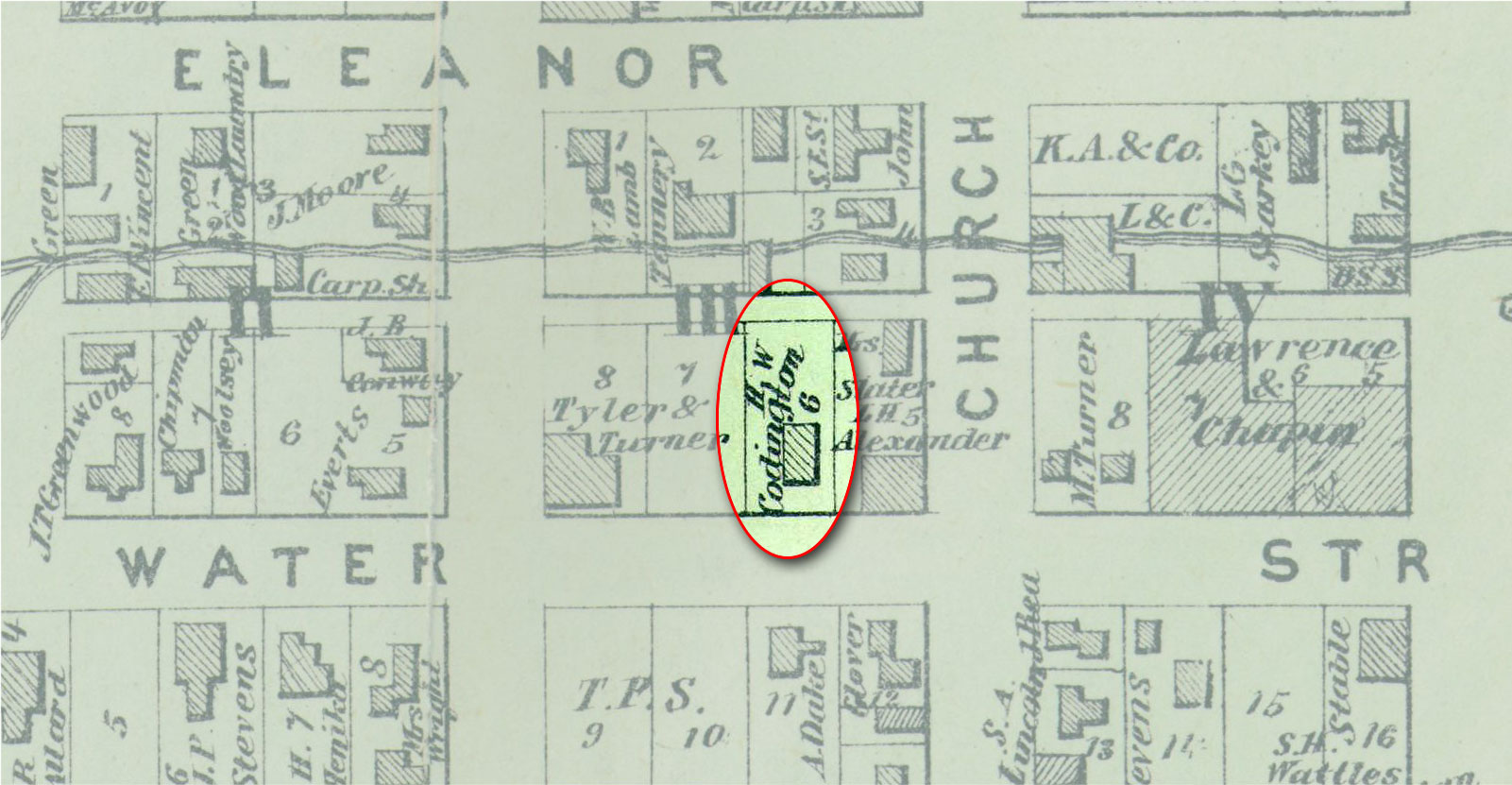 Coddington’s workshop and office, 90-94 Water Street, c.1873. Published by F.W. Beers & Co., 1873. University of Michigan Library
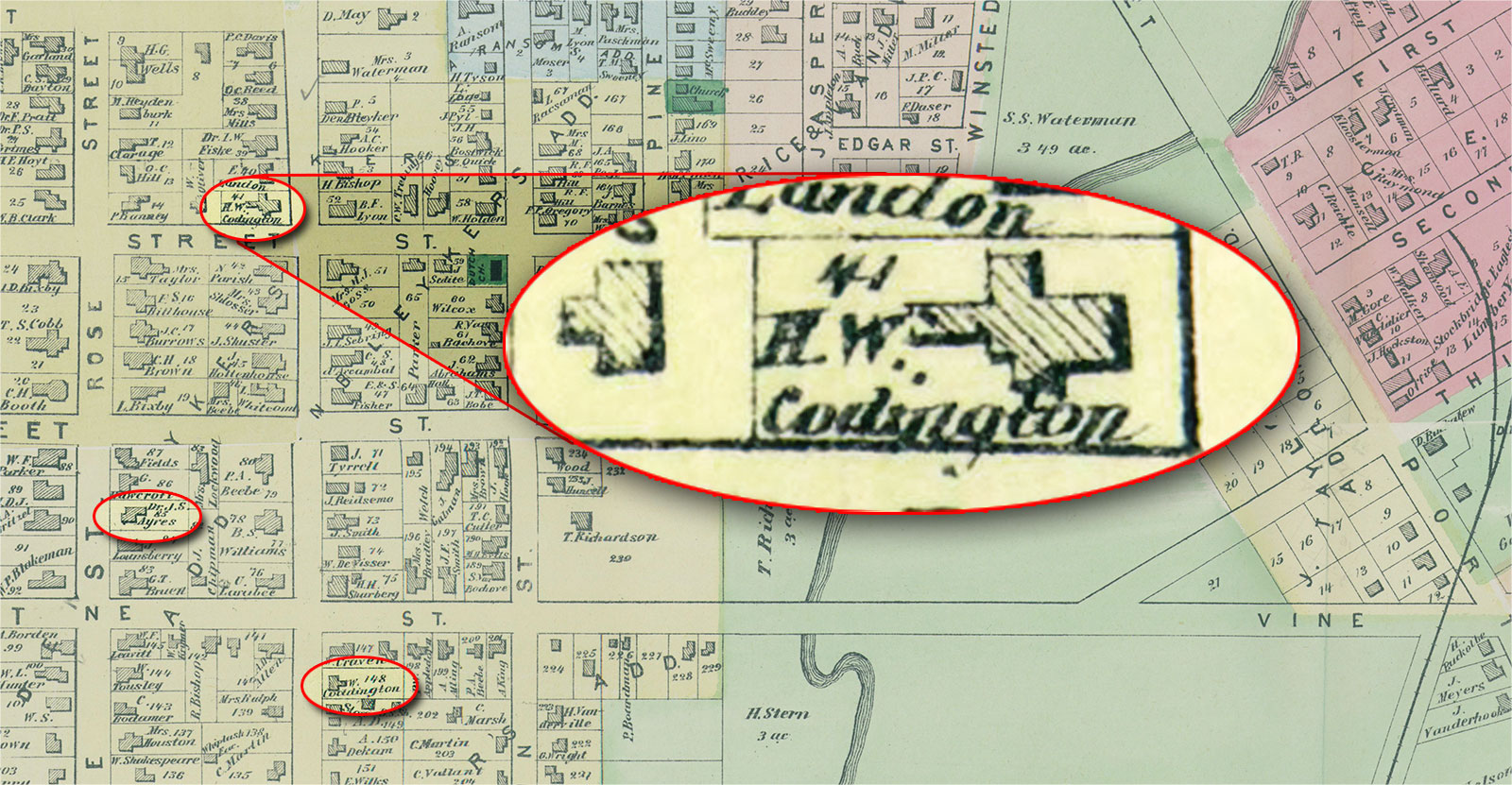 H.W. Coddington home (top), J.S. Ayres home (middle), and W.W. Coddington home (bottom), c.1873.
(inset) newer (c.1872) home (right) and older (c.1857) home (left). Published by F.W. Beers & Co., 1873. University of Michigan Library
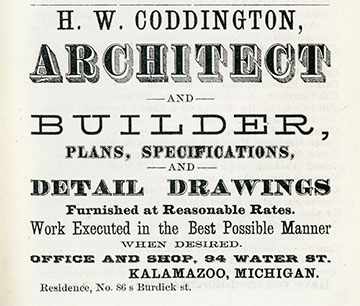 Kalamazoo County Directory, 1871-1872.
Kalamazoo Public Library
By 1871, Coddington had begun building a new home for his family at the east end of their Burdick Street lot in front of the existing house, and by the spring of 1872, construction was well underway. “The style is unique, showy and graceful,” raved a reporter for the Kalamazoo Daily Telegraph, “one of the prettiest dwellings we have seen. We look upon this pretty building is the best thing in the architectural line that Mr. Coddington has yet produced.”
During the early morning hours of 9 February 1873, fire broke out at a store located near the corner of Water and Church streets. The flames soon spread and before the fire could be brought under control, both the store and Coddington’s workshop next door had burned to the ground. Coddington suffered a $1,200-$1,500 loss (roughly $40,000 in today’s dollars) for which he had no insurance. Rather than rebuild his workshop and office, Coddington sold their newly built Burdick Street home in March 1873 to Dr. James S. Ayres and moved his family (and his office) to Dr. Ayres’ former residence on South Rose Street, north of Vine Street (67 South Rose Street).
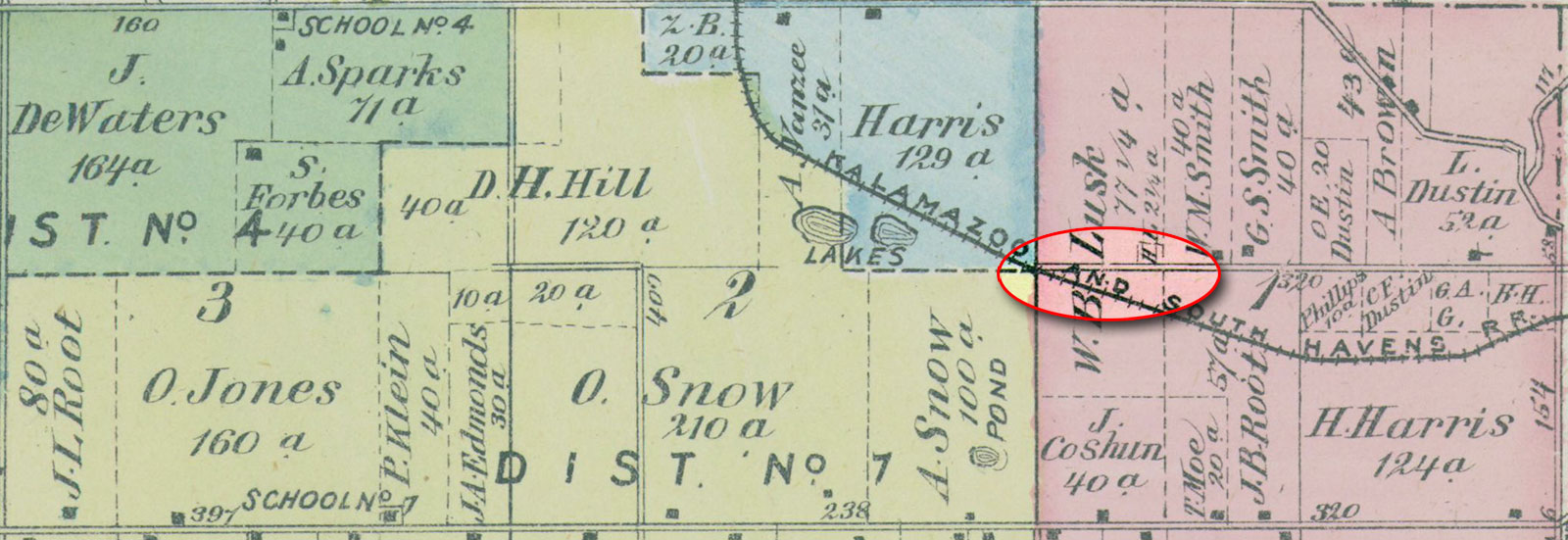 Approximate location of the Chappell & Coddington brick factory, described as “three cornered piece north of railroad” in Section 1, Oshtemo Township. Published by F.W. Beers & Co., 1873. University of Michigan Library
Chappell & Coddington Brick Factory
In 1877, Coddington purchased nine acres in Oshtemo Township, just west of Brownell Station near the Kalamazoo & South Haven Railroad line and, with partner Delos Chappell, set up a substantial brick manufacturing business. Their highly mechanized operation, capable of producing a million or more bricks per season (ten times that of the older hand-pressed method), employed a dozen hands and a machine manufactured by the J.W. Penfield & Son company of Willoughby, Ohio, “one of the largest and best brick and tile making machines in the market” (Kalamazoo Telegraph).
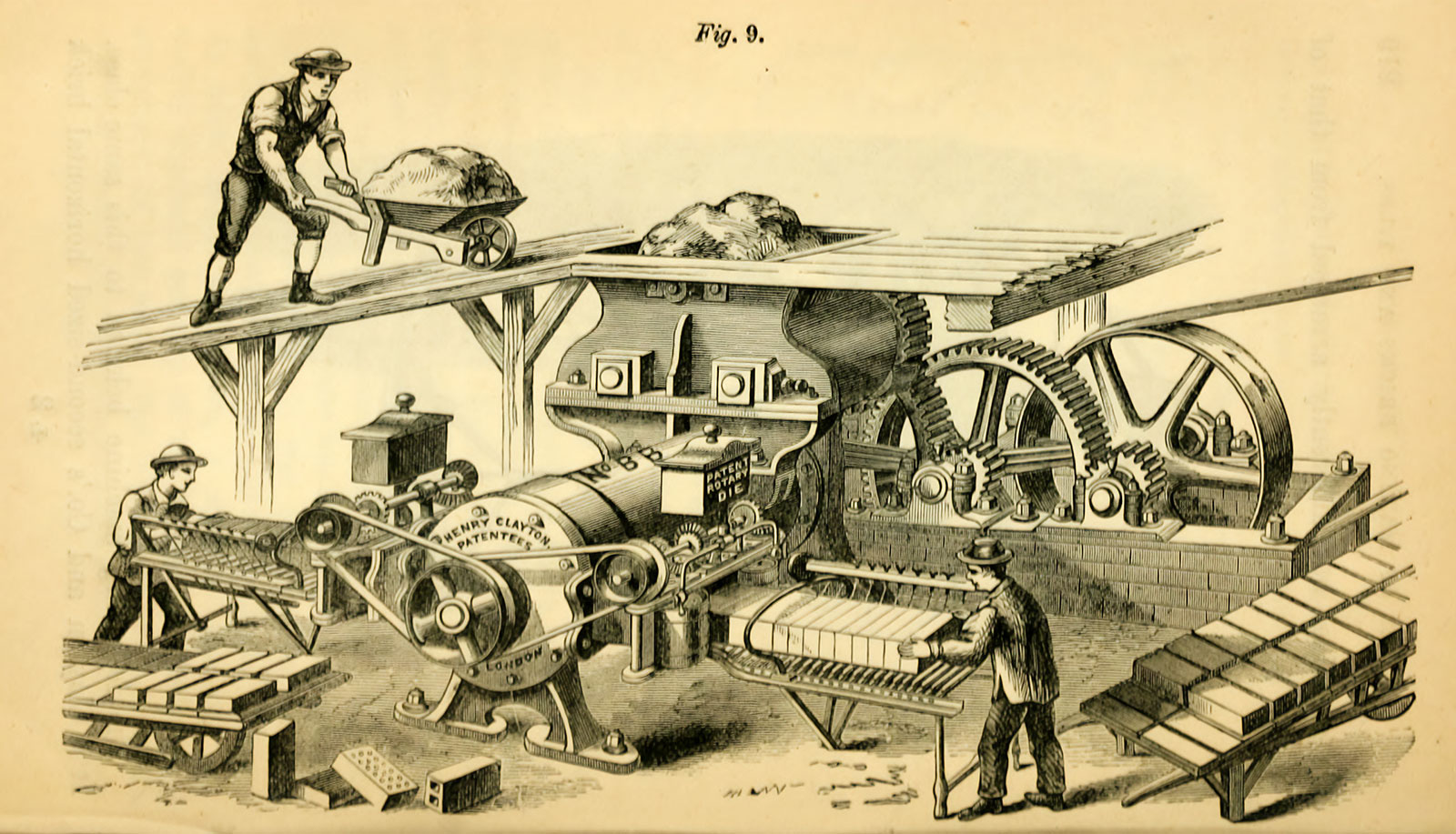 Brick and tile making machine, c.1880. From The Practical Brick and Tile Book by Edward Dobson (1880). NCSU Libraries
“They have an inexhaustible supply of fine clay for making pressed brick, tile or pottery,” wrote the Kalamazoo Telegraph, “producing, where found both a deep cherry red and salmon colored brick.” A narrow-gauge incline railway with a series of dump cars was used to move the clay from the pits to the processing area and into the two permanent kilns for drying. The brickyard appears to have been in operation for a brief period, perhaps four or five years. Chappell and Coddington terminated their partnership in 1880 and apparently discontinued the business soon after.
Residential Work
During his time in Kalamazoo, Coddington built several fine homes in the village, including Henry Gilbert’s residence at the northeast corner of Lovell and Rose streets (27 South Rose Street), Dr. William Mottram’s residence at the northwest corner of Lovell and Burdick streets (60 South Burdick), James P. Clapham’s residence at the corner of Spring and Taylor streets (14 Spring Street), and First National Bank vice president Robert S. Babcock’s residence on Academy Street (48 Academy Street). And Coddington’s residential work was not limited to Kalamazoo. In 1876, he built a stunning new home for J.A. Henry, a railroad contractor in Joliet, Illinois, said to be “one of the finest residences in the state, complete in every feature of modern improvement, style of architecture, and luxurious appliances” (Joliet Sun via Kalamazoo Telegraph).
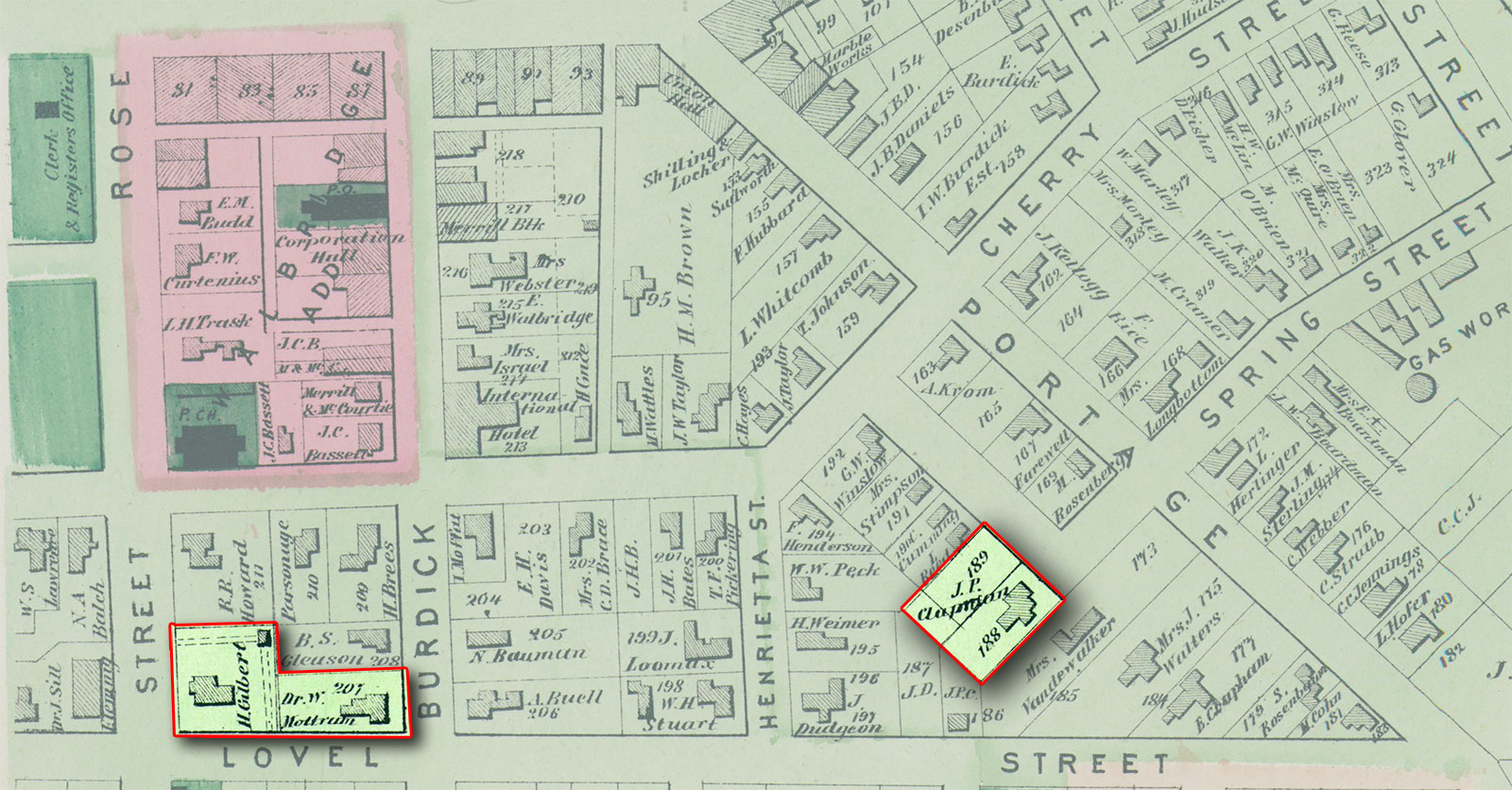 (l-r) Gilbert, Mottram, and Clapham houses, c.1873. Published by F.W. Beers & Co., 1873. University of Michigan Library
In addition to building new homes, Coddington was known for his masterful renovation work on existing properties. In 1879, Coddington purchased and renovated the former home of prominent Kalamazoo brewer George Foegel, located across from the Kalamazoo College Ladies Hall on Lovell Street, and in 1883, he made extensive repairs and improvements to druggist George McDonald’s home at 707 West Main Street. Coddington’s 1870-71 renovation of the First Baptist Church on Main Street received rave reviews. “The members of the church are to be congratulated that the matter is in such good hands, as well as in the fact that they are soon to have a structure that will be not only a source of pride and satisfaction to them, but an ornament to our village” (Kalamazoo Telegraph).
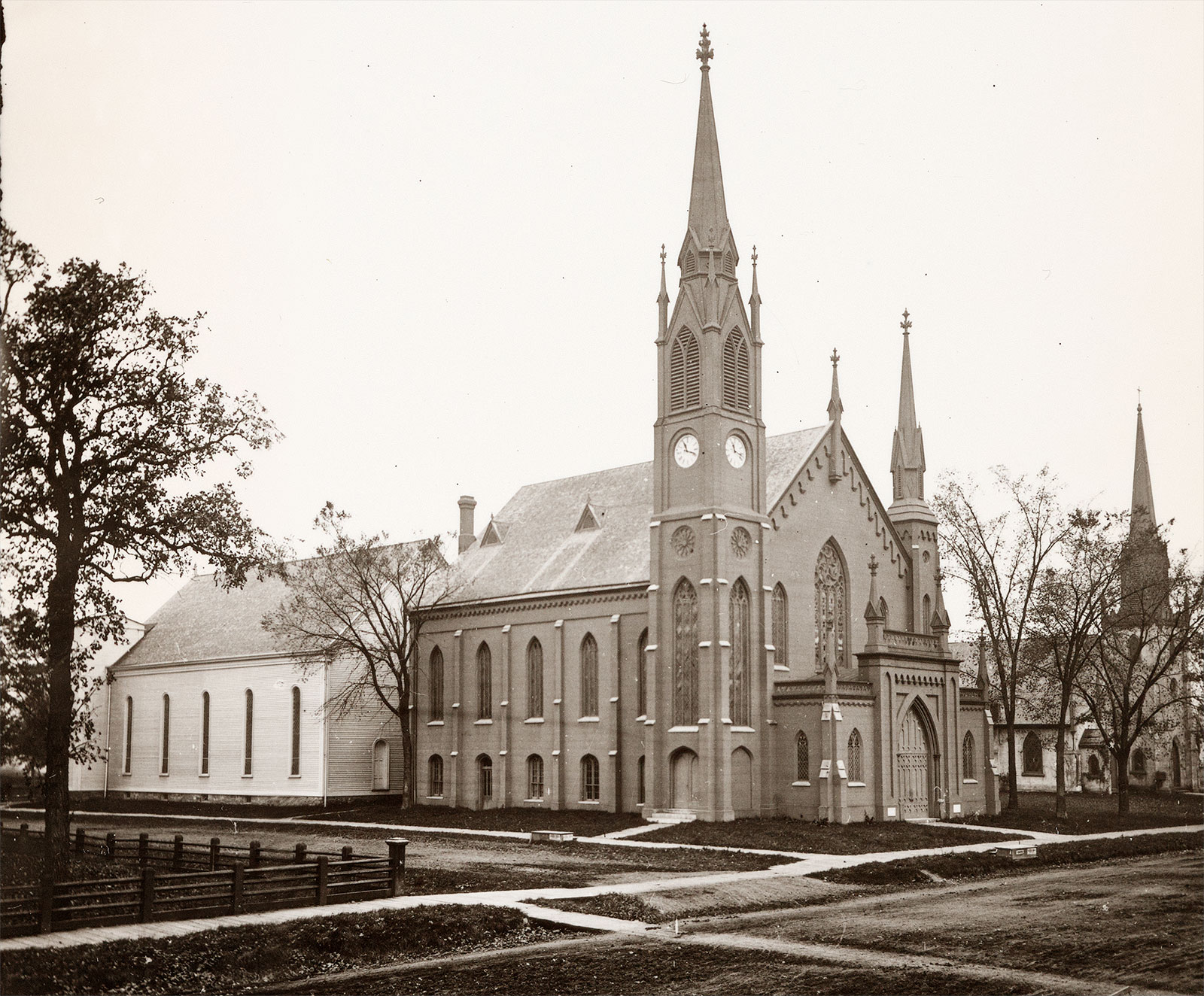 First Baptist Church after 1870-71 renovation. Likely photographed by Wallace S. White. Kalamazoo Public Library photo file P-350
Churches and Commercial Structures
Along with his residential work, Coddington was perhaps best known for designing, building, and repairing many prominent churches and commercial structures in Kalamazoo and elsewhere. The following were among the many projects he worked on:
When contractors were being selected for the construction of Kalamazoo’s second courthouse in 1885, Coddington submitted a $53,150.00 bid, the third lowest of the bids received, but the contract was awarded to a firm from Toledo. When the time came to build Kalamazoo’s new Public Library building in 1891, Coddington submitted a bid in the amount of $47,867.00, again the third lowest of the six competing entries. In the end, however, the contract went to Ulysses D. Wheaton of Kalamazoo.
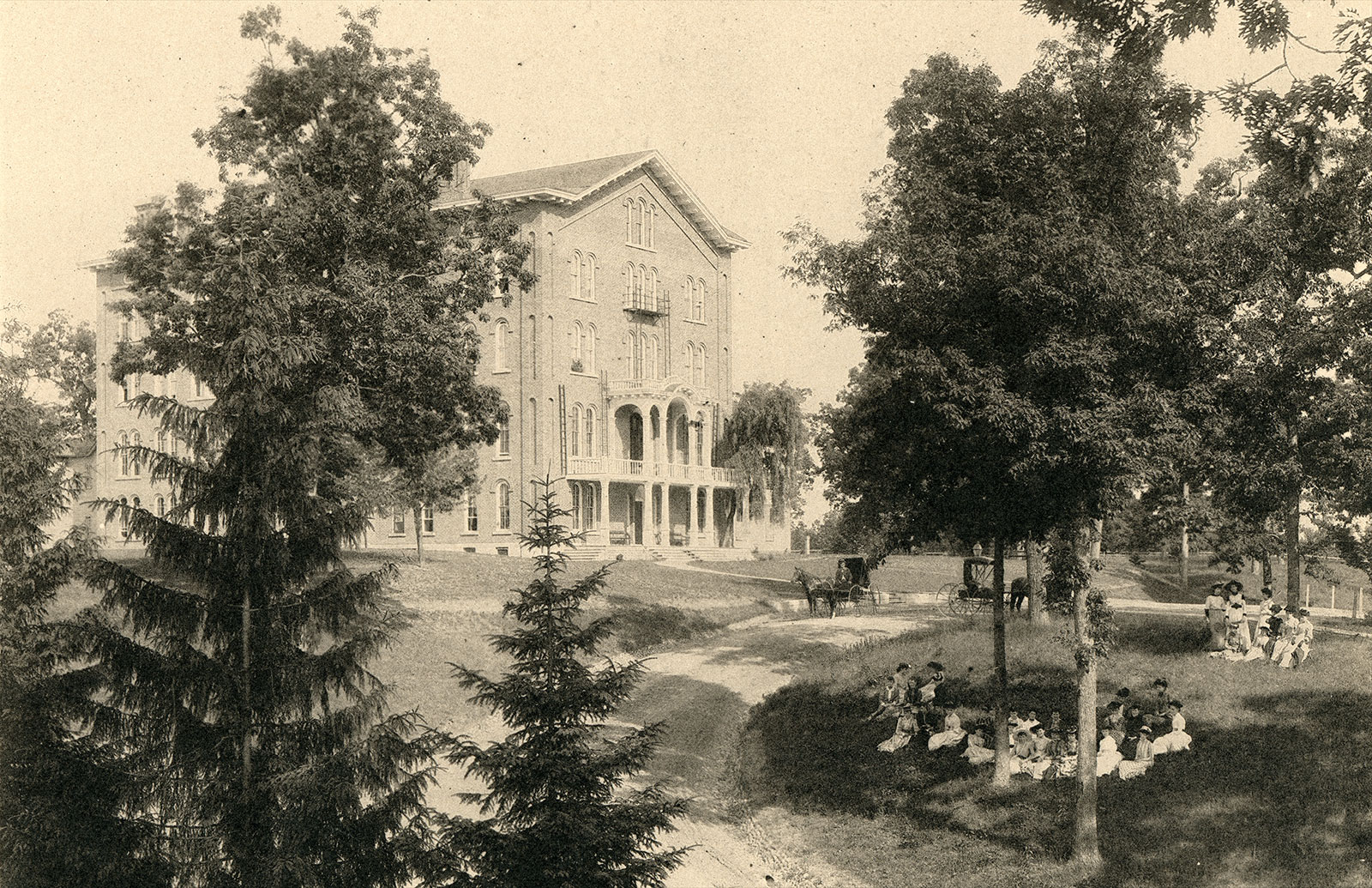 Michigan Female Seminary. From Picturesque Kalamazoo (1890), likely photographed by Schuyler C. Baldwin. Kalamazoo Public Library
“Messrs. Coddington and Menard have contracted to build a very pretty dome over the well, which will be completed in a short time. Mr. Menard does the stone work and Mr. Coddington the wood work and finish.”
—Kalamazoo Daily Telegraph, 12 April 1872
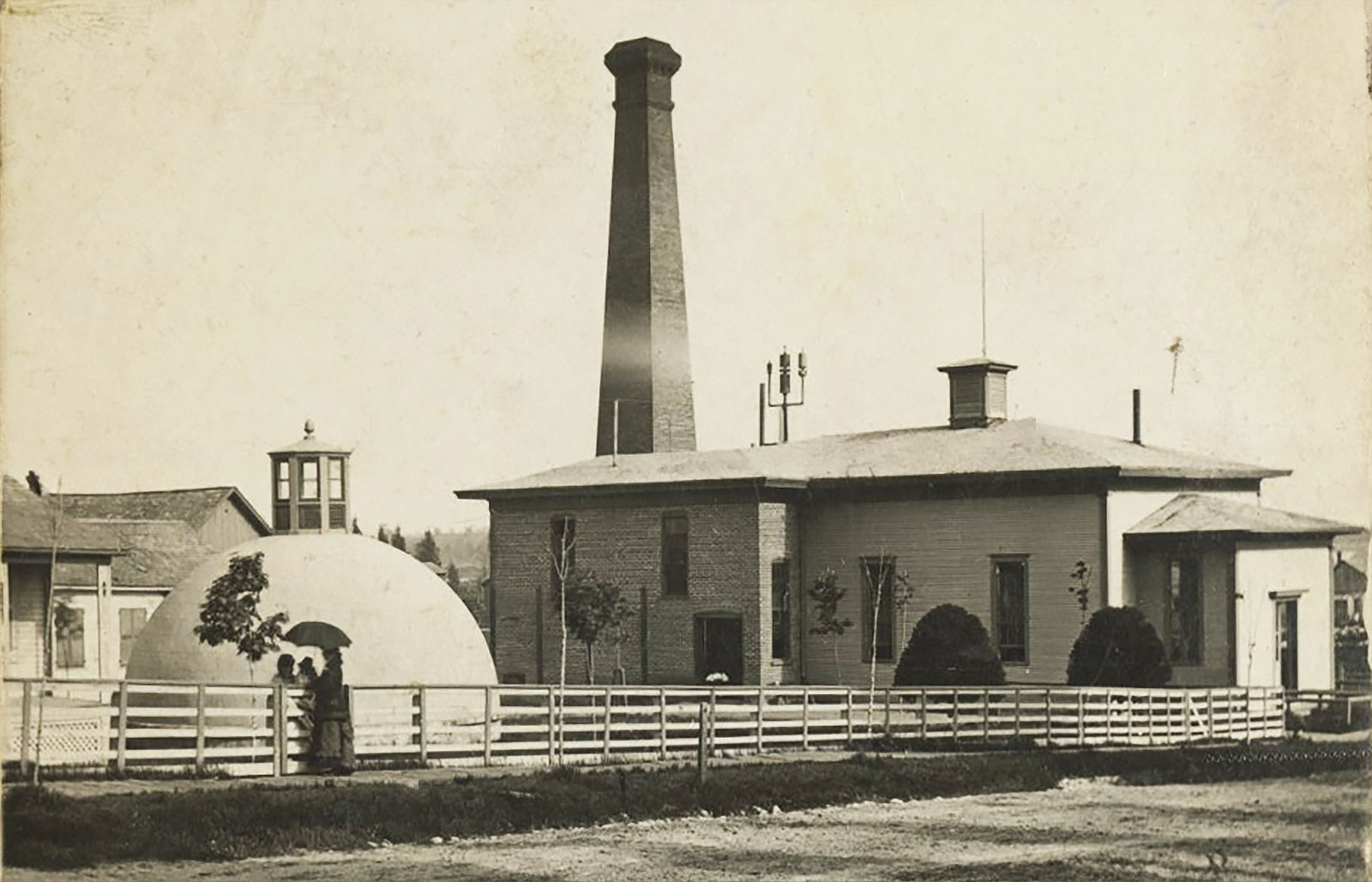 Holly Water Works in Kalamazoo, 1870. Stereoview photo by unknown photographer. Courtesy, Kalamazoo Valley Museum
Erection of the parish house at St. Luke’s Church would be Henry Coddington’s final construction project. In February 1895, Coddington suffered a stroke, from which he never fully recovered. Henry Coddington passed away at his home in Kalamazoo on 1 December 1895 at the age of 67. He was a highly respected Past Master Workman member of the Ancient Order of United Workmen (AOUW) fraternal organization. Upon his death, Coddington was described by the Kalamazoo lodge as “one of the most indefatigable workers and the order at large one of its most earnest and consciencious[sic] supporters” (Gazette). His younger brother, William W. Coddington, also of Kalamazoo, passed away in July 1897 at the age of 66. Jennie (Clute) Coddington passed away in April 1902 at the age of 73. All were granted a final resting place at Mountain Home Cemetery.
Written by Keith Howard, Kalamazoo Public Library staff, February 2026
Sources
Books
Kalamazoo County Directory, 1869 and 1870
James M. Thomas, publisher, Kalamazoo, Michigan, page 202
H 917.7417 K14
Brown’s Directory of Kalamazoo, Mich. 1871-72
C. Exera Brown, publisher, Kalamazoo, Michigan, page 99
H 917.7417 K14
Articles
“Notice”
Kalamazoo Gazette, 29 November 1861, page 3, column 5
“The new block”
Kalamazoo Telegraph, 28 September 1864, page 4, column 1
“The new mission Sunday school building”
Kalamazoo Telegraph, 22 August 1866, page 4, column 2
“Local affairs”
Kalamazoo Telegraph, 19 December 1866, page 6, column 3
“Local affairs”
Kalamazoo Telegraph, 13 December 1869, page 4, column 3
“Jottings”
Kalamazoo Telegraph, 21 October 1870, page 4, column 1
“Jottings”
Kalamazoo Telegraph, 26 November 1870, page 4, column 1
“The First Baptist Church”
Kalamazoo Telegraph, 23 February 1871, page 4, column 2
“‘Collins Springs,’ Kalamazoo”
Kalamazoo Telegraph, 24 April 1871, page 4, column 2
“A beautiful residence”
Kalamazoo Telegraph, 18 March 1872, page 1, column 2
“The new well”
Kalamazoo Telegraph, 12 April 1872, page 4, column 1
“Jottings”
Kalamazoo Telegraph, 17 May 1872, page 4, column 1
“Jottings”
Kalamazoo Telegraph, 29 May 1872, page 4, column 1
“Jottings”
Kalamazoo Telegraph, 8 July 1872, page 4, column 1
“Building”
Kalamazoo Telegraph, 31 July 1872, page 4, column 2
“Jottings”
Kalamazoo Telegraph, 13 August 1872, page 4, column 1
“Fire”
Kalamazoo Gazette, 14 February 1873, page 3, column 3
“Jottings”
Kalamazoo Telegraph, 12 April 1873, page 4, column 1
“Jottings”
Kalamazoo Telegraph, 12 September 1873, page 4, column 1
“Jottings”
Kalamazoo Telegraph, 4 February 1874, page 4, column 1
“200,000 brick wanted”
Kalamazoo Telegraph, 5 March 1875, page 4, column 3
“Jottings”
Kalamazoo Telegraph, 13 March 1875, page 4, column 2
“Jottings”
Kalamazoo Telegraph, 30 March 1876, page 4, column 2
“Jottings”
Kalamazoo Telegraph, 26 December 1876, page 4, column 3
“Coddington and Westfall…”
Kalamazoo Gazette, 14 October 1877, page 1, column 1
“Local matters”
Kalamazoo Telegraph, 1 October 1878, page 4, column 3
“Our school masters”
Kalamazoo Telegraph, 9 November 1878, page 4, column 4
“Jottings”
Kalamazoo Telegraph, 7 December 1878, page 4, column 3
“Meeting of the school board”
Kalamazoo Telegraph, 12 February 1879, page 4, column 3
“Schoolcraft”
Kalamazoo Telegraph, 13 May 1879, page 4, column 4
“Schoolcraft”
Kalamazoo Gazette, 17 July 1879, page 4, column 2
“The Chappell & Coddington brick factory”
Kalamazoo Telegraph, 17 January 1880, page 4, column 6
“Jottings”
Kalamazoo Telegraph, 3 April 1880, page 4, column 2
“Local news”
Kalamazoo Gazette, 9 April 1880, page 5, column 3
“Transfers of real estate”
Kalamazoo Gazette, 28 May 1880, page 8, column 4
“Transfers of real estate”
Kalamazoo Gazette, 6 May 1881, page 2, column 2
“Local news”
Kalamazoo Gazette, 17 March 1882, page 5, column 1
“Jail”
Kalamazoo Gazette, 26 January 1883, page 7, column 4
“Jottings”
Kalamazoo Telegraph, 14 February 1889, page 7, column 1
“Local gleanings”
Kalamazoo Gazette, 16 July 1890, page 5, column 1
“Henry W. Coddington”
Kalamazoo Gazette, 26 September 1890, page 4, column 1
“New guild house”
Kalamazoo Telegraph, 30 June 1894, page 1, column 5
“Jottings”
Kalamazoo Gazette, 11 August 1894, page 7, column 1
“Jottings”
Kalamazoo Gazette, 25 August 1895, page 5, column 1
“Among the dead”
Kalamazoo Gazette, 3 December 1895, page 8, column 2
“30 years ago”
Kalamazoo Gazette, 6 February 1925, page 6, column 7