Leta G. Snow (1880-1980)
"Patron Saint of Fine Music"
From the Michigan Women’s Hall of Fame:
Leta Snow (1880-1980), Kalamazoo’s “patron saint of fine music” was accomplished at every level of community endeavor and shared the lessons of her success with a nation. Snow began her career in music education, teaching piano to students in her home, a practice she continued until the age of 93. In 1921, she founded the Kalamazoo Symphony Orchestra (KSO). From an initial recruiting class of 25 players, heavy on clarinets and brass, Snow eventually developed an ensemble praised by Harvard University as a model orchestra. Through the Great Depression and World War II, Snow saw to it that the KSO not only survived, but thrived, as she employed whatever means necessary to recruit players and lure audiences. In the darkest days of the war, she also went national in her crusade for cultural expression and music appreciation. Her goal was to develop an organization that would exchange ideas, promote music by American composers, and extend opportunities to young American conductors and artists. At her invitation, representatives from 40 orchestras met in Chicago and the American Symphony Orchestra, now the League of American Orchestras, was born. Snow served as its president for the first four years. Among her other honors were being named president of the Kalamazoo Musical Society, a director of the Music Board of the National Society of Arts, and receiving an honorary master of music degree from Western Michigan University. After 28 years of leadership, she retired as president and manager of the Kalamazoo Symphony Orchestra and was declared honorary chair for life.
The Early Years
Born in 1880 to Joseph and Mellissa Packer, Leta and her family resided in Hartford, Michigan. Her parents were Quakers, but most importantly, they were a musical family. Her father was the first in Van Buren County to own a piano, and her mother sang ballads while strumming a guitar. Leta was seven when she first began to play the piano, and later, with the encouragement of her mother, she learned to play the violin. The family later moved to Paw Paw, where her talents were even more honed with weekly trips to Chicago to take lessons with the American Conservatory.
Before marrying her husband Harry Snow in 1900, Leta was involved in teaching, both musical instruction as well as the subjects of German, Latin, English, and history. Harry was also involved on the administrative side of education, and always encouraged Leta’s passion for connecting music to a broader audience. During the early years of the 20th century, the couple took up residence in Indiana, Michigan and Wisconsin after Harry accepted superintendent positions there. Eventually, the couple moved to Wilmette, Illinois after Harry abandoned the education profession for real estate.
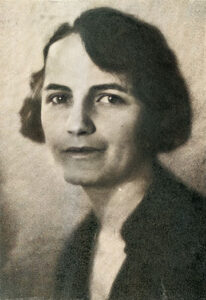 Leta G. Snow. Musical America, 10 May 1933
In 1917, Harry and Leta moved to Kalamazoo, where Leta figured her life as a musician would likely end due to a lack of community interest or opportunities. However, Leta found a passionate but unorganized musical landscape in her new home. It was not as though Kalamazoo was a musical desert when Snow arrived. For decades, the seeds of possibility and potential had been sown by an accomplished assortment of composers, conductors and musicians. Inspired by what a galvanized community of musicians and benevolent patrons could accomplish, Leta went to work toward establishing relationships with local musicians and community movers and shakers sympathetic to her ambitious vision, eventually becoming the president of the Kalamazoo Musical Society in 1920. The KMS had formed out of two other groups, the Madrigal Society and the Schubert Club. Snow helped to form weekly sessions on Thursdays dubbed Morning Musicale. These small get togethers were performances set at the homes of different musicians each week. Members of KMS also played at the Burdick Hotel’s ballroom once a week, and even a local automobile dealership’s showroom. The following year, she traveled to Davenport, Iowa to represent the KMS at the Federation of Music Clubs conference, where she became enamored with the multi-city orchestra model. Inspired by the Tri-City Symphony Orchestra, she returned to Kalamazoo in hopes of forming something similar in Kalamazoo with the participation of the Battle Creek community (Battle Creek’s symphony had already been formed in the late 1890s). Though a partnership with Battle Creek never materialized, Snow and her fellow musicians moved forward with plans to establish a foundational piece of Kalamazoo’s cultural pie, in the form of the Kalamazoo Symphony Orchestra. Snow’s dream was not limited to the creation and sustaining of a community orchestra, but rather one that saw Kalamazoo connected to the broader musical landscape.
“A Feisty Little Gal”
Debuting as a 25-member orchestra, augmented with the financial support of some of Kalamazoo’s most influential citizens (Edward B. Desenberg, Alfred B. Connable, Charles Farrell, Henry Overley, A.L. Waldo were original board members), the first iteration of the KSO was led by the baton-wielding Chester Z. Bronson. The first concert was held at the Masonic Temple in December of 1921.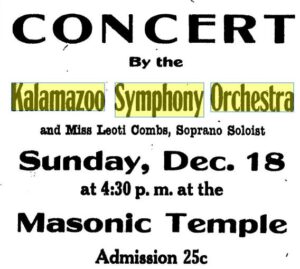 Despite its initial success, Snow looked back later and suggested that the early years of the KSO were at times imperfect because of a lack of certain resources, namely particular instruments.
“At its first performance, there were no French horns, no oboes, no bassoons, one cello, three basses, 10 violins, one viola, one flute, and an overabundance of clarinets and brasses. Because they only had one cellist, Leta had to sit in during that curtain-raiser. The reason that Bronson was given the baton was because a few of “The Magnificent 25″ had played under him before. Thus at times, masterful pieces were played without all of the required instruments, probably causing Beethoven and Mendelssohn to turn over in their graves. But the concerts went on.”
Encore Magazine, Nov./Dec., 1974
During those early years, in addition to sitting in with the orchestra on occasion, Snow sought to bring in better, more skilled musicians from other communities. An indefatigable manager and lobbyist of the KSO for 28 years, Snow often toured the surrounding communities for untapped talent, once bringing in a retired violinist from Paw Paw who had played with the Chicago Symphony. Two of her most significant contributions as manager of the KSO centered around growing local talent through the school system, and working to ensure that concert prices were reasonable for the largest number of community members. Snow worked with the Kalamazoo Public Schools to provide school credit for studying music. Students were provided the opportunity to play with the KSO by winning competitions set up by Snow. Snow understood the importance of community attendance for performances, especially during the Great Depression and war years, and so pricing was set well below the standard cost of listening to skilled musicians in other cities. It was her view, that large markets would always have the financial resources and artistic talent in order to support a local orchestra, but it was the medium-sized communities like Kalamazoo, where struggling to provide access to the artistry of orchestral music was most important.
“As a founder, business manager and player, Leta Snow had a myriad of activities. She sold advertisements for the symphony’s programs at each concert and these were prime sources of income in those days. She tabulated season tickets. She staged patron fund drives. She kept track of members and hunted for talented, dedicated players.”
Encore Magazine, 1974
Snow’s tireless efforts in keeping the symphony both relevant and of a high quality during the challenging years of the 1930s and 1940s extended beyond just the daily operations of the KSO. It was Snow who provided a life-altering opportunity to a down-on-his-luck cellist from Chicago named Hans Baldauf. A dejected Baldauf wrote to Snow, inquiring about work opportunities in Kalamazoo. Snow was able to find Baldauf, an astronomer, musician and sculptor, a position at the Kalamazoo Vegetable Parchment Company. Upon relocating to Kalamazoo, Baldauf not only contributed his musical talents to the KSO, but later led the effort to have a planetarium added to the Kalamazoo Public Museum. In 1930, Snow encouraged the formation of the Women’s Committee of the Kalamazoo Symphony Orchestra, which later changed its name to the Women’s Symphony Association. Blanche Hull was its first president. A Junior Symphony was also formed in the early 1930s. As time went on during her role as general manager of the orchestra, Snow brought in an array of talented musicians that continued to raise the orchestra’s national profile, including Percy Grainger, Otto Wimmler, Herman Felber, Alexander Schuster, and Misha Livschutz.
In 1942, six years before she retired from managing the KSO, Snow was an instrumental figure in the formation of a national organization comprised of conductors, managers, composers, and women’s symphony association members. What became of Snow’s vision for a national group organized to provide support, advice and assistance to community orchestras was the American Symphony Orchestra League, headquartered in Symphony Hill, Virginia. Snow lead the association as president for its first four years. In 1943, a two year Harvard study conducted by A.D. Zanzig, that focused on the subject of community orchestras, was published, rating the KSO as the best run in the country. In 1955, eight years after the death of Harry, Western Michigan University awarded Snow an honorary degree.
In retirement, with her legacy assured, Snow provided piano lessons inside of her home at 113 Allen Boulevard. She was also a painter and avid gardener who adored her flowers. Snow passed away in 1980 at the age of 100 as one of Kalamazoo’s most important cultural champions. In 2008, Snow was added to the Michigan Women’s Hall of Fame, one of only five women who were from or who resided in Kalamazoo County.
“When asked, at the age of 99, what made the symphony a success, Snow replied impishly: “Why me, of course!” She was quick to add: “But that’s not nice to say and it isn’t true. When I heard the first tone at the first concert, I knew we were on our way to becoming tops. The musicians poured their hearts and souls into the orchestra. It was their spirit and dedication that made the symphony a success.”
Kalamazoo Gazette, 19 January 1992
For additional background information about the Kalamazoo Symphony Orchestra and the years prior to its formation, see Keith Howard’s article here.
Written by Ryan Gage, Kalamazoo Public Library staff, June 2025.