 Public libraries offer many services that people often think of as synonymous with libraries: books, online content like databases and streaming services, programs, technology. What’s talked about less are the people who make those services meaningful—and the human work that happens every day at the desk.
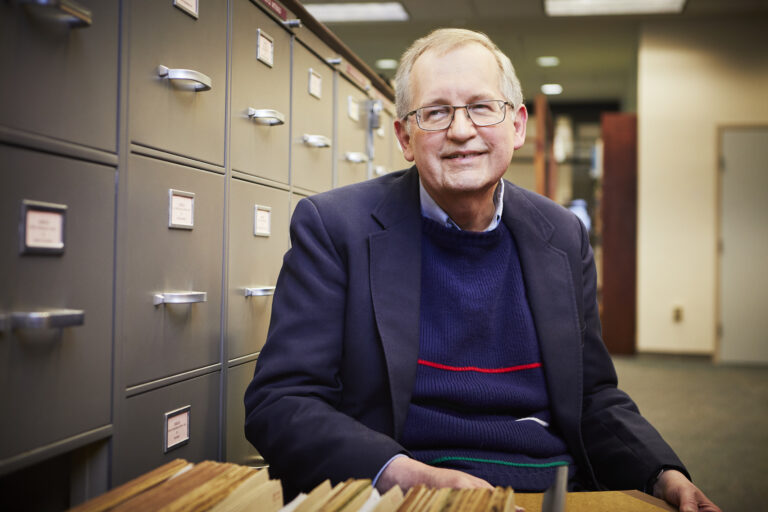
For David DeVries, a longtime librarian at Kalamazoo Public Library, the “Public” in public library has always meant people—and the responsibility that comes with serving them.
David works in the Local History collection on the second floor of Central Library, where he helps preserve and interpret the story of Kalamazoo and the people who have lived here.
“In local history,” DeVries explains, “we serve Kalamazoo, but we’re open to the whole world, because we have things that nobody else has.” While most use comes from the Kalamazoo community, researchers regularly contact the library from across the country and beyond. “We’ve had calls from California,” he recalls. “We even had one from Switzerland.”
The Local History Library offers resources that, together, document everyday life in Kalamazoo and the surrounding area. These include Kalamazoo-area and regional high school yearbooks, histories of houses in the local community, obituaries, historic maps of neighborhoods and cities, and a complete archive of the local newspaper, the Kalamazoo Gazette.
The newspaper archive plays a particularly important role, even as the place of newspapers in society has changed. “We have the complete archive of the Kalamazoo Gazette,” DeVries says, “and an index for quite a bit of it.” That indexing work ensures the material can be found and used—not just now, but decades into the future.
“A hundred years from now,” he adds, “some of this will be very valuable, because it’s unique to us.” What newspapers capture—daily life, local moments, names, and events—often exists nowhere else. That makes them essential not only to understanding the past, but to telling our story in the present and preserving it for the future.
Individually, these materials answer specific questions. Together, they tell a much larger story.
For DeVries, and for many library staff, meeting and helping people is deeply rewarding. “Sometimes a bond is established,” he says. “You get to see the same people again, and you develop a rapport.”
Many patrons arrive with curiosity—and a bit of hesitation—about what they’re trying to find. Sometimes the question they start with isn’t the one they leave with. DeVries listens, asks a few gentle questions, and helps the conversation unfold.
Librarians call this a reference interview. The name doesn’t capture what it really is—a human exchange where trust begins to form.
Reluctance is common. “Some people don’t think to ask their real question,” DeVries says. That’s where approachability matters.
DeVries treats every question as important, regardless of how small it may seem on the surface. “If someone has the boldness to ask a question, that means it’s important to them,” he explains. “Even if somebody asks where the bathroom is—to that person, that’s a very weighty question.”
Some questions carry more visible emotional weight, particularly those involving family histories, loss, or deeply personal moments. But DeVries approaches all questions with the same care. “We try to treat most questions that way,” he says, “even if their demeanor doesn’t indicate it.”
As more people use the library remotely, DeVries reflects on what can be missed. “I think they miss the socialization—the experience of being in a library.” Chance discoveries, conversations, and shared space all matter. “People come in and say, ‘I didn’t know you had this.’”
Accessing many resources still benefits from guidance. “A lot of it is self-explanatory,” DeVries explains, “but usually what I must do is help them get into it. Once they’re in, things start to happen.” For platforms like Ancestry.com, library access also allows people to explore without the cost of a personal subscription.
Although the library is locally funded, DeVries makes a clear distinction between funding and service. “Funding is public, of course, but service is different,” he explains. “As far as local history and reference go, we serve everyone—anybody who has a question.”
The Local History Library documents Kalamazoo from before formal settlement through the present day and continues to grow as new materials are collected and preserved. History does not stop, and neither does the responsibility to care for it. Our staff works together as a team, so if one of us doesn’t have an answer someone else might. We also do referrals to other organizations and libraries.
In a time when information is abundant but often disconnected from place, collections like these provide continuity. They help people understand where they came from, how their city evolved, and how individual lives fit into a larger story.
Public libraries remain one of the few places where people can simply be—asking questions, learning, connecting. That, DeVries believes, is the heart of the public library: people as they are, and the care taken to meet them there.
Written by Donna Jackson, Kalamazoo Public Library staff, Spring 2026