Stuart, 316: Taylor-Hatfield-Sutherland House
Built in 1889
One of the Stuart Neighborhood’s best examples of a Queen Anne-style home is situated at 316 Stuart Avenue. Three of its early occupants were figures in Kalamazoo’s bustling, industrial past, one that included the manufacturing of spring harrows, corsets and paper products. By the late 19th century, the neighborhood had gained a reputation for housing some of Kalamazoo’s wealthiest citizens, and their opulent, luxurious homes.
 316 Stuart Avenue shows up on the 1890 Kalamazoo County Plat Map
The Taylor-Hatfield-Sutherland House was built in 1889 for Frederick A. Taylor, an important figure in Kalamazoo’s successful spring-toothed harrow industry. Taylor purchased the lot, part of the Charles E. Stuart Addition, for $1500.
“Suitable to the needs of wealthy businessmen, this is a large Queen Anne home which displays an entire catalogue of inventive details. It is one of the town’s finest structures in this style. The house is of frame construction and is 2 1/2 stories in height. The basically square plan is enlivened by the creative addition of a large veranda, corner tower and bay windows. The roofline is irregular with multiple gables and Tudor chimneys. The roof retains its original boards and narrow clapboard. A large stained glass window is found on the stairwell on the north side. An unusual feature seen in several Stuart area houses, curved plate glass is used feature seen in several Stuart area homes, curved plate glass is used in second-floor window.”
National Register of Historic Places Inventory Nomination Form, 1982
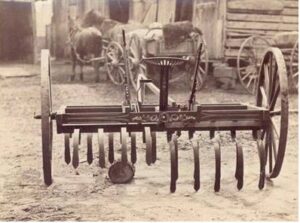 Spring Tooth Harrow, c. 1890. Kalamazoo Valley Museum Collection, 52.329
The late 19th century was a fruitful time for businessmen involved in the making of agricultural implements, and Kalamazoo was one of the largest producers of spring-toothed harrows. Taylor joined with James Henry to form the Taylor and Henry Spring-Toothed Harrows Company in the early 1890s, and then later helped to establish the Standard Harrow Company. When the company relocated to Utica, New York, Taylor stayed on, leaving Kalamazoo and his grandiose home behind.
James Hatfield and his wife Alice moved into the ostentatious, 2.5-story home in 1902. Hatfield, like many businessman of his era, appeared ill-equipped for rest or relaxation. Constantly focused on a commercial endeavor, Hatfield was the president of the Kalamazoo Corset Company, Kalamazoo Paper Box Company, Fidelity Building & Loan Company, Kalamazoo Sales Book Company, and the Four Loop Hook & Eye Company. Alice too was active in community affairs. Her large house was the site for meetings, lectures and luncheons for the Travel Club, a group Alice established as a way to learn about other countries and cultures.
The Hatfield family remained in the house until 1919. It was later occupied by another important figure in Kalamazoo’s commercial, social and political past. The city directory lists Louis W. Sutherland and his wife Agnes as residents of the Stuart Street mansion in 1922. They would remain there for the next twenty five years. Born in Portage Township, later moving to Kalamazoo after the death of his father in 1889, Sutherland began his ascent toward becoming one of the city’s most influential figures by learning the printing trade while working with several local companies, including the Ihling Brothers Everard Company.
“At thirty-five, he and his brother (Fred) put $10,000 into the Kalamazoo Carton Company. Within five years he had succeeded well enough to become the third owner for 316 Stuart in 1922.”
Kalamazoo: nineteenth-century homes in a midwestern village, p.188
When not growing his paper company empire, Sutherland also devoted time to running the American Sign Corporation. And like many of his generation, Sutherland dipped his toe into local politics, representing the Fourth Ward as an alderman, then later as a city commissioner. From 1943-1945, Sutherland served as Mayor of Kalamazoo. In the 1940s, Sutherland was instrumental in establishing an assisted living facility that would become the Heritage Community of Kalamazoo.
 316 Stuart Avenue, 1976. Photographer: Balthazar Korab
The early 1950s saw the showy Victorian home converted into apartments.
Written by Ryan Gage, Kalamazoo Public Library staff, October 2025