The Hawes-Potter House
Onetime Residence of Judge
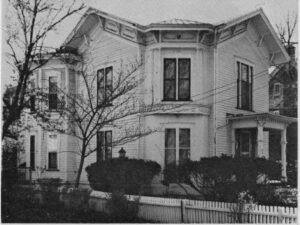 The Hawes-Potter House, c. 1980. Photo Gary Cialdella
Along South Street’s historically important stretch of homes that once housed a who’s who of Kalamazoo’s most prominent citizens, is the Hawes-Potter House. Situated on the south side of the street at 717, the home’s distinctive architecture catches the attentive eye, with its jagged roofline and blending of Greek Revival with Italianate styles. It was also home to two individuals who are less discussed within the history of Kalamazoo than some of the persons connected to the other nearby houses.
Josiah L. Hawes (1823-1907)
A lawyer and realtor by trade, Hawes was born in Schoharie County, New York. He married Lucia R. Foote in 1850. The couple moved to Kalamazoo around 1852, and had the home built around 1855 in a pre-war Greek Revival farmhouse style. Hawes had moved into the old Justus Burdick House along Rose Street, but soon after left for the increasingly fashionable South Street. Hawes went into private practice with former Michigan Supreme Court Judge, Thomas R. Sherwood. Politically, Hawes was a Whig before switching to support the Democratic Party. Hawes later became circuit court judge for Kalamazoo County, beginning around 1876. He remarried in 1883 after Lucia died in 1880. His second wife was Elizabeth Charlotte Griswold. Hawes moved to upstate New York later in life and died in Ovid, New York in 1907.
 Kalamazoo City Directory, 1867
Clark S. Potter (1811-1875)
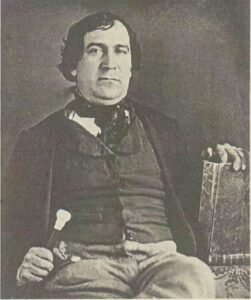 Clark S. Potter, c.1860
Another native New Yorker, Potter shows up in Cooper Township, Michigan in 1862. The 1850 Federal Census lists his occupation as that of a “merchant.” A decade later, his trade was described as “revenue office.” By 1865, he and his large family (11 children) had arrived in Kalamazoo. Hawes sold the property to Potter around 1870, and shortly afterward, the Potter family went about reconfiguring aspects of the home to fit with the then popular Italianate-style. Clark had married Abigail Holmes while still in New York, likely sometime in the 1830s. Abigail continued to live in the South Street home after her husband’s death in 1875, dying herself in 1901. Abigail’s children stayed in the house for a few more years. Dairyman and onetime city clerk and alderman, Horace E. Ralston, moved into the home in 1907, but eventually, the family home was split into apartments by 1950. In 1946, the Kalamazoo Gazette ran a feature on the home, referring to it as the “Nathan Potter House.” Nathan was one of Clark’s sons.
The home’s unique blending of period-specific features was not uncommon, when those who could afford to alter their residences did so to keep up with architectural trends. Homes built before the war were typically designed to feature Greek Revival elements.
“Greek Revival structures are characterized by symmetry and the suggestion of a temple front. Windows are simple, rectangular in shape, and evenly spaced. Doorways are bold and often sidelighted. Many structures feature classically styled entablatures and porticos.”
—Walking Through Time: A Pictorial Guide to Historic Kalamazoo, p.17
Clearly, the home’s original structure had been tastefully modified after the war, likely in the early 1870s. Modernizing the austere roofline on the northeast side of the home gave the home more of an ornamental, Italianate appearance. The entryway continues to feature a classical portico while some of the stylistic mouldings reflect a showier tone.
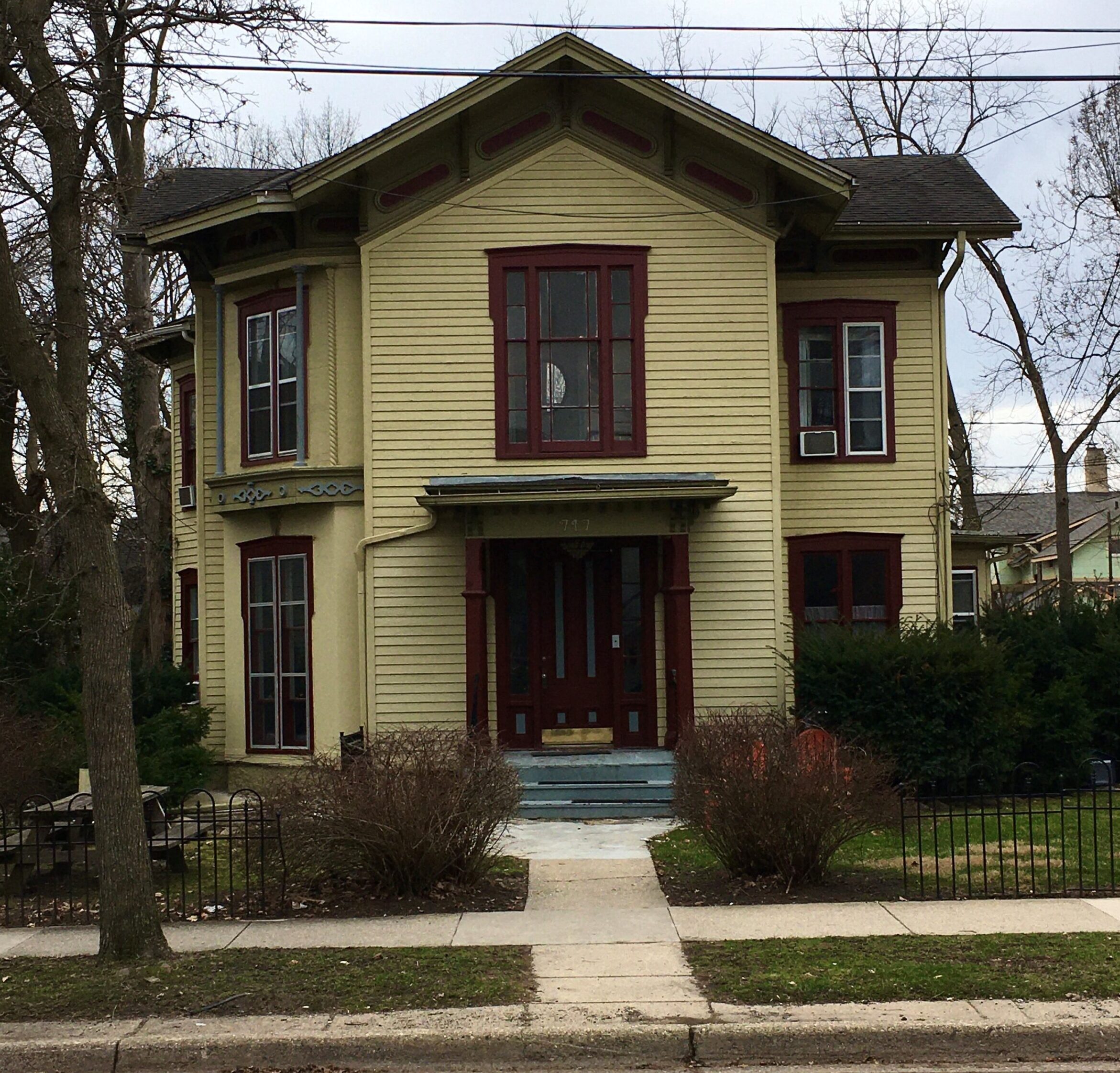 Hawes-Potter House, 717 W. South St. Photo Ryan Gage, 2025
Article written by Ryan Gage, Kalamazoo Public Library staff, March 2025.
Sources
Books
Walking through time: A pictorial guide to historic Kalamazoo
Brendan Henehan
Kalamazoo : Kalamazoo Historical Commission, c1981
H 720.9774 H498
Kalamazoo: Nineteenth-century homes in a midwestern village
Peter J. Schmitt & Balthazar Korab
Kalamazoo City Historical Commission, c1976
H 720.9774 S355
Articles
“The Nathan Potter house, 717 W. South Street”
Kalamazoo Gazette, 24 November 1946