American House Hotel
AKA Park-American and Harris Hotel
At one time, the American House Hotel footprint comprised an entire block of Kalamazoo’s primary commercial artery. Strategically located across the street from the Grand Rapids and Indiana Railroad station (built in 1870), the first version of the American House Hotel was the village’s fourth hotel, opening in 1844. Several iterations and name changes later, the hotel came down for good in 1969, leaving behind a vacant parking lot prior to the opening of a Wendy’s restaurant and later, the YWCA facility.
 Stereograph of American House Hotel interior, c. 1870. History Room Photograph File P-328
American House (1844-1910)
Built in 1844 by Elisha Weeks, and owned by Henry Boohr, the first American House existed for at least two decades, before suffering the fate of so many wood-frame buildings in the 19th century, a destructive fire. Rebuilt on the same site by a German immigrant named Frederick Hotop in the late 1860s, the second hotel along the 300 block of E. Main Street possessed three stories and adopted the Italianate-style. By 1875, Hotop had bought out his brother and co-partner, becoming the sole proprietor. Hotop represented a sizable influx of German immigrants whose commercial activities were so pronounced along Main Street, that the area was dubbed the German District. Under Hotop, the hotel began to find financial success. Known for its consistent occupancy, the hotel’s third floor was comprised of a single room that could hold twenty eight sleepers. As elegant as the hotel’s interior features were, it was not considered the most lavish, by Victorian standards. That distinction went to its Main Street rival, the Burdick Hotel.
 American House Hotel, c. 1885-1890. History Room Photograph File P-332
During Hotop’s time as manager of the hotel, several additions were made, including a “fourth floor, a brick addition and dining room.” A livery was conveniently located in the back of the hotel for the storage of horses. The building also holds the distinction as the first hotel to feature electricity and the first building to have an elevator. In 1905, Kalamazoo’s preeminent builder, Henry Vander Horst added a five-story addition to the west of the 1860’s building. Five years later, a new owner took over the hotel after the death of Hotop. The new hotelier was prominent businessman Charles B. Hays, onetime mayor, Edison Neighborhood developer, paper industry investor, and golf and horse enthusiast.
Park-American Hotel (1910-1947)
The Kalamazoo Gazette reported that Joseph E. Browne and Hays purchased the hotel from the executors of the Hotop estate for $130,000. Hays immediately renamed the lodging the Park-American Hotel. Dedicated to updating the hotel’s building, a special emphasis was on fireproofing the property, likely due to the age of the 1869 portion. Hays kept around the 19th century part of the hotel for only four years before it was finally demolished, creating space for another addition that connected with Vander Horst’s contribution. This new addition was designed by Louis Thies. Several others owned and operated the hotel after Hays, including Stephen B. Monroe and Earl H. Shepard, who bought the hotel in 1937.
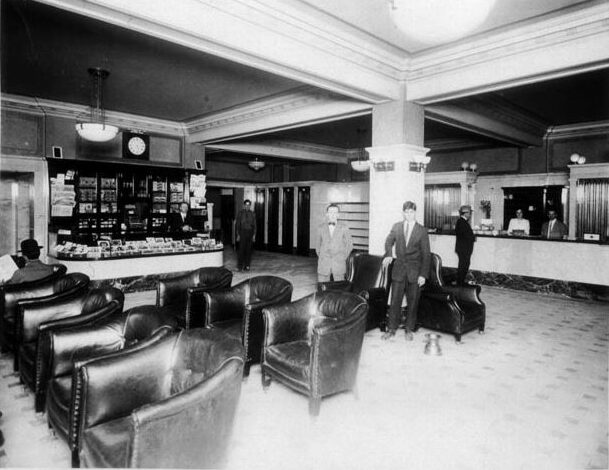 Park-American Hotel lobby, c.1914. Kalamazoo Valley Museum Collection, 78.3198
Harris Hotel (1947-1968)
The final version of the hotel was active for two decades, following WWII when it was purchased by Harry L. Harris & Associates. Harris was part of a group of businessmen from St. Joseph. During this period, the hotel’s reputation centered around its fine dining experience and access to clubs that could legally serve alcohol. Many of Kalamazoo’s famous visitors lodged at the hotel during this period. In the early 1960s the hotel was renamed Harris Motor Inn. Both changes to the exterior and interior were made, helping to extend the hotel’s life for another five years before it closed its doors for good.
In June of 1974, construction crews of the property owners unearthed portions of the hotel’s barbershop, Turkish baths and gymnasium. Exposed were the subterranean tiled baths and a room that featured a boxing ring. Workers also removed “four ancient cast iron cash registers, two clay bathtubs and nearly 50 slabs of white marble in mint condition among heaps of broken concrete and twisted steel girders.”
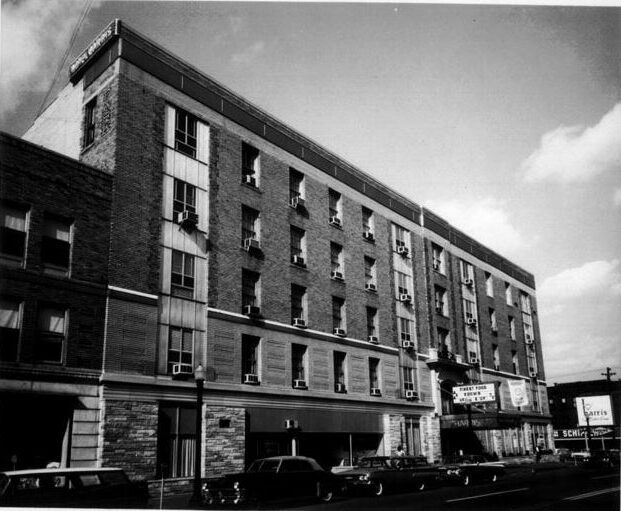 Harris Hotel, 1960. Kalamazoo Valley Museum Collection, 78.3196
Article written by Ryan Gage, Kalamazoo Public Library staff, March 2025
Sources
Books
Hotels and taverns in Kalamazoo, 1832-1876
Karen Peterson
History Seminar of Kalamazoo College; no. 67, 1957
H 647.9 P485
Kalamazoo: lost & found
Lynn Smith Houghton and Pamela Hall O’Connor
Kalamazoo Historic Preservation Commission, 2001
H 720.9774 H838
Articles
“Pay $130,000 for the American House”
Kalamazoo Gazette, 10 February 1910
“Old ‘baths’ unearthed at Harris site”
Kalamazoo Gazette, 25 June 1974, page A5, column 1