City Hall
Seat of Local Government

Kalamazoo City Hall, photographed by Ward Morgan, August 1943. Miller Davis Collection, Kalamazoo Public Library photo file MD-501
“Kalamazoo’s finest example of Art Deco architecture”
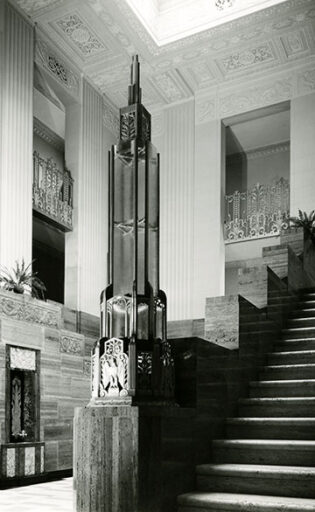 Kalamazoo Public Library photo file P-30
Built in 1931 to replace the older Corporation Hall, the present City Hall, located at 241 W South Street, was dedicated by Mayor S. Rudolph Light on 1 September 1931. It was designed in the Art Deco style by Weary and Alford of Chicago, and was erected by Miller-Davis and equipped at a cost of $524,000.
It is a four-story reinforced concrete building decorated with granite and limestone. A floral motif, typical of the Art Deco style, can be found throughout the building, in such details as the flagpoles, light fixtures, and railings. A band of bas-relief carvings and text describing significant events in Kalamazoo’s past adorns the top of all four exterior walls. The featured events are: 1829 first settler, Titus Bronson, arrived; 1831 original plat filed; 1831 became the county seat; 1833 free school established; 1835 first newspaper published; 1836 name changed to Kalamazoo; 1838 Kalamazoo incorporated as a village; 1846 steam railway transportation established; 1858 free high school established; 1884 incorporated as a city; 1904 Western State Teachers College founded; 1918 commission-manager charter adopted; 1928 air mail service established.
A striking feature of the interior is the mural on the walls and ceiling of the city commission chambers, painted by local artist Otto Stauffenberg.
“City Hall is Kalamazoo’s finest example of Art Deco architecture. Its plan and simplicity reflect its classical origins, while its ornament and details are twentieth century. The reinforced-concrete building is faced with granite and Indiana limestone. Bold flutings are carved in the giant pilasters, and floral and geometric designs along with local historical scenes are in relief panels on the frieze. The frames and spandrels of the recessed window are of dark-colored cast aluminum. Within, the building is arranged around a three-story, skylit atrium lobby and is finished with black and gold marble and polished siena travertine. Fountains, stair rails and grilles, lanterns, and a letter box cast in aluminum with stylized carp, birds, pond lilies, and other plants add to the Art Deco imagery. The walls and ceiling of the commission chambers were painted in peach, aqua, and gold geometric designs by German-born Kalamazoo artist Otto Stauffenberg. Architects Weary and Alford of Chicago also designed the American National Bank (now Fifth Third Bank; 136 E. Michigan Avenue) in 1929–1930 with the same Art Deco motifs.”
—Kathryn Bishop Eckert, Society of Architectural Historians
Written by Karen Santamaria, Kalamazoo Public Library Staff, 2002. Last updated 8 July 2024.
Sources
Books
Kalamazoo Lost and Found
Houghton, Lynn Smith and O’Connor, Pamela Hall
The Kalamazoo Historic Preservation Commission, 2001, pages 55 and 188
H 720.9774 H838
Etching 1867 Corporation Hall and a community’s growth
Freeland, Wes. c.2012.
H 720.9774 E838 (CEN)
Local History Room Files
Subject File: Kalamazoo (Govt.) – City Hall