Prohibition Hits Kalamazoo
When Kalamazoo Voted to Go Dry
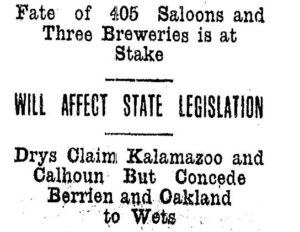 Kalamazoo Gazette, 3 April 1915
Like most cities, Kalamazoo has always had its share of adult beverage watering holes. An alleyway called Whiskey Alley runs east and west off of N. Burdick Street and calls to mind the number of taverns near North Burdick and East Main during the late 19th and early 20th century. In 1910, there were around 55 saloons located in the city. But in 1915, Kalamazoo County residents voted in favor of prohibition.
Several years before the country voted for nation-wide prohibition (18th Amendment, enacted in 1920), Michigan had begun the process of outlawing the sale and production of liquor, first through legislation that provided counties a ‘local option’, and then later a state-wide constitutional ban (enacted in 1918). Attempts at banning the sale and production of alcohol had been happening for decades with varying degrees of success at enforcement. Some cities in Michigan had been dry for years (Holland e.g.), but Kalamazoo boasted a healthy saloon industry prior to 1915 despite the growing popularity of temperance advocacy. Even as early as 1836, a local group called Kalamazoo Total Abstinence was formed to combat alcohol sales and consumption. Less than 100 years later, advocates would finally taste victory.
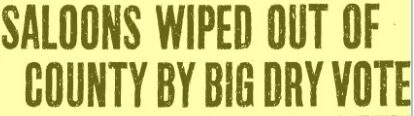 Kalamazoo Gazette, 6 April 1915
The temperance movement had been successfully gaining political power for decades, arguing from a (Protestant Christian) religious perspective against the social ills of drinking. Putting their lobbying power behind dry officials, groups like the Anti-Saloon League, the Red Ribbon Society, the Prohibition Party, and the Women’s Christian Temperance Union aggressively sought the goal of ridding Michigan of alcohol throughout the first decade of the 20th century. Those who represented the other side of the issue were saloon proprietors, breweries, distilleries, individual freedom advocates, and wet politicians whose constituents often came from cultural traditions where drinking was normalized.
“The local option fight has been the hottest ever waged in Kalamazoo county. Both the “dry” and “wet” forces have been unusually well organized and for two months the contest for votes has been strenuous. The “drys” on the one hand resorted to several meetings at which all kinds of oratory against the saloon has been uncorked. They also sent out thousands of circulars all over the county and got a line on every available voter. They worked much more in the open than their opponents. The “wets” did a lot of gumshoes campaigning, being satisfied to get a line on the vote and not using much printer’s ink until the last two or three days, when they cut loose and fairly swamped the community with reading material.”
Kalamazoo Gazette, 6 April 1915
Finally, in the spring of 1915, the voters of the county went to the ballot box to decide the fate of alcohol, with the anti-drinking block coming out victorious. The tightly contested affair saw 7286 voting for prohibition while 6396 pulled the lever against. The result stunned some observers, who were convinced that city voters would once again protect the right to make and consume alcohol. A previous attempt was made by prohibition advocates three years earlier that failed because of a lack of support from city residents. But in the intervening three years, temperance supporters were able to make strides in convincing a small portion of city residents to join them in order to tilt the final result in their favor despite losing the majority of the city vote. In the end, city “wets” were joined by Kalamazoo, Texas and Pavilion townships in voting against prohibition. Ten of the fourteen city precincts voted for the liquor interests. However, the 13 remaining townships voted for a dry county, enough to enact the ban.
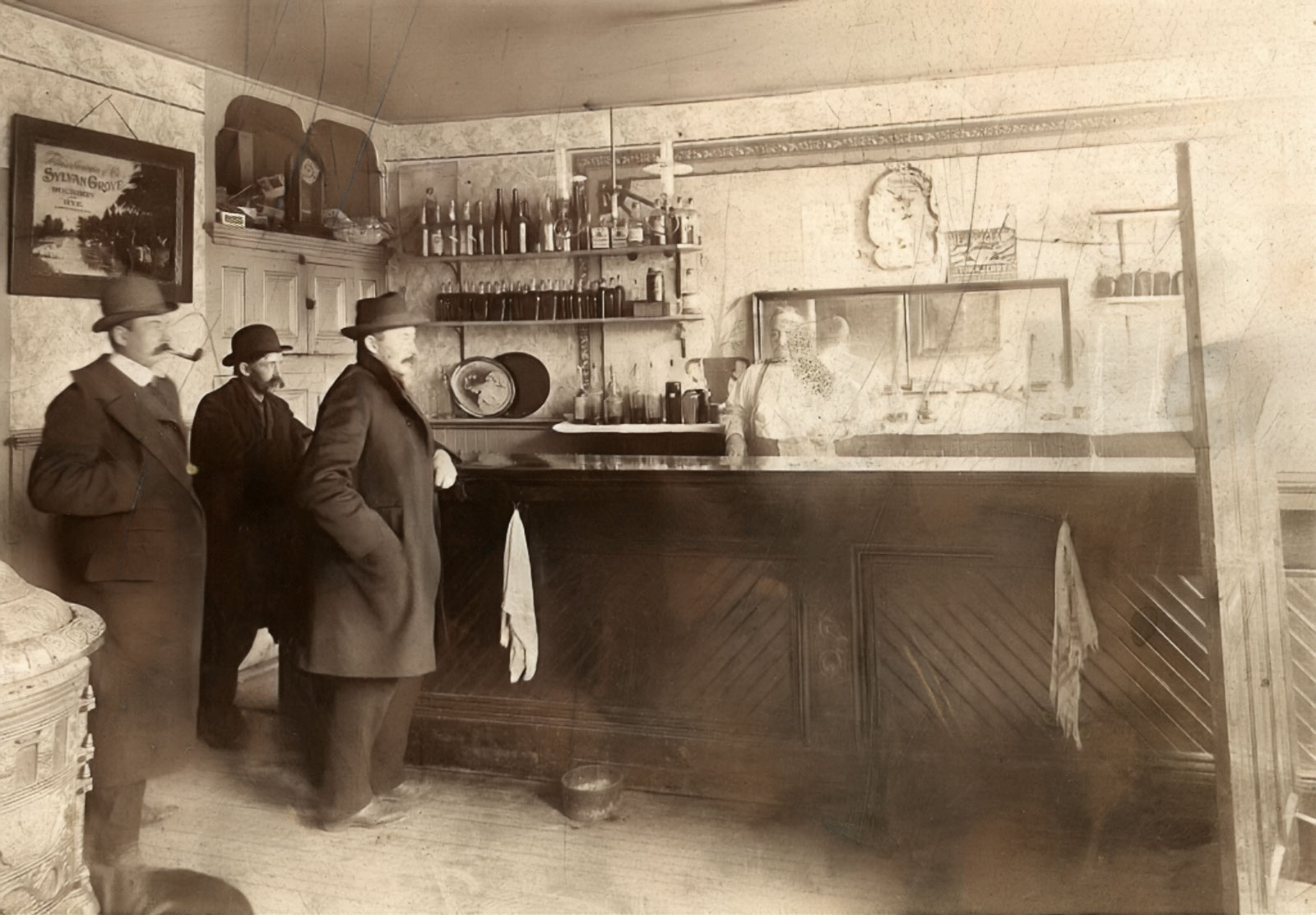 John B. Cretsinger’s saloon pre-prohibition, c.1910. The saloon was located at 417 E. Michigan Avenue
As a result of the new law, 34 city-based saloons and 65 establishments involved in the sale of alcohol within the county closed on 1 May 1915. Popular watering holes like Dutch Arnold’s closed their doors as the era of the legal saloon came to an end.
Written by Ryan Gage, Kalamazoo Public Library staff, November 2024
Sources
Books
Prohibition in Southwestern Michigan (2020)
Norma Lewis & Christine Nyholm
Charleston, South Carolina : The History Press, 2020
H 364.1332 L6754
Articles
“Saloons wiped out of county by big dry vote”
Kalamazoo Gazette, 6 April 1915