Saniwax Building
300 Block of W. Kalamazoo Avenue
One of Kalamazoo’s most prominent factory buildings has progressed through several name changes, while serving as a base for an assortment of commercial activities. Today, most citizens will know of the building by its current name, the Park Trades Center, a studio space for small businesses and artists, but the massive structure’s origins extend backward to the city’s deeply entrenched association with the paper industry. And despite the fact that the first occupant of the building was not the Saniwax Paper Company, many longtime residents continue to connect the structure with that company. Whether you call it the Saniwax Building, the Loose Leaf Binder Company Building or the Park Trades Center, this vintage vestige of the Paper City-era of Kalamazoo continues to provide a site for locals to advance their personal and commercial visions.
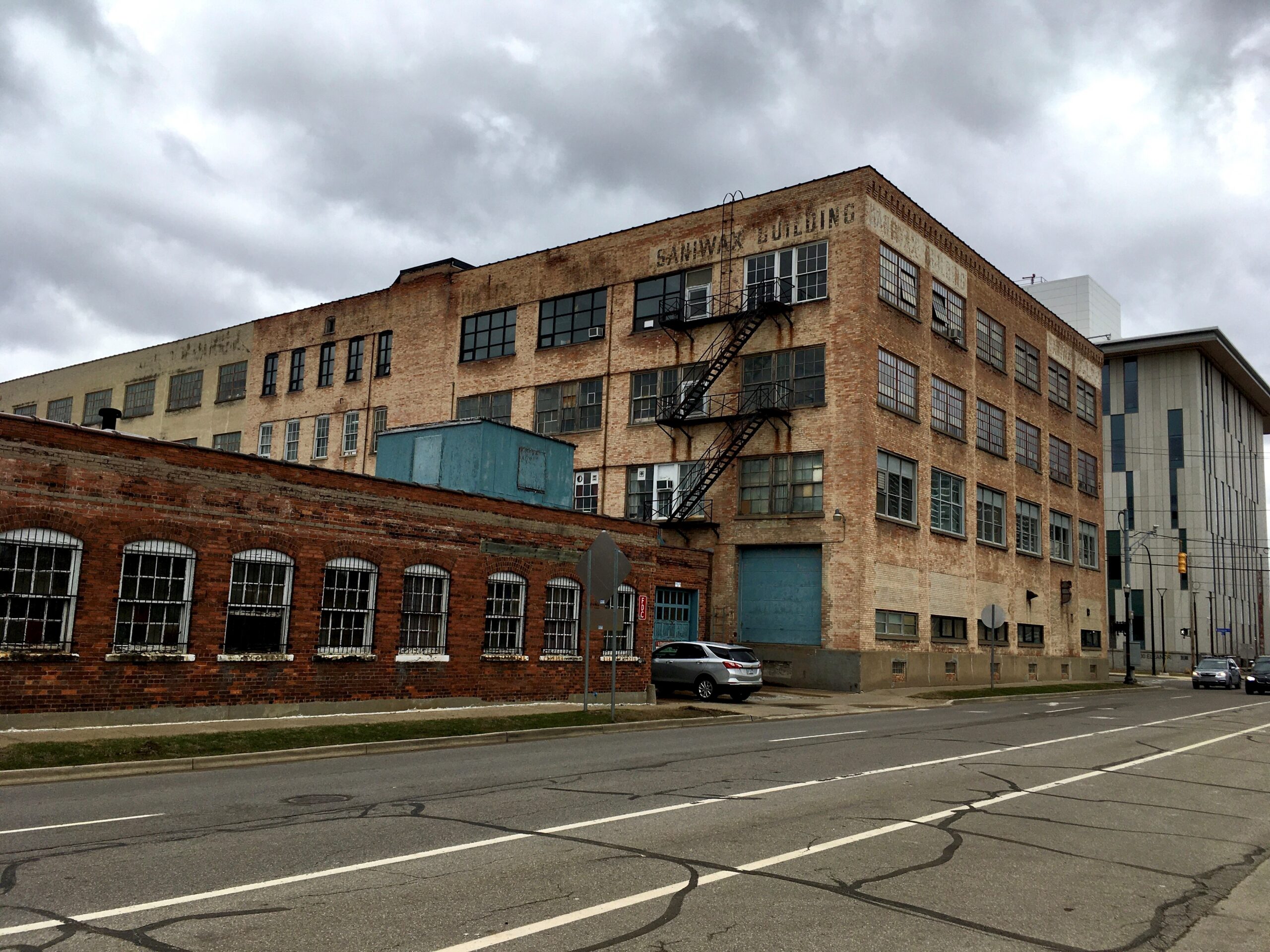 Park Trades Center, showing the 1909, one-story building, 2026. Photo: Ryan Gage
19th Century History
In 1861, the corner of W. Kalamazoo Avenue and N. Park Street comprised four lots (block 13), with four structures that were likely homes. Lot 8 was owned by Oscar M. Allen. The nearby railroad tracks to the north had been laid in 1846, making this portion of the village an attractive hub for manufacturers to situate their activities. The most notable non-dwelling in the neighborhood was the St. Augustine’s Church, located just west of the intersection.
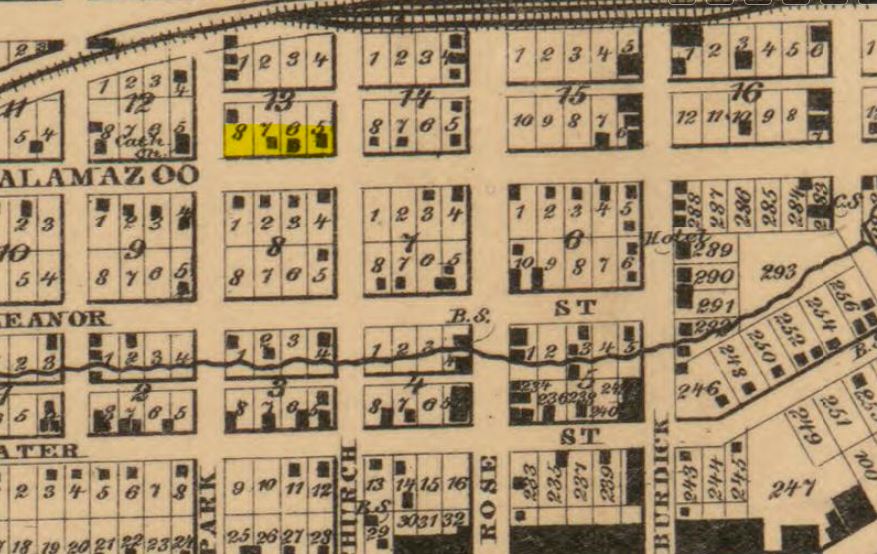 Corner of N. Park and W. Kalamazoo Avenue, 1861
A decade later, local businessman Oscar M. Allen had bought up half of the block, and built a large home on the corner of Park Street and Kalamazoo Avenue. In 1883, the successful casket maker began construction on a new home, a considerable mansion on W. Main (Michigan Avenue). Nearing the end of the century, Allen’s first home became surrounded by an assortment of dwellings, sheds and a lumber yard to the north. A fire insurance map detail of this corner from 1896, has the words printed over Allen’s home, “To Be Torn Down.”
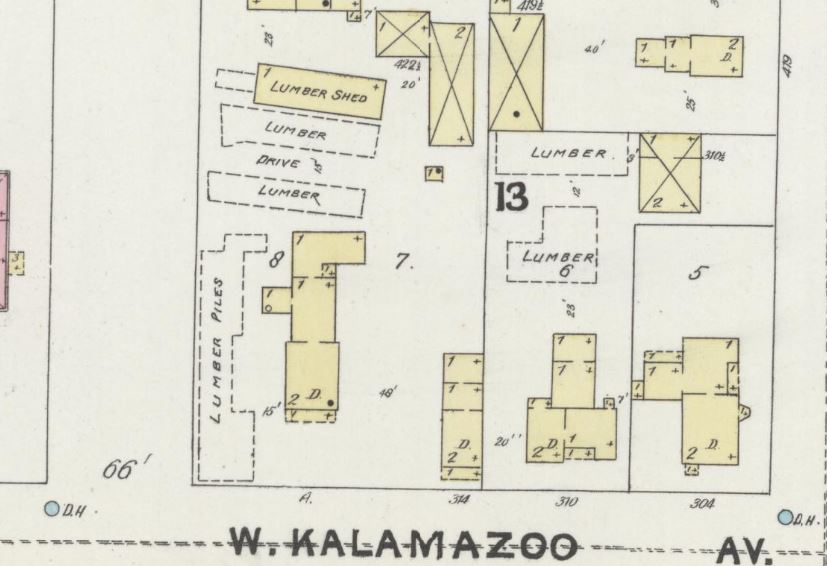 O.M. Allen’s old house surrounded by a lumber yard. Kalamazoo Sanborn Fire Insurance Map, 1892. Library of Congress
Kalamazoo Loose Leaf Ledger Company
By 1906, the city of Kalamazoo was fully leaning into its commercial identity as “Paper City,” and with the economic success of local paper mills, came the subsequent development of businesses focused on the selling of paper-based products. One of those companies to emerge was the Kalamazoo Loose Leaf Ledger (later, “Binder”) Company, a firm formed by an existing business, Ihling Brothers and Everard. The offshoot firm moved into their brand new building on Kalamazoo Avenue, a four-story structure with rounded windows (these help to distinguish between later additions). The construction was supervised by local firm George Rickman and Sons, and completed in the Fall of 1906.
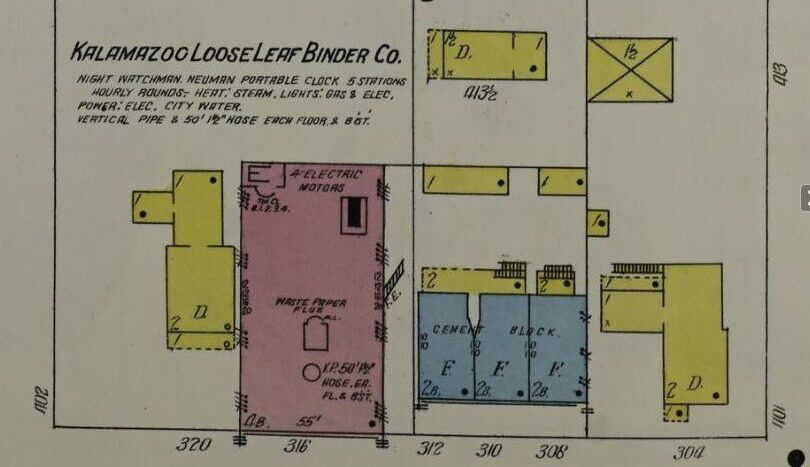 O.M. Allen’s residence, west of the new factory, had yet to be demolished in 1908. Sanborn Fire Insurance Map, 1908.
Eleven years later, when the successful company added a three-story addition to the west, the Kalamazoo Gazette wrote a glowing profile of the firm, praising its world-class products and managerial skill.
“Constructed on a foundation of diligent enterprise and backed by a product that is admittedly second to none the world over, the new plant of the Kalamazoo Loose Leaf Binder company, at Park street and Kalamazoo avenue, stands today as the largest and best equipped institution of its kind in the world.”
Kalamazoo Gazette, 14 July 1917
According to Kalamazoo: Lost & Found, the company also made “ledgers, catalog covers, ruled sheets, indexes, and even hand accounting equipment.” Further additions to the east (1921) and the west (1913, 1917), led to the Kalamazoo Loose Leaf Binder Company fronting the entire block between Park and Church streets.
In 1909, after the removal of the old homes that were situated along N. Park Street, the Enameled Tank Company began construction on a one-story building to face Park Street, extending northward toward the railroad tracks. The firm remained the building’s occupant until 1918, when the Saniwax Company moved into the structure.
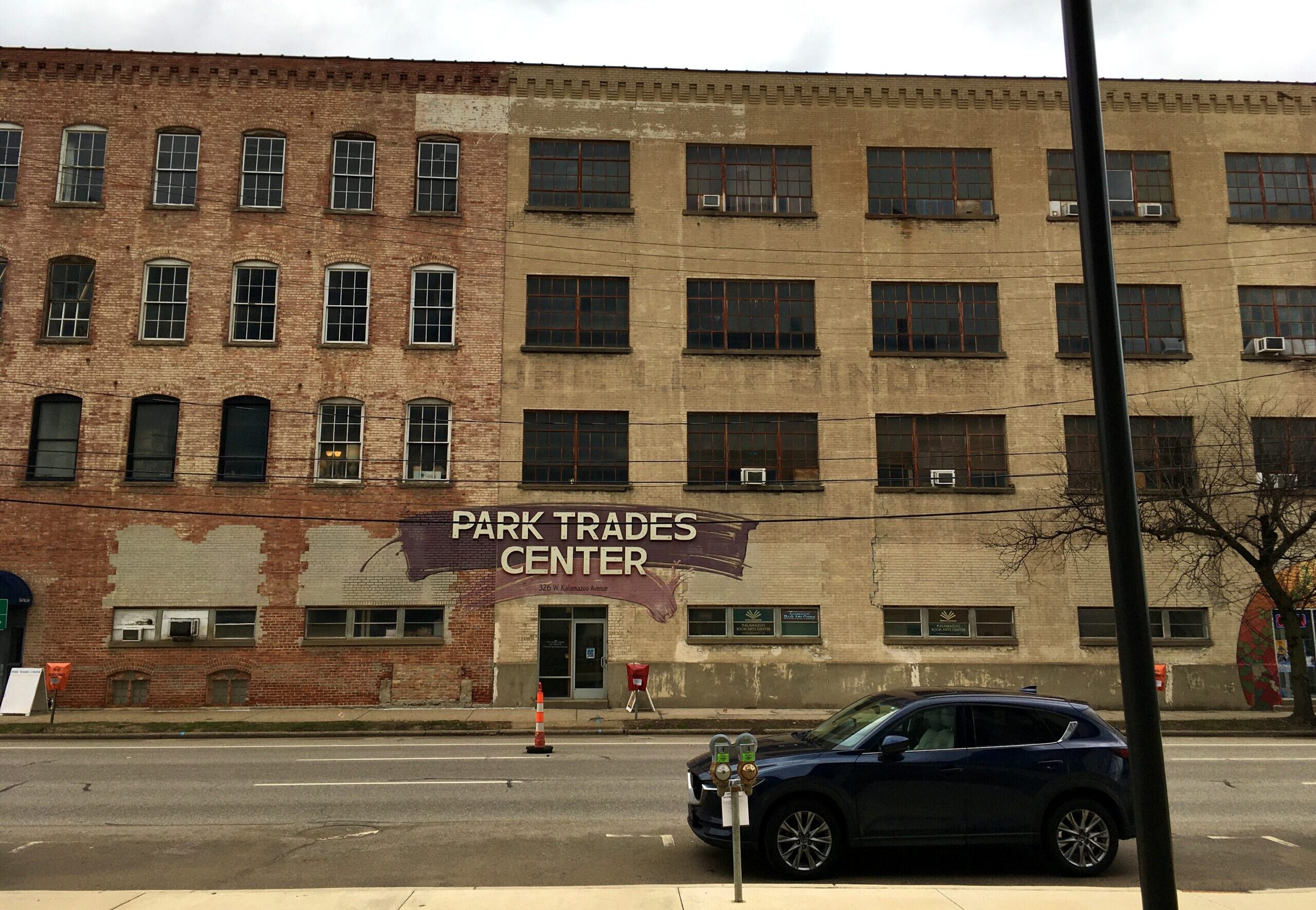 Kalamazoo Avenue side of the Park Trades Center, 2026. The rounded windows are part of the original building. Photo: Ryan Gage
Remington to Saniwax, 1927-1971
In 1927, the KLLBC merged with the Remington-Rand Company. In 1929, the company moved its operations to Benton Harbor, Michigan. Several ex-employees who stayed behind in Kalamazoo established a similar business called MasterCraft, that produced business forms. They operated out of the Kalamazoo Avenue factory until 1935. With the departure of any vestiges of the Kalamazoo Loose Leaf Binder Company, a hodgepodge of different tradespersons, artisans and entrepreneurs moved their small-scale activities into the space (then dubbed The Remington Building), until the Saniwax Company, who had been operating in the nearby building on N. Park Street since 1918, moved their operations into the factory along Kalamazoo Avenue.
While the Saniwax Company owned the building, much of the factory continued to house a wide array of commercial activity, including the Hoover Machine and Mill Supply Co., Kalamazoo Twisting Corporation, Richardson Garment Co., Vivi-Tone Co. (musical instruments), Merchants Publishing, Young Rug Repair Services, Q-Vita Co. (vitamins), Rural Bible Mission Co., and the J-B Label Shop. The Saniwax Company, which produced waxy paper for preserving and packaging foods, would stay until 1971. During Saniwax’s time owning the building, they consolidated the various buildings and their separate parts into one, adding loading docks and connecting hallways to the structure.
The Park Trades Center, 1985-
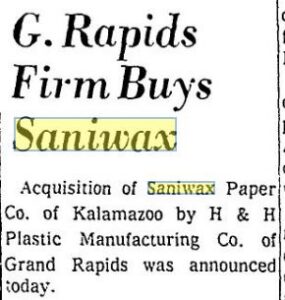 Kalamazoo Gazette, 6 April 1971
Saniwax moved out of the building after being purchased by Grand Rapids-based H & H Plastic Manufacturing Company in 1971, but the building continued its reputation for attracting small businesses and artists seeking affordable space to conduct their activities. In 1982, John Thingstad’s 436 Park Corporation purchased the 140,000 square foot building, and in 1985, the name was changed to the Park Trades Center. During the economic downturn of the 1980s, it was Thingstad who devotedly helped transform the onetime factory into a creative incubator by supporting the rental needs of local artisans, and by ensuring that the building structure afforded tenants a clean, safe, and functioning environment.
“I don’t want to mislead you into thinking there was a grand plan to turn this into a place for artists, because there wasn’t. Now, yes, we try to attract artists. We came to see the difference the synergy makes,” said John Thingstad, president of 436 Park Corp., which owns the Park Trades Center.
“Most artists in the building owe a lot to John’s organization, his generosity and sensitivity to what it takes to get an art studio going,” said Blake Ketchum, an artist who calls her space the Sculpture Studio.
Kalamazoo Gazette, 2 November 1997
Late in 2014, ownership of the building once again changed hands from the 436 Park Corporation to the real estate development company, PlazaCorp. The Park Trades Center continues to be a supportive partner with the local arts community in providing the space and ammenities for creative individuals and entrepreneurs to persue their passion.
Park Trades Center Trivia: In 1993, the photographer Mark Seliger took a famous closeup image of Nirvana singer/guitarist, Kurt Cobain, that would later be published by Rolling Stone Magazine for their cover at the time of Cobain’s death a year later. The photo shoot took place at the Park Trades Center before the band’s performance at Wing’s Stadium.
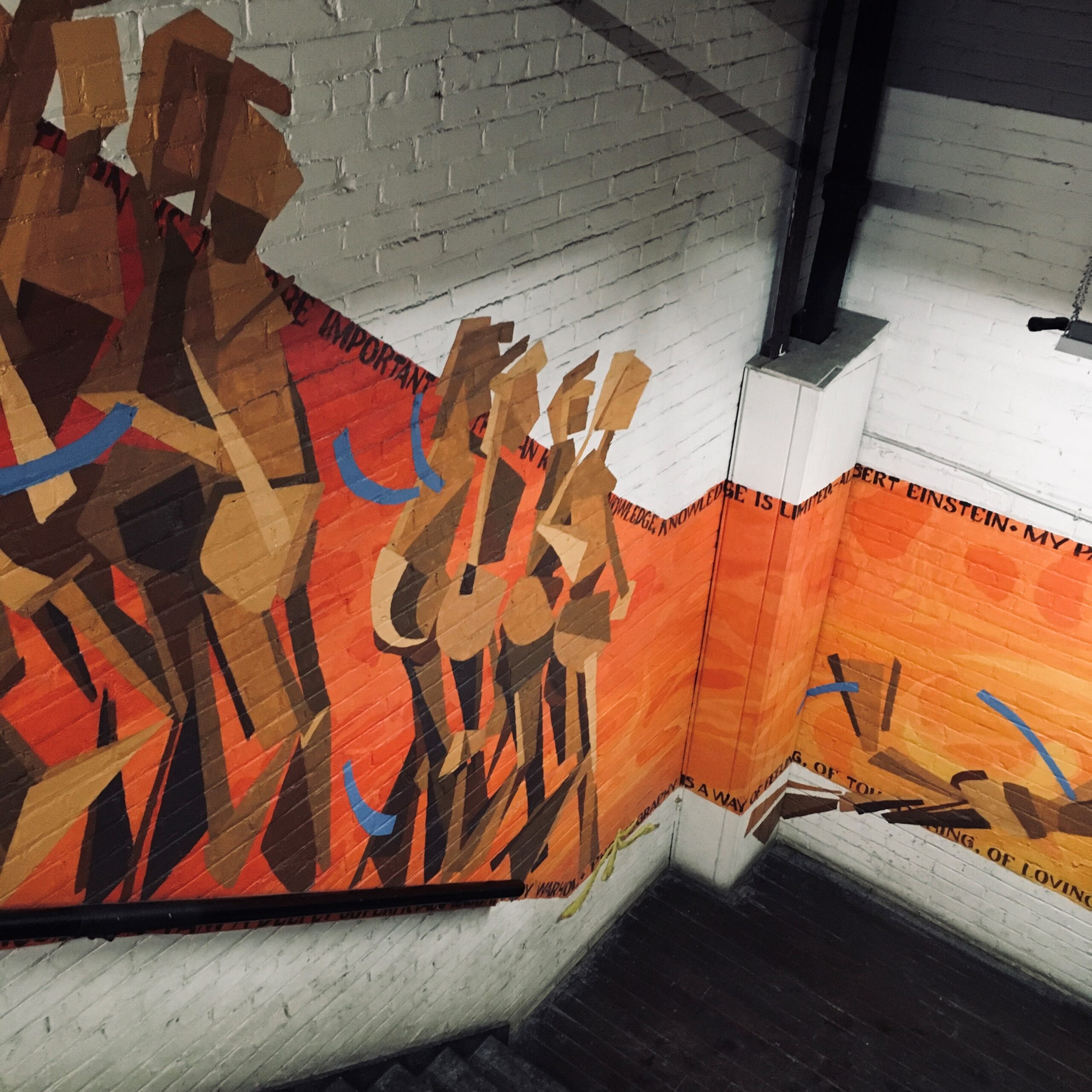 Park Trades Center stairwell mural, 2026. Photo: Ryan Gage
Article written by Ryan Gage, Kalamazoo Public Library staff, March 2026
Sources
Books
Kalamazoo: Lost & Found
Lynn Smith Houghton, Pamela Hall O’Connor
Kalamazoo Historic Preservation Commission, 2001
H 720.9774 H838
Articles
“Nearly complete”
Kalamazoo Gazette, 24 October 1906
“Asks that sidewalk line be established”
Kalamazoo Gazette, 2 June 1909
“New tank factory due”
Kalamazoo Gazette, 27 January 1909
“Kalamazoo has largest loose leaf binder plant in world”
Kalamazoo Gazette, 17 July 1917
“G.R. firm buys Saniwax”
Kalamazoo Gazette, 6 April 1971
“Studio sanctuary”
Kalamazoo Gazette, 2 November 1997
Local History Room Files
Subject File: Buildings – Kalamazoo – Kalamazoo Ave., W., 326
Subject File: Kalamazoo Loose Leaf Binder Company