Moses L. Walker
Longtime Northside Resident and Civic Leader
Even after passing away in January of 2020 at age 79, longtime civic leader Moses L. Walker was still receiving accolades for his many years of service to the community. Walker’s family members received the 2021 Red Rose Citation from the Rotary Club of Kalamazoo, a recognition that is given to those “who fulfill the club’s service above self” philosophy. Over the course of five decades, Walker’s list of accomplishments and contributions to service is a long one.
“Moses has been a rock as it relates to the Northside community and getting services and resources into the community.”
Kalamazoo Gazette, 13 June 2019
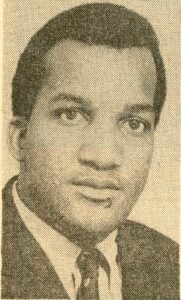 Moses L. Walker, c.1968, Kalamazoo Gazette
Born on Cobb Avenue on the city’s northside in 1940, Walker grew up with parents who instilled in him a strong work ethic, while also encouraging him to find ways of giving back to the neighborhood and wider Kalamazoo community. His father, a forklift operator at a paper mill told the young Walker, “Son, whatever you do, be the best. His mother added, “Son, never forget the bridge that carried you across.” A graduate of Kalamazoo Public Schools, Walker was the first in his family to attend college at Western Michigan University in 1958. At first, college life was not for the young Walker, who sought out a different type of experience when he joined the U.S. Army a year later. The armed services provided Walker with many valuable life lessons and experiences, many of which drove Walker’s indefatigable determination to work towards making life better, more equitable for those in his community. It was the casual and explicit forms of racism and discrimination Walker experienced while traveling through the deep south on convoys that fueled his appetite for wanting to prove others wrong.
After serving three years in the Army, where he remained a private despite scoring well on an officers’ exam, Walker returned to Kalamazoo and WMU in 1964 to complete his undergraduate degree in Social Science. He later told the Kalamazoo Gazette in 2019 that “I wasn’t sure what I wanted to do, but I knew I wanted to be the leader.” Social work’s focus on the kinds of issues (public health, education, employment, e.g.) facing northside residents appealed to Walker, and so he completed his master’s degree at Wayne State University in 1967. Years later, Walker returned to WMU in 1990, and completed a master’s degree in business administration.
Upon completing his education, Walker turned toward the organization that provided his childhood with a meaningful foundation from which to develop–the Douglass Community Association. After a brief stint working in Detroit with Coleman A. Young, and serving the DCA as associate director, the 27 year-old Walker accepted the position of executive director in 1968 after its board waived its age requirement rule. It was during this turbulent time, when Walker centered the DCA as an important hub for civil rights organizing and community planning.
“You learned how to play ball. You learned how to dance. You learned everything here at Douglass.”
Kalamazoo Gazette, 13 June 2019
Always an advocate for social progress and more equitable conditions for advancement, Walker entered into local politics throughout the 1970s, serving as city commissioner from 1973-1975 and from 1979-1981. He also served as a board member of the Kalamazoo Board of Education, the First National Bank and Trust Company, the Kalamazoo Consultation Center, Greater Kalamazoo United Way, Communities in Schools, Kalamazoo Community Mental Health and Substance Abuse Services, and the Northside Association for Educational Advancement Scholarship Committee. One of Walker’s most important legacies was his involvement in the promotion and development of better public health services for northside residents. In 2017, after serving on the board of the Family Health Center since its inception, the nonprofit that “provides primary, preventive and supplemental health services” renamed the facility the “Moses L. Walker Building.” Now a large, modern facility, the Family Health Center began as a mobile trailer located on Paterson Street. Walker served as an important voice for expanding health care accessibility to poor and disadvantaged residents. Ahead of his time, Walker recognized an important part of public health was in destigmatizing mental illness within communities of color. In August of 1978, Walker left the DCA to become the director of the Borgess Mental Health Center, beginning a two-decade long relationship with the local hospital, serving in several capacities at the executive level.
Article written by Ryan Gage, Kalamazoo Public Library staff, November 2025