Francis Hodgman
Climax's multi-hyphenate
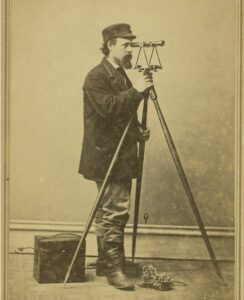 Francis Hodgman, 1870. WMU Regional History Collection
History reminds us that it isn’t always the big and medium size cities that produce transformative individuals. Francis Hodgman was born and lived in the small village of Climax for most of his life, but left an indelible legacy when he died in 1907. During his lifetime, Hodgman was a multi-hyphenate, having possessed interests in civil engineering, music, poetry and photography. In a 1940 article printed in the Kalamazoo Gazette, it was stated that Hodgman’s interests were so many and so varied that he required a wheelbarrow to collect the large volume of correspondence he received at the post office. Respected by many for both his artistic talents and his knowledge, local academics like early Western Michigan University professor Ernest Burnham warmly sang his praises years after Hodgman’s death.
“He as an unobtrustive gentleman through whose ideas the community often benefited. He bore no veneer. Education did not spoil him or isolate him and he did not run to cover when anyone spoke to him. Until the end, he remained himself.”
–Dr. Ernest Burnham, faculty at Western State Teachers College, 1940
Early Life
Born to Moses and Frances Hodgman New Hampshire natives), the young Francis grew up with two other brothers, Charles (1845-1923) and Samuel (1831-1900). The Hodgman family arrived in Kalamazoo County in 1836. His father was a shoemaker and postmaster, while his mother worked in a distric school. After moving around several times, the family finally settled down in 1848 on a lot just south of the District No. 1 school, on South Main Street.
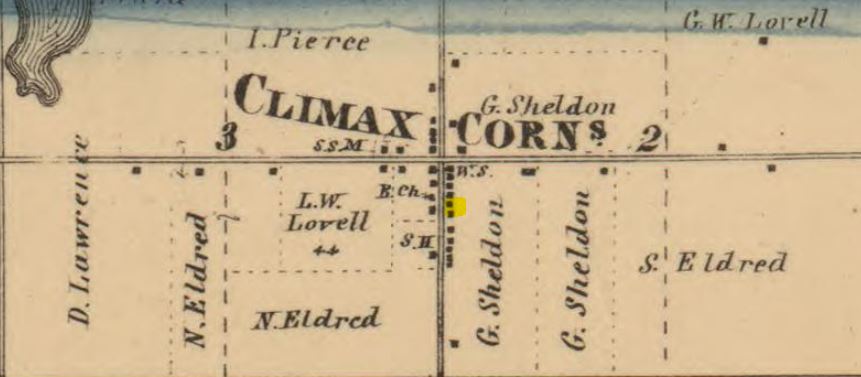 The Hodgman residence, downtown Climax Corners, 1861
The young Francis attended a district school, and then one term in the high school in Battle Creek. During the summer months, beginning at the age of ten, Francis worked on nearby farms for twenty-five-cents a day. During 1857-58, Francis taught at the District No. 6 school, which was located in Section 26 of Climax Township. At the age of 17, he enrolled at the Michigan Agricultural College, where he financed his education by teaching during the winter months, and helping out on the campus farm during the warmer months. He completed is Bachelor of Science in 1862, and a Master of Science degree was conferred on him in 1865. In 1860, Francis spent six months in Sandusky, Ohio learning the new trade and science of photography, which would later lead him to open his own photography gallery in Galesburg, Michigan five years later.
Mapping the County
After three years operating his photography business in Galesburg, avoiding the trade that he was most qualified to pursue, Hodgman was nominated by a retired county surveyor without solicitation, for the office of Kalamazoo County Surveyor. Hodgman would go on to hold this office until failing health forced him to retire in 1893. During this period, Hodgman also supervised two railroad projects. For a year (1881-1882) he worked as an engineer with the Denver Rio Grande Western Railroad, supervising their construction projects in Utah. He also “was engaged for a year as leveler on the line of the defunct Marshall & Coldwater Railroad.” (Fisher, 178) Between 1883 through 1889, Hodgman oversaw the remonumenting of 8 of the 16 townships in the county, a grueling process of mapping that required the burying of concrete markers (aka “monuments”) into the ground after determining the most concise location of township borders, performed using a staff compass and a Gunter’s Chain. 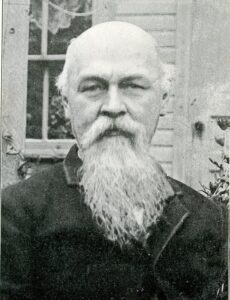 Throughout his long career as county surveyor, Hodgman also embraced a variety of civic positions and roles, including founding the Michigan Engineering Society, leading the effort to incorporate the Village of Climax and establishing the Kalamazoo County Husbandman’s Club. During his time as county surveyor, he edited the Michigan Engineer, the publication of the Michigan Engineering Society, and then in 1886, co-authored along with Prof. C.F.R. Bellows, the Manual of Land Surveying, a highly praised treatise considered to be a foundational guide for engineers. His views on practices related to boundary distinctions were so respected throughout the state and nation that a Michigan Supreme Court decision was reversed (Wilson v. Hoffman) after the reading of Hodgman’s criticism of the court’s initial ruling.
In 1870, Hodgman married Florence B. Comings. The couple resided in Galesburg at 76 Rail Road. In 1874, Hodgman returned to his childhood home in downtown Climax along Main Street, where he would live for the rest of his life. Hodgman married twice more, to Emma F. Smith (m. 1888) and then to Jennie A. Dickey (m. 1902). When not indulging in his primary vocation as an engineer, Hodgman was an avid poet and musical enthusiast. He was a member of a Coronet band for many years. He published a collection of his poetry in a work entitled Wandering Singer and His Songs. “In 1899, he published a volume of music of his own composition entitled Home’s Sweet Harmonies.” (Fisher, 179) Nearing the end of his life, Hodgman reflected upon his early days growing up in rural Kalamazoo County in a memoir entitled Early Days of Climax: Reminiscences. Hodgman’s family homestead survived into the 21st century but was torn down sometime after 2008.
Hodgman died in 1907, and was buried in the Prairie Home Cemetery in Climax, where his tombstone reads: “Civil Engineer – Civic Leader – Historian – Poet – Musician – Artist – Publisher By Old Time Friends.”
Written by Ryan Gage, Kalamazoo Public Library staff, February 2026
Sources
Books
Compendium of history and biography of Kalamazoo County, Mich. illustrated
Edited by David Fisher and Frank Little (1906)
H 977.417 F53
Early days in Climax: reminiscences (1905)
Francis Hodgman
H 977.417 H688
Articles
“Mail so heavy he had to use wheelbarrow”
Kalamazoo Gazette, 17 March 1940
“He’s a marker man!”
Encore Magazine, 8 September 2011, page 8
Local History Room Files
Name File: Hodgman, Francis