The Rickman Hotel
A Kalamazoo Landmark
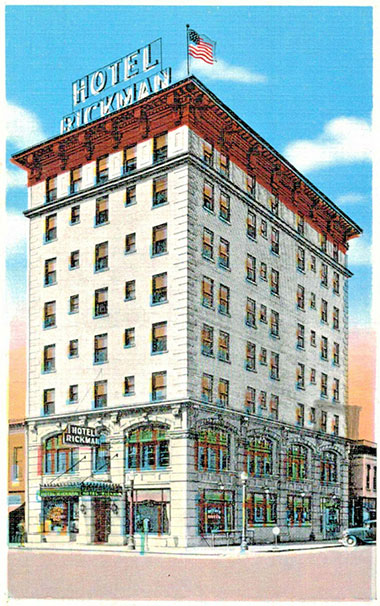 Postcard image of Hotel Rickman, c.1940
Towering over the intersection of Kalamazoo Avenue and Burdick Street, the Rickman House is one of the most impressive and imposing landmarks on the north end of downtown Kalamazoo. The elegant architecture speaks to the building’s century-old history as one of Kalamazoo’s finest hotels. The building’s origins date back to 14 May 1907 when the Kalamazoo Gazette announced that plans for a new hotel at the southwest corner of Kalamazoo Avenue and North Burdick Street had been finalized.
This new hotel was part of a wave of new skyscrapers that was transforming the central business district. The building boom had begun the year prior when work began on the city’s first steel-framed skyscraper, the Kalamazoo Building. However, the Rickman’s skyscraper status generated less fanfare in the local papers. Instead, the press was more interested that the Rickman added to the city’s roster of modern hotels. The Gazette noted with pride that as soon as three in-progress hotel projects were completed Kalamazoo would boast first class hotels that would rival any found elsewhere in Michigan.
George Rickman
The hotel project was intended to be the crowning achievement of the Rickman family’s distinguished construction portfolio. Family patriarch George Rickman had been a successful contractor for many years. He emigrated from England and came to Kalamazoo in 1872. He started out as a mason and worked his way up in the construction trade, including a stint as the superintendent of construction at the Kalamazoo State Hospital. By the turn of the century, he had established the firm George Rickman and Sons and engaged in the construction of major buildings throughout the state. A few examples of the company’s work included the Van Buren County Courthouse in Paw Paw, the Hackley School in Muskegon, and the Michigan Building at the 1904 St. Louis World’s Fair. George Rickman died unexpectedly on 28 August 1901 while inspecting a construction project in Muskegon. When his family proposed the new hotel, it was intended both as a lasting tribute to their late father and as a savvy investment for the profits the contracting business had generated.
Architecture
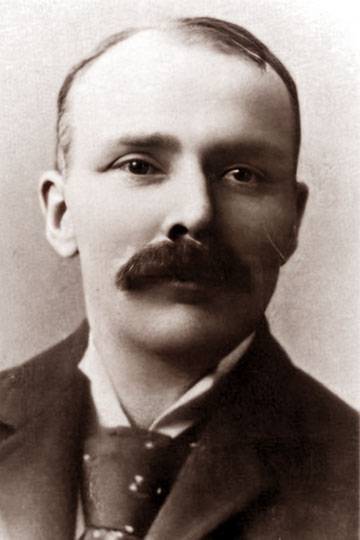 Architect Claire Allen. MLive
The hotel’s architect was just as accomplished as its builder/owners. The Rickman family hired Claire Allen of Jackson, a prominent southern Michigan architect who practiced during the late 19th and early 20th centuries. Allen designed a number of courthouses in the area. These projects included the Van Buren County Courthouse in Paw Paw, for which the Rickmans served as contractors. Allen also had experience with high-rises. He designed the seven-story Glazier Building in Ann Arbor, that city’s first skyscraper.
Ground was broken on 21 May 1907, and the building was ready for the public a year later. The formal opening took place on 14 May 1908. The first event was a private luncheon held at noon for fifty guests of the owners and management, although the general public was not left out of the festivities. Doors were opened at 2 o’clock in the afternoon for an open house enabling the public to inspect their city’s newest landmark top to bottom. The Gazette estimated over two thousand took the opportunity to tour the building. They found a structure built to impress. The exterior featured a finely detailed two-story base with rusticated stone pilasters and large arched windows. The upper six floors were faced with white brick with quoins at the corners. An elaborate pressed metal cornice completed the structure’s elegant appearance.
The Rickman offered its guests the latest comforts then available. The public rooms were all located on the lower levels. The ground floor featured an elegant lobby with an ornate plaster ceiling, as well as a barbershop, bar, and a single commercial storefront. The second floor was largely occupied by the hotel’s dining room, which had large arched windows overlooking North Burdick and Kalamazoo Streets. The second floor also offered a Turkish room and a parlor. In addition to the hotel’s modern heating plant, the basement was home to a billiard hall and public restrooms.
The six upper floors contained seventy-two guestrooms. Forty-eight of those had their own private baths; the remainder shared public baths on each floor. This was a typical arrangement for the time. The first commercial hotel to offer private baths for every room, the Statler in Buffalo, New York, had just opened. It would not be until after the First World War that private baths for every guestroom became standard throughout the industry.
The rooms on the Rickman’s top two floors were sample rooms. Sample rooms were large, but sparsely furnished rooms that catered to the needs of traveling salesmen. The salesmen would use the rooms not only for sleeping, but also for business. The beds could be easily stowed away, and the room set up for the display of wares to clients. Sample rooms were a must-have feature for any first-class hotel, as traveling salesmen made up a significant portion of the industry’s business.
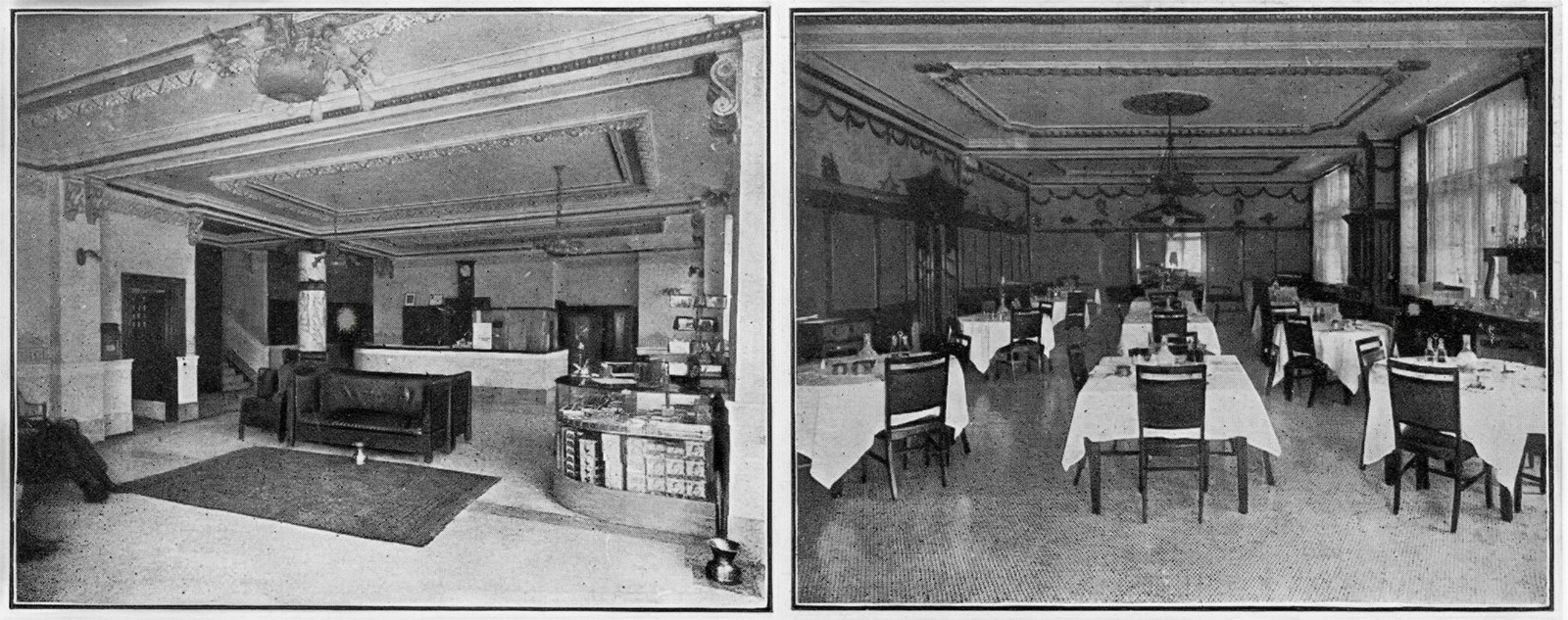 Hotel Rickman lobby (left) and dining room (right). Picturesque Kalamazoo, published by E.E, Labadie (1909). Kalamazoo Public Library
Grand Opening
The Rickman formally opened on 14 May 1908 with a series of festivities. The first of these was a private inspection and luncheon for the Rickman family, as well as friends and family of the hotel’s management. This private affair was followed by an activity for the public. The entire building was opened up for an open house. Over two thousand Kalamazooans took the opportunity to tour the city’s newest landmark from top to bottom. This lasted from noon until five, when the hotel had to be cleared to prepare it for a formal banquet that evening.
Sadly, the Rickman’s open house did not go as smoothly as the management had hoped. In its aftermath, staff discovered that a large percentage of the hotel’s guest room furnishings had disappeared. Some members of the public had decided to treat themselves to a free souvenir, pocketing towels, pin cushions, doilies, and other small articles. The Gazette estimated the losses to the hotel were several hundred dollars. Needless to say, hotel staff found themselves in a difficult position as those rooms had to be ready for the first overnight guests in just a few short hours.
The grand opening festivities concluded with an evening banquet that had three hundred guests, twice the number that had been planned. Despite the larger than expected crowd and the missing furnishings from the guest rooms, the Rickman’s grand opening was deemed a success, and it promptly joined the ranks of Michigan’s finest hotels.
Changes
Unfortunately for the Rickman family, the hotel would not prove to be the financial investment they had hoped for. In 1912 the family’s construction business entered receivership. The company experienced cash-flow problems during a large contract for a federal building in Owosso, and the fact that so much of the firm’s capital was tied up in the hotel only made the situation worse. The hotel was put up for sale and in June purchased by the owners of the Burdick Hotel.
Although the Rickman family’s association with the hotel ended, the Rickman name endured. The extensive national advertising, as well as the reputation the hotel enjoyed under the Rickman name, was too valuable to sacrifice to a name change. Thus, although the hotel project ultimately did not provide the family with a long-term financial investment, it succeeded as a monument to the late George Rickman.
This was only the first of many ownership changes throughout the hotel’s life. And yet the Rickman name endured until 1944. By then the hotel had been absorbed into the Milner Hotels chain, and the name was finally changed to reflect this. Milner was a Detroit-based chain of budget hotels that operated 172 units at its peak. The former Rickman remained a Milner until 1964, when the chain disposed of the Kalamazoo location, and it then became known as the Reid Hotel.
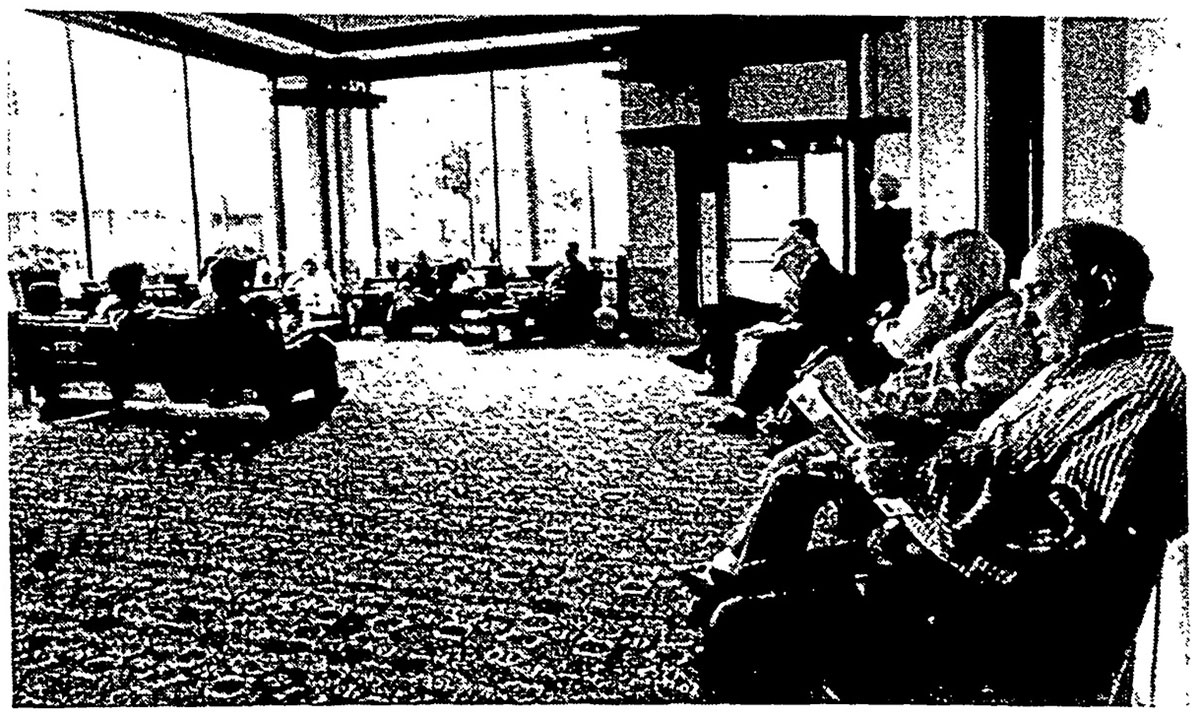 Remodeled lobby at Stratton Arms. Kalamazoo Gazette, 22 November 1979. Kalamazoo Public Library
A Place for Seniors
The Reid operated until September 1979 when it was sold to Dr. Kenneth Kensey, a physician from Portage who quit his practice in order to focus his energies on the hotel. By that point the Reid had transitioned from catering to transients, to housing low-income seniors and former patients of the Kalamazoo State Hospital. Kensey saw that the hotel provided the community with a needed service and hoped to ensure that it would continue to serve. He renamed it the Stratton Arms and undertook a renovation of the facility into a foster care center, with spruced up interiors, medical, and social services. The transition was completed by Thanksgiving of that year.
However, the Stratton Arms was short-lived. In 1980 a city inspection found that the hotel had over 700 violations of the city’s health, safety, and fire codes. These violations were largely the result of changes in these codes that had occurred since the building first opened in 1908 and did not reflect its structural condition, which the city admitted was sound. Nonetheless, in 1981 the city sought to have the hotel closed. Kensey informed the Gazette that the required renovations would cost over one and a half million dollars, which he hoped to raise via private and public sources. In the meantime, the hotel’s 73 residents would have to move out.
The Rickman House
After months of uncertainty, Kensey sold the hotel in the spring of 1982, and a $2.5 million renovation project to convert the building into low-income housing for the Senior Services, Inc. began. The building was rebuilt from top to bottom. The project included historically restored public areas as well as 84 rebuilt apartments. The result was a fine example of historic preservation as well as the continued assurance that low-income senior housing would remain in downtown Kalamazoo. One final change brought about by the renovations was yet another renaming. The Rickman name was restored as the facility became known by its present name, the Rickman House.
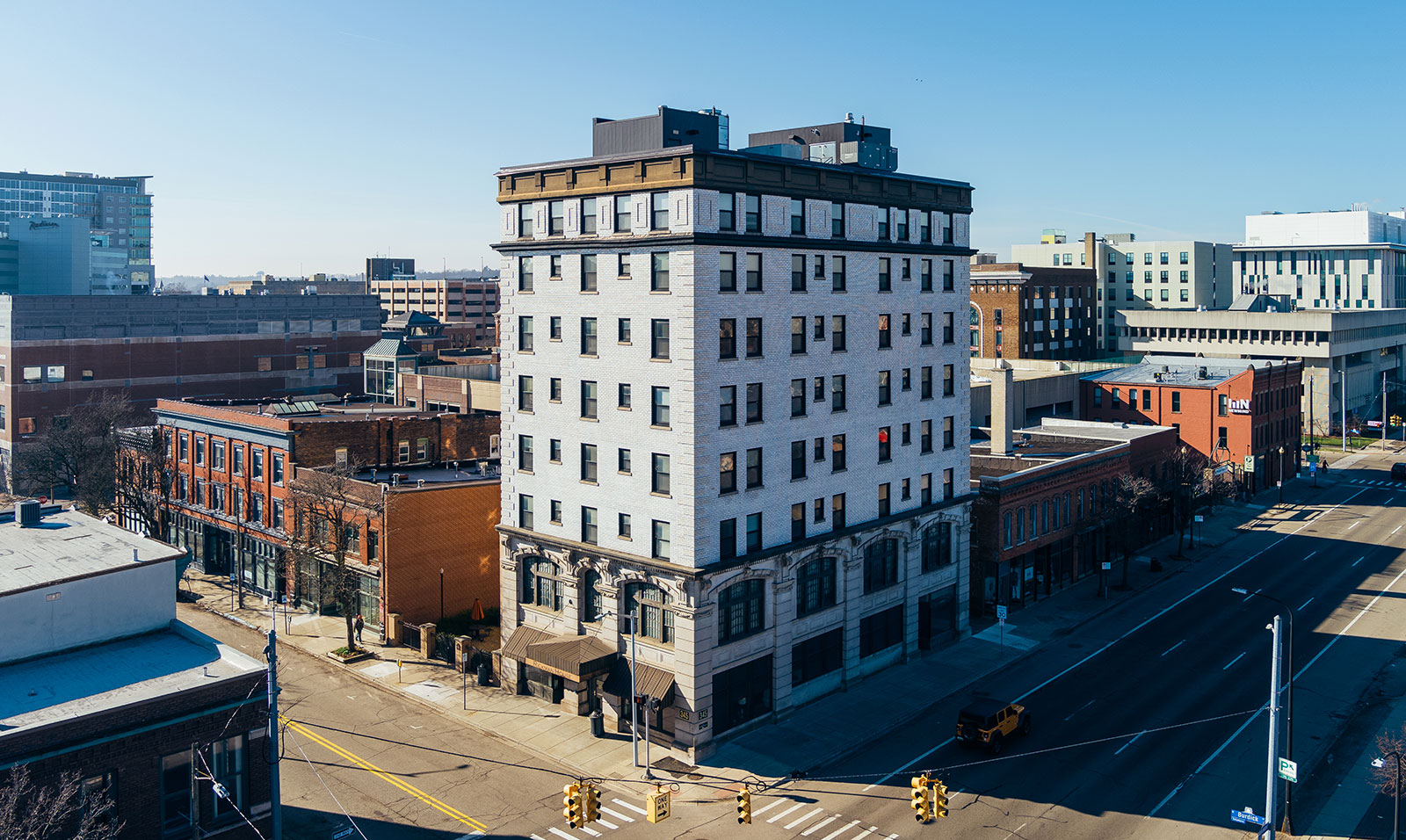 The Rickman House, February 2024. Photo by Bill Dolak
Today
As the Rickman House, the building has continued to endure as a landmark at the corner of Kalamazoo and Burdick streets. In 1994 it was added to the National Register of Historic Places. Kalamazoo Historic Preservation Commission member Rodger Parzyck noted that of five hotels that once surrounded the Michigan Central Station, the Rickman House was the only survivor. The 1994 listing helped fund another major renovation of the building between 2011 and 2012. Once again, the structure was gutted and rebuilt. Its 84 apartments were reduced to 46 larger units. Another benefit of the project was the establishment of capital reserves that will fund the facility’s staffing for a full fifteen years. It is certain that the Rickman will continue as a city landmark and as a monument to the memory of its namesake, George Rickman.
Written by David Kohrman, Kalamazoo Public Library Staff, c.2012. Updated and published March 2025.
Sources
Articles
“Hotel business on the increase”
Kalamazoo Gazette, 22 October 1907, page 10, column 3
“Ready for the roof”
Kalamazoo Gazette, 1 November 1907, page 5, column 1
“Rickman Hotel to be opened May 12”
Kalamazoo Gazette, 25 April 1908, page 5, column 1
“Will open Rickman Thursday”
Kalamazoo Gazette, 10 May 1908, page 8, column 1
“Elegant Rickman Hotel will open today for business”
Kalamazoo Gazette, 14 May 1908, page 3, column 3
“At the Rickman”
Kalamazoo Gazette, 15 May 1908, page 9, column 2
“Polite thievery”
Kalamazoo Gazette, 17 May 1908, page 4, column 2
“New corporation secures two big Kalamazoo hotels”
Kalamazoo Gazette, 29 December 1912, page 3, column 1
“No date set for hotel transfer”
Kalamazoo Gazette, 1 December 1943, page 15, column 6
“Reid Hotel to hold open house”
Kalamazoo Gazette, 5 May 1964, page 19, column 4
“Rickman House on agenda of Council for the Handicapped meet”
Kalamazoo Gazette, 6 May 1983, page 20, column 1
“Rebuilt hotel has occupant”
Kalamazoo Gazette, 1 August 1983, page 1, column 4
Local History Room Files
History Room Name File: Rickman, George R.