Why Role-Playing Games Are Thriving Right Now
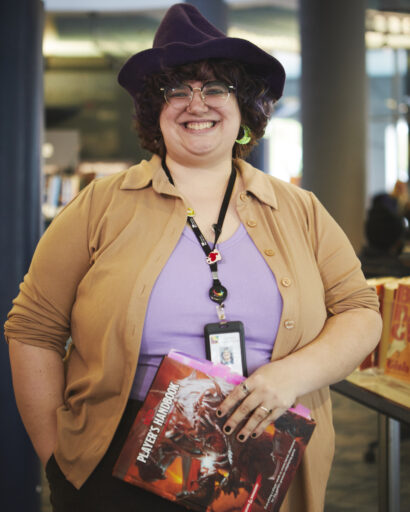 Image of Intern Ellie Seeyle currently one of our staff members leading Dungeons and Dragons (DnD) for youth youth and teens
Tabletop role-playing games like Dungeons & Dragons (DnD) are growing in popularity, and while it may seem like a trend, it reflects something deeper. People are looking for connection, creativity, and ways to engage beyond a screen.
After years of isolation and digital communication, many of us are still finding our way back to shared experiences. These games create a space where people sit together and build something in real time. Not just a game, but story.
Ellie Seelye, a KPL intern and one of the staff members supporting RPG programming, shared their thoughts on DnD: “It’s a way to not only socialize with people, but to create with people.”
In a world where so much is consumed individually, this is collective. It requires imagination and listening. It invites people to step into something unfamiliar and make it their own.
Ellie also pointed to why this moment matters. “The pandemic made people realize how isolated they are,” they said, noting that games like these offer a way to reconnect and build something together again. Play.
We do not often give ourselves permission to play, especially as adults. These games offer structure, which makes that return to play feel more accessible. There are rules and systems, but within them is openness to explore, experiment, and even fail. People begin to learn about themselves.
“Your characters reflect you in ways you don’t expect,” Ellie shared. Through imagination, players often uncover parts of their identity and confidence. Helping guide that experience is the Dungeon Master.
As Jaclyn Lewis, a professional Dungeon Master, explains, the role is less about control and more about facilitation. “It’s just a conversation between the players and the Dungeon Master,” she said. Players decide what they want to do, and the Dungeon Master responds, shaping the world around those choices. It is a balance of structure and flexibility that allows creativity to grow.
Jaclyn also emphasized that the role is about making space for ideas, even when they fall outside the rules. “You have this really cool idea… so let me change it to make it happen,” she said.
That flexibility also extends to how people participate. Not everyone has to step fully into a character. Some describe what their character might do, while others contribute by taking notes, tracking the game, offering ideas, or creating artwork inspired by the story. The goal is not performance, it is participation. It is also why libraries are an important part of this work.
Libraries have always been spaces of access, discovery, and community. Role-playing games align naturally with that mission. They are accessible and rooted in shared experience.
“The thing that most people are looking for… are other people to play it with,” Jaclyn noted. For younger audiences, especially tweens and teens, this becomes even more meaningful. These programs offer a place to explore identity, practice communication, and build relationships. They offer a place to belong. DnD, tabletop games, and other role-playing experiences are about storytelling and connection. Creating something together that only exists in that moment, with those people. And that is something we all need.
We have several DnD programs you can sign up for this summer. You can also explore tabletop games available to check out from the library.