Technology is For Everyone
Accessible Technology at Your Pace
 Technology shapes how we communicate, how we learn, how we work, and how we move through the world. It is an integral part of daily life, which means it has become a mainstay in public libraries.
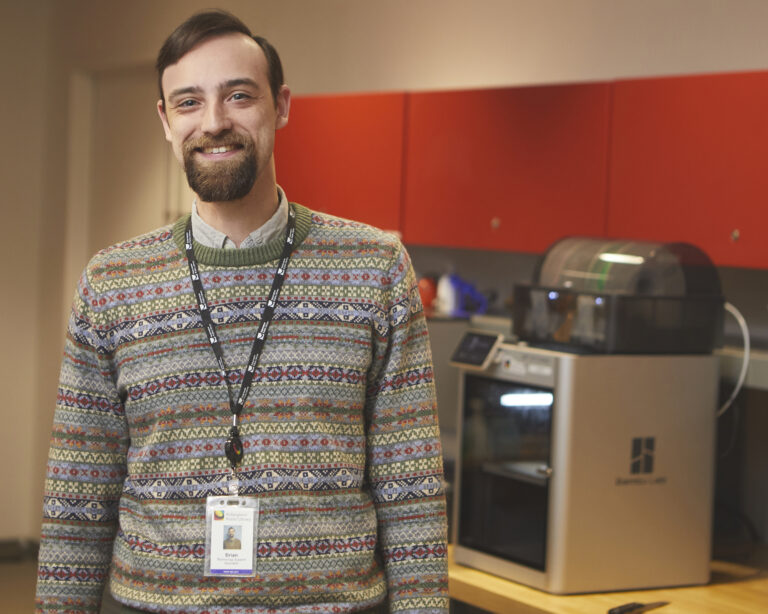
For Brian Rocha, Technology Support Specialist at Kalamazoo Public Library, technology is never just about equipment. It is about the people standing in front of it. He talks about the library as a place where technology should feel welcoming rather than intimidating, where someone can sit down, ask a question, and build skills in a low-stress environment. It is not about keeping up with trends. It is about giving people room to learn at a pace that feels right to them.
One of the most visible and engaging ways technology shows up at KPL is through 3D printing. Patrons design or submit a model online and return to the library to pick it up once it has been printed. What stays with them is not the technical process, but the moment they hold the finished object in their hands. As Brian puts it, people are online, but then they get something tangible. Seeing an idea move from screen to object creates a sense of awe and makes learning feel real.
Programs like Design a Pet and Dungeons and Dragons character workshops are built around that experience. In these programs, participants design a pet or a game character online and then have their creations printed using the library’s 3D printers. They leave with a physical reminder of something they imagined and built themselves.
That same approach to hands-on learning carries into the library’s creative software offerings. Through access to tools like Adobe Creative Cloud, patrons can design graphics, edit videos, and explore digital creativity at their own pace. The library also offers classes such as Video Editing for Beginners, 3D Modeling, and Lightroom for Beginners, creating opportunities for people to learn new skills, experiment with creative tools, and build confidence using professional-grade software. The learning itself may be quiet, but confidence lasts.
Some of the most meaningful uses of technology at the library are also the least visible. Brian shared that the library’s Accessibility Collection, which includes free 3D printed items such as pen grips, shopping bag holders, and tools that support people with limited dexterity. These items are available without a library card, because the goal was to remove barriers rather than limit access. Brian described the collection as an equity and accessibility effort. The focus is not on showcasing technology, but on using it to support everyday tasks and make daily life a little easier.
Adult gaming grew out of a simple observation. Brian noticed that video games in libraries are often geared toward teens, even though adults also benefit from places where they can relax and decompress. He saw adults already spending time on browser-based games at public computers and recognized that interest as something worth supporting more intentionally. Adult gaming computers were implemented to give people space to play, explore, and engage with technology in ways that feel appropriate and welcoming to them.
This, too, is a form of library service. It acknowledges that adults need room to rest, connect, and enjoy themselves just as much as anyone else. In this context, technology supports rest as much as productivity.
Learning without pressure is one of the quiet strengths of the library. Brian spoke about access in practical terms, explaining that libraries cannot assume everyone has a reliable computer or smartphone. What the library can offer is space, time, and technology that people can use for free, allowing them to build skills at their own pace. The library becomes a starting point, a place where someone can apply for a job, learn new software, or simply grow more comfortable using a device, alongside others who already have access to advanced tools.
Supporting technology at the library also means supporting the people who help make that learning possible. Brian spoke about the technology internship program as an extension of the library’s commitment to service and growth. Interns are often the first point of contact for patrons, helping with computers, printing, digitization, and passport services, while learning how to work confidently with the public.
What mattered most to Brian was not just the technical experience, but what interns carry forward. They leave with stronger communication skills, greater independence, and a clearer understanding of how their work affects others. Those skills stay with them, no matter where their careers lead, and they reflect the library’s role in supporting both community learning and future professionals.
Technology at the library also extends beyond the building. Brian pointed out that while physical browsing has changed, digital circulation continues to grow, showing how people engage with the library online. Digital collections like Libby, Hoopla, Kanopy, and Freegal allow the library to travel with people, fitting into daily life at home, at work, and on the go.
Technology allows the library to exist in many places at once while remaining rooted in community. At its core, technology at the library is about access, patience, and trust. Brian summed it up simply when he said the goal is for people to start here, build skills, and then move forward when they are ready.