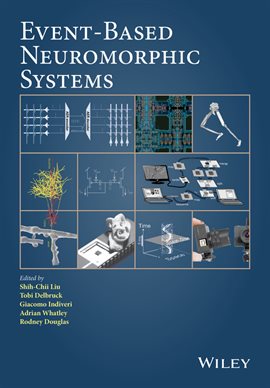
 eBook
hoopla Instant
eBook
hoopla Instant
Event-Based Neuromorphic Systems
Year
2014
Language
ENGLISH
Publication Information
Wiley
Summary
Neuromorphic electronic engineering takes its inspiration from the functioning of nervous systems to build more power efficient electronic sensors and processors. Event-based neuromorphic systems are inspired by the brain's efficient data-driven communication design, which is key to its quick responses and remarkable capabilities. This cross-disciplinary text establishes how circuit building blocks are combined in architectures to construct complete systems. These include vision and auditory sensors as well as neuronal processing and learning circuits that implement models of nervous systems. Techniques for building multi-chip scalable systems are considered throughout the book, including methods for dealing with transistor mismatch, extensive discussions of communication and interfacing, and making systems that operate in the real world. The book also provides historical context that helps relate the architectures and circuits to each other and that guides readers to the extensive literature. Chapters are written by founding experts and have been extensively edited for overall coherence. This pioneering text is an indispensable resource for practicing neuromorphic electronic engineers, advanced electrical engineering and computer science students and researchers interested in neuromorphic systems. Key features: • Summarises the latest design approaches, applications, and future challenges in the field of neuromorphic engineering. • Presents examples of practical applications of neuromorphic design principles. • Covers address-event communication, retinas, cochleas, locomotion, learning theory, neurons, synapses, floating gate circuits, hardware and software infrastructure, algorithms, and future challenges.